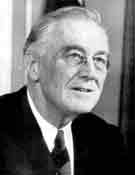
Franklin D. Roosevelt was born in Hyde Park, New York
on January 30, 1882, the son of James Roosevelt and Sara Delano Roosevelt.
His parents and private tutors provided him with almost all his formative
education. He attended Groton (1896-1900), a prestigious preparatory
school in Massachusetts, and received a BA degree in history from Harvard
in only three years (1900-03). Roosevelt next studied law at New York's
Columbia University. When he passed the bar examination in 1907, he
left school without taking a degree. For the next three years he practiced
law with a prominent New York City law firm. He entered politics in
1910 and was elected to the New York State Senate as a Democrat from
his traditionally Republican home district.
In the meantime, in 1905, he had married a distant
cousin, Anna Eleanor Roosevelt, who was the niece of President Theodore
Roosevelt. The couple had six children, five of whom survived infancy:
Anna (1906), James (1907), Elliott (1910), Franklin, Jr. (1914) and
John (1916).
Roosevelt was reelected to the State Senate in 1912,
and supported Woodrow Wilson's candidacy at the Democratic National
Convention. As a reward for his support, Wilson appointed him Assistant
Secretary of the Navy in 1913, a position he held until 1920. He was
an energetic and efficient administrator, specializing in the business
side of naval administration. This experience prepared him for his future
role as Commander-in-Chief during World War II. Roosevelt's popularity
and success in naval affairs resulted in his being nominated for vice-president
by the Democratic Party in 1920 on a ticket headed by James M. Cox of
Ohio. However, popular sentiment against Wilson's plan for US participation
in the League of Nations propelled Republican Warren Harding into the
presidency, and Roosevelt returned to private life.
While vacationing at Campobello Island, New Brunswick
in the summer of 1921, Roosevelt contracted poliomyelitis (infantile
paralysis). Despite courageous efforts to overcome his crippling illness,
he never regained the use of his legs. In time, he established a foundation
at Warm Springs, Georgia to help other polio victims, and inspired,
as well as directed, the March of Dimes program that eventually funded
an effective vaccine.
With the encouragement and help of his wife, Eleanor,
and political confidant, Louis Howe, Roosevelt resumed his political
career. In 1924 he nominated Governor Alfred E. Smith of New York for
president at the Democratic National Convention, but Smith lost the
nomination to John W. Davis. In 1928 Smith became the Democratic candidate
for president and arranged for Roosevelt's nomination to succeed him
as governor of New York. Smith lost the election to Herbert Hoover;
but Roosevelt was elected governor.
Following his reelection as governor in 1930, Roosevelt
began to campaign for the presidency. While the economic depression
damaged Hoover and the Republicans, Roosevelt's bold efforts to combat
it in New York enhanced his reputation. In Chicago in 1932, Roosevelt
won the nomination as the Democratic Party candidate for president.
He broke with tradition and flew to Chicago to accept the nomination
in person. He then campaigned energetically calling for government intervention
in the economy to provide relief, recovery, and reform. His activist
approach and personal charm helped to defeat Hoover in November 1932
by seven million votes.
The Depression worsened in the months preceding Roosevelt's
inauguration, March 4, 1933. Factory closings, farm foreclosures, and
bank failures increased, while unemployment soared. Roosevelt faced
the greatest crisis in American history since the Civil War. He undertook
immediate actions to initiate his New Deal. To halt depositor panics,
he closed the banks temporarily. Then he worked with a special session
of Congress during the first "100 days" to pass recovery legislation
which set up alphabet agencies such as the AAA (Agricultural Adjustment
Administration) to support farm prices and the CCC (Civilian Conservation
Corps) to employ young men. Other agencies assisted business and labor,
insured bank deposits, regulated the stock market, subsidized home and
farm mortgage payments, and aided the unemployed. These measures revived
confidence in the economy. Banks reopened and direct relief saved millions
from starvation. But the New Deal measures also involved government
directly in areas of social and economic life as never before and resulted
in greatly increased spending and unbalanced budgets which led to criticisms
of Roosevelt's programs. However, the nation-at-large supported Roosevelt,
elected additional Democrats to state legislatures and governorships
in the mid-term elections.
Another flurry of New Deal legislation followed in
1935 including the establishment of the Works Projects Administration
(WPA) which provided jobs not only for laborers but also artists, writers,
musicians, and authors, and the Social Security act which provided unemployment
compensation and a program of old-age and survivors' benefits.
Roosevelt easily defeated Alfred M. Landon in 1936
and went on to defeat by lesser margins, Wendell Willkie in 1940 and
Thomas E. Dewey in 1944. He thus became the only American president
to serve more than two terms.
After his overwhelming victory in 1936, Roosevelt took
on the critics of the New deal, namely, the Supreme Court which had
declared various legislation unconstitutional, and members of his own
party. In 1937 he proposed to add new justices to the Supreme Court,
but critics said he was "packing" the Court and undermining
the separation of powers. His proposal was defeated, but the Court began
to decide in favor of New Deal legislation. During the 1938 election
he campaigned against many Democratic opponents, but this backfired
when most were reelected to Congress. These setbacks, coupled with the
recession that occurred midway through his second term, represented
the low-point in Roosevelt's presidential career.
By 1939 Roosevelt was concentrating increasingly on
foreign affairs with the outbreak of war in Europe. New Deal reform
legislation diminished, and the ills of the Depression would not fully
abate until the nation mobilized for war.
When Hitler attacked Poland in September
1939, Roosevelt stated that, although the nation was neutral, he did
not expect America to remain inactive in the face of Nazi aggression.
Accordingly, he tried to make American aid available to Britain, France,
and China and to obtain an amendment of the Neutrality Acts which rendered
such assistance difficult. He also took measures to build up the armed
forces in the face of isolationist opposition.
With the fall of France in 1940, the American mood
and Roosevelt's policy changed dramatically. Congress enacted a draft
for military service and Roosevelt signed a "lend-lease" bill
in March 1941 to enable the nation to furnish aid to nations at war
with Germany and Italy. America, though a neutral in the war and still
at peace, was becoming the "arsenal of democracy", as its
factories began producing as they had in the years before the Depression.
The Japanese surprise attack on Pearl Harbor, December
7, 1941, followed four days later by Germany's and Italy's declarations
of war against the United States, brought the nation irrevocably into
the war. Roosevelt became the Commander-in-Chief of the Armed Forces,
a role he actively carried out. He worked with and through his military
advisers, overriding them when necessary, and took an active role in
choosing the principle field commanders and in making decisions regarding
wartime strategy.
He moved to create a "grand alliance" against
the Axis powers through "The Declaration of the United Nations,"
January 1, 1942, in which all nations fighting the Axis agreed not to
make a separate peace and pledged themselves to a peacekeeping organization
(now the United Nations) on victory.
He gave priority to the western European front and
had General George Marshall, Chief of Staff, plan a holding operation
in the Pacific and organize an expeditionary force for an invasion of
Europe. The United States and its allies invaded North Africa in November
1942 and Sicily and Italy in 1943. The D-Day landings on the Normandy beaches in France, June 6, 1944, were followed
by the allied invasion of Germany six months later. By April 1945 victory
in Europe was certain.
The unending stress and strain of the war literally
wore Roosevelt out. By early 1944 a full medical examination disclosed
serious heart and circulatory problems; and although his physicians
placed him on a strict regime of diet and medication, the pressures
of war and domestic politics weighed heavily on him. During a vacation
at Warm Springs, Georgia, on April 12, 1945, he suffered a massive stroke
and died two and one-half hours later without regaining consciousness.
He was 63 years old. His death came on the eve of complete military
victory in Europe and within months of victory over Japan in the Pacific.
President Roosevelt was buried in the Rose Garden of his estate at Hyde
Park, New York.