Israel Zangwill
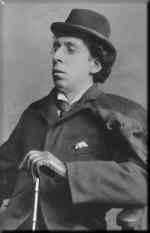
(1864-1926)
Israel Zangwill, Anglo-Jewish writer and political
activist, was probably the best known Jew in the
English-speaking world at the start of the twentieth
century.
Zangwill was born in London on January 21, 1864
to parents who had immigrated from Eastern Europe.
For part of his childhood the family lived in Plymouth
and Bristol, but they eventually settled in London’s
East End where Zangwill attended and then taught
in the Jews’ Free School. Zangwill graduated
from the University of London in 1884 with honors
in English, French, and Mental and Moral Science.
Zangwill began his career as a
journalist and humor writer, contributing to Jerome
K. Jerome’s
periodical The Idler as well as Jewish periodicals.
His novel Children of the Ghetto, first published
in 1892, made him a literary celebrity. It was followed
by the collections Ghetto Tragedies (1893
and 1899), Dreamers of the Ghetto (1898),
and Ghetto Comedies (1907), and the comic
novel The King of Schnorrers (1894), as well
as several novels and many stories not specifically
on Jewish themes. Throughout the 1890s, too, Zangwill
was a literary and social critic for British and
American magazines and a frequent writer and speaker
on Jewish issues. He was a member of “wanderers
of Kilburn,” a group of London Jewish intellectuals
that also included Solomon
Schechter, Joseph Jacobs,
and Solomon J. Solomon, among others. This group
later formed the core of the Maccabaeans and the
Jewish Historical Society of England. Zangwill’s
friends throughout his life included many prominent
men and women in the arts, literature, and theater.
In 1903, he married Edith Ayrton, a writer and feminist.
In the twentieth century, Israel Zangwill turned
to drama and to direct involvement in the social
movements of his day. He also participated in a translation
of the Mahzor with Arthur Davis, Nina Davis
Salaman, and others, and published a translation
of the religious poetry of Solomon
Ibn Gabirol (1923).
Of his many plays on social mores and the world situation,
his most enduring has been The Melting Pot,
first performed in 1908.
Zangwill was also an activist
in the Zionist,
pacifist, and women’s suffrage
movements of the early twentieth century. He was
not an absolute pacifist, however, nor was he,
in the end, a mainstream Zionist, although he had
introduced Theodor
Herzl to potential supporters among Anglo-Jewry
in 1895 and was a leading British Zionist until
Herzl’s
death. In 1905, believing that the need to rescue
Jews was urgent and knowing that Herzl himself
had explored sites other than Palestine for
a Jewish homeland, Zangwill formed the Jewish
Territorial Organization (the ITO), the goal of which was to
establish a homeland for the Jews wherever one
could be found. The ITO considered territories
in north and east
Africa, Australia, Mexico, Canada, and elsewhere,
but none were, in the end, viable options. Zangwill’s
greatest ITO success was in working with Jacob
Schiff on the Galveston Plan, which
brought 10,000 immigrants to the United States
between 1907 and 1914.
Around the time of the Balfour
Declaration, in 1917, Zangwill returned
to the Zionist fold, but warned that the Jews
needed a homeland with autonomy, not simply
a place of refuge under British or other rule.
Seeing the Arab presence in Palestine as an
insuperable obstacle, and recognizing that Arab resettlement
could not be done peacefully or practically,
Zangwill ultimately continued to advocate territorialism
and in 1923 alienated many Jews when, in an
address to 4,000 at Carnegie Hall, he criticized
the Zionist leadership and declared “political
Zionism is dead.”
Still, when Israel Zangwill died on August 1, 1926,
near his home in East Preston, Sussex, the Jewish
world mourned the loss of a prominent literary interpreter,
defender, and public figure.
Sources: Meri-Jane Rochelson, Professor of English, Florida International University |