
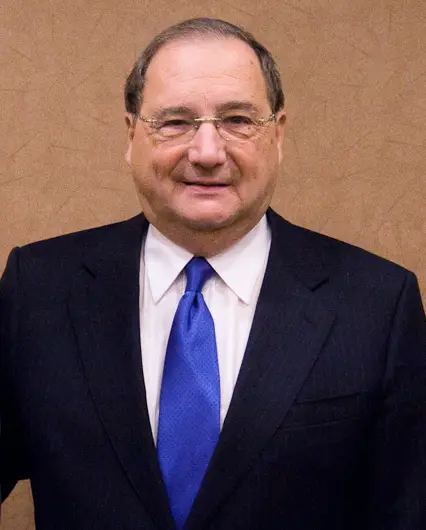
Abraham “Abe” Foxman (May 1, 1940 - May 10, 2026) was a Holocaust survivor, lawyer, Jewish communal leader, and longtime national director of the Anti-Defamation League (ADL). He led the ADL from 1987 until 2015 and remained one of the most prominent American Jewish voices on anti-Semitism, Holocaust memory, Israel, interfaith relations, and civil rights. Foxman died at the age of 86.
Foxman was born to Polish Jewish parents in what is now Belarus. During the Holocaust, his parents, Joseph and Helen Foxman, entrusted him to his Polish Catholic nanny, Bronislawa Kurpi, in an effort to save his life after the German occupation of Lithuania and the confinement of Jews in the Vilna Ghetto. Kurpi had him baptized and raised him as a Catholic. Foxman later recalled that as a young child, he had absorbed his wartime Catholic identity so fully that he would make the sign of the cross when passing a church and kiss a priest’s hand when he encountered one.
After World War II, Foxman was reunited with his parents. The family spent time in a displaced persons camp in Austria before immigrating to the United States in 1950, when Foxman was 10. His childhood as a hidden Jewish child during the Holocaust became central to his later public life. It gave him personal authority in discussions of anti-Semitism, Holocaust memory, and Jewish survival.
Foxman received his law degree from New York University School of Law and joined the ADL in 1965 as a legal assistant. Over the next two decades, he rose through the organization’s ranks and was appointed national director in 1987. He held that position until his retirement in 2015, when Jonathan Greenblatt succeeded him.
As national director, Foxman transformed the ADL into one of the most visible Jewish advocacy organizations in the United States and internationally. He warned repeatedly that anti-Semitism was not merely a relic of the past but a recurring and adaptable hatred. In his 2003 book, Never Again? The Threat of the New Anti-Semitism, Foxman argued that anti-Jewish hatred had reemerged in new forms after a period in which he had believed anti-Semitism was declining. He described the new moment as “serious,” “different,” and “dangerous,” warning that anti-Semitism was “not a fact of history” but a current threat.
Foxman connected the resurgence of anti-Semitism to violent attacks on Jewish institutions in the United States, the collapse of the Israeli-Palestinian peace process, the demonization of Israel at the 2001 Durban conference, the spread of anti-Israel boycotts and rhetoric, anti-Semitic attacks in Europe, conspiracy theories after the September 11 attacks, and the use of the Internet as what he called a “superhighway of anti-Semitic hate.” He argued that the line between legitimate criticism of Israel and hatred of Jews had increasingly blurred. That anti-Zionist language was often used to legitimize older anti-Semitic tropes.
Foxman was also deeply involved in interfaith relations, particularly Catholic-Jewish dialogue. During the controversy over Mel Gibson’s film The Passion of the Christ, Foxman warned that depictions of Jews as responsible for the death of Jesus could revive the deicide charge that the Catholic Church had formally rejected in Nostra Aetate at the Second Vatican Council. His concerns reflected his broader view that anti-Semitism could reappear through culture, politics, religion, or media, and required constant vigilance.
In 1987, President Ronald Reagan appointed Foxman to the United States Holocaust Memorial Museum Council. He was later reappointed by Presidents George H. W. Bush, Bill Clinton, and Joe Biden. In later years, he was the only Holocaust survivor serving on the museum’s board. From 2016 until 2021, he served as vice chair of the board of trustees of New York’s Museum of Jewish Heritage.
After leaving the ADL, Foxman remained active in Jewish communal life and became more openly involved in political commentary. No longer bound by the constraints of leading a nonpartisan organization, he endorsed candidates and policies, including Vice President Kamala Harris’ 2024 presidential bid, while also criticizing the Democratic Party’s leftward shift on Israel. At the same time, he criticized Republicans and the Trump administration when he believed their actions threatened democratic norms or targeted immigrants. Speaking at the U.S. Capitol during a Holocaust Remembrance Day ceremony in 2025, Foxman said that as a survivor, his “antenna quivers” when he saw books being banned, people being abducted in the streets, government attempts to dictate what universities should teach, and immigrants being demonized. At the same address, he credited both the Biden and the second Trump administrations for their commitments to fighting anti-Semitism.
Greenblatt described Foxman as “an iconic Jewish leader who embraced the ideal of an America free from anti-Semitism and hate.” He said Foxman transformed the ADL, confronted hate “from both left and right,” held world leaders accountable, and worked to ensure that Israel remained Jewish, secure, and democratic. Israeli President Isaac Herzog called Foxman a “passionate Zionist, a humanist, and an outspoken, wise friend,” saying that the Holocaust shaped his mission of “combating anti-Semitism and hypocrisy, calling out racism and bias, speaking up for the Jewish people and the Jewish democratic Israel.”
Foxman married Golda Bauman in 1967 after the two met at Camp Herzl in Webster, Wisconsin. He is survived by his wife and their two children, Michelle and Ariel. His life, shaped by survival during the Holocaust and decades of public advocacy, made him one of the defining Jewish communal leaders of the late 20th and early 21st centuries.
Sources: LifeStyles Magazine
“Former ADL director Abe Foxman dies at 86,” Times of Israel, (May 10, 2026).
Melissa Weiss, “Longtime ADL head Abe Foxman dies at 86,” Jewish Insider, (May 10, 2026).
Photo: Justin Hoch, CC BY 2.0, via Wikimedia Commons.