
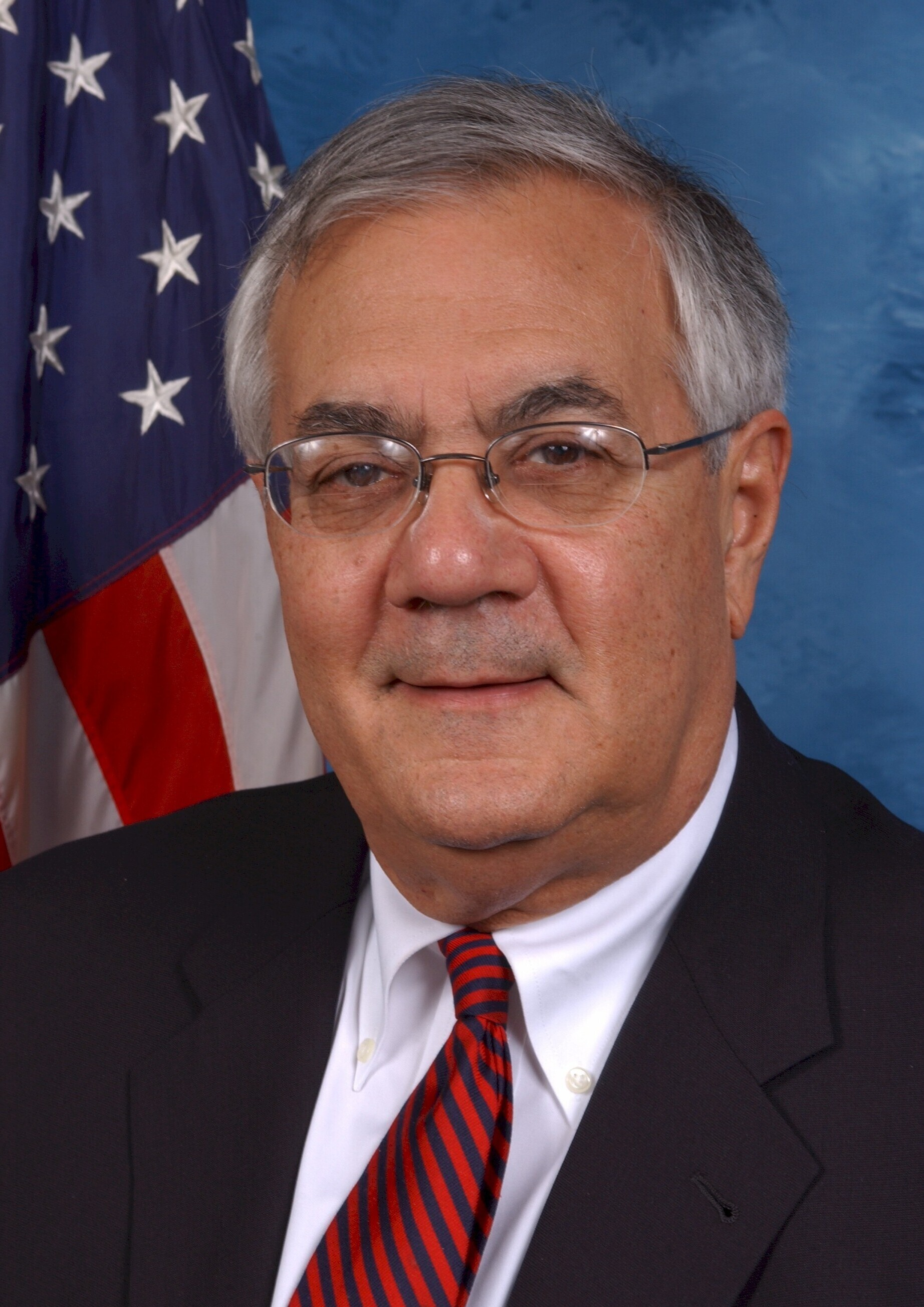
Barney Frank was a Jewish American politician who served for 32 years in the U.S. House of Representatives and became one of the most prominent gay politicians in the United States. A liberal Democrat from Massachusetts, he was known for his sharp wit, combative debating style, advocacy for marginalized communities, and central role in the passage of the Dodd-Frank Wall Street Reform and Consumer Protection Act after the 2008 financial crisis.
Frank was born Barnett Frank on March 31, 1940, in Bayonne, New Jersey. His grandparents had immigrated to the United States from Poland and Russia. He later legally changed his first name to Barney. His mother, Elsie Golush Frank, worked as a legal secretary, and his father, Samuel Frank, co-owned a truck stop near the Holland Tunnel in Jersey City. Frank grew up in a working-class family that placed a strong emphasis on education.
Frank graduated from Harvard College in 1962 with a degree in government. He was working toward a doctorate at Harvard when he became involved in Boston politics. In 1968, before completing his Ph.D., Frank left graduate school to become chief assistant to Boston Mayor Kevin White, a position he held for three years. He also participated in Freedom Summer in 1964, helping register Black voters in Mississippi, an experience rooted in his early concern for civil rights.
In 1971, Frank spent six months as a fellow at the Institute of Politics at the John F. Kennedy School. He then served for one year as an administrative assistant to U.S. Congressman Michael J. Harrington. In 1972, Frank was elected to the Massachusetts Legislature, where he served for eight years. During that time, he entered Harvard Law School and graduated in 1977.
In 1980, Frank won election to the U.S. House of Representatives from Massachusetts’ 4th District. He took office in 1981 and represented suburban Boston communities for 16 terms. From 1985 to 2008, Frank won re-election 12 times in a row, usually by wide margins. He became known on Capitol Hill as one of its most intelligent and quotable members, often described as “brainiest,” “funniest,” and “most eloquent” in Washingtonian magazine’s polls of congressional staffers.
On May 30, 1987, Frank publicly came out as gay, becoming the first sitting member of Congress to do so voluntarily. His decision was prompted in part by growing media interest in his private life and by the death of Stewart McKinney, a closeted Republican congressman from Connecticut. Frank later said he wanted to avoid uncertainty about his identity after his death and to show that homosexuality was nothing to be ashamed of. “If you ask the direct question ‘Are you gay?’ the answer is yes,” he told The Boston Globe. “So what?”
Frank became a leading advocate for LGBTQ rights, AIDS funding, civil rights, women’s rights, and affordable housing. He pressed the Clinton administration to end the ban on gay people serving openly in the military and later helped advance the repeal of the “Don’t Ask, Don’t Tell” policy. In 2012, he became the first sitting member of Congress to marry a same-sex partner when he wed Jim Ready, his longtime partner.
Frank’s most significant legislative achievement came after the 2008 global financial crisis. As chairman of the House Financial Services Committee, he helped craft the Dodd-Frank Wall Street Reform and Consumer Protection Act with Senator Christopher Dodd of Connecticut. Signed by President Barack Obama in 2010, the law tightened oversight of large financial institutions, imposed new rules on banks, created stronger consumer protections, and established the Consumer Financial Protection Bureau.
Frank was also a controversial figure. In 1990, the House voted to reprimand him for misuse of office after an ethics investigation involving Stephen Gobie, a male prostitute whom Frank had hired as a personal employee. The committee did not substantiate Gobie’s claim that he had run a prostitution ring from Frank’s home, but it found that Frank had improperly intervened on Gobie’s behalf. Frank apologized, saying, “I should have known better,” and was re-elected that year.
In November 2011, Frank announced that he would not seek re-election in 2012, citing redistricting and the changing demands of another campaign. He retired from Congress in January 2013 after serving 16 terms. After leaving office, he remained active in public debate, appearing frequently on television and commenting on Democratic politics, financial regulation, and LGBTQ rights. His memoir, Frank: A Life in Politics from the Great Society to Same-Sex Marriage, was published in 2015.
In his later years, Frank continued to argue for a pragmatic liberal politics. Shortly before his death, he completed another book, The Hard Path to Unity, in which he urged the political left to avoid turning unpopular cultural issues into litmus tests and to build broader support through practical reforms. He is survived by his husband, Jim Ready; his brother, David Frank; and his sisters, Doris Breay and Ann Lewis.
Frank died on May 19, 2026, at his home in Ogunquit, Maine, at age 86, after entering hospice care with congestive heart failure.
Sources: Congressman Barney Frank.
Michael Williams, Jeanne Sahadi, “Barney Frank, liberal icon who regulated a ‘too big’ financial industry, dies at 86,” CNN, (May 20, 2026).
Steven Sloan, “Barney Frank, a liberal congressman and trailblazer for gay rights, dies. He was 86,” AP, (May 20, 2026).
Katharine Q. Seelye, “Barney Frank, Gay Pioneer and Liberal Stalwart in Congress, Dies at 86,” New York Times, (May 20, 2026).
Photo: Public domain via Wikimedia Commons.