
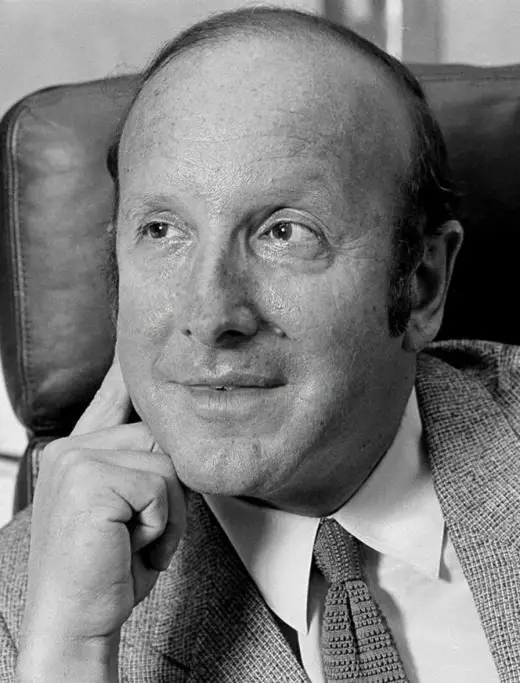
Clive Jay Davis (April 4, 1932 - June 22, 2026) was an American record executive, producer, and one of the most influential figures in the modern music industry. Over a career that stretched more than six decades, he helped guide the rise of rock, pop, R&B, hip-hop, country, and adult contemporary acts and became known for pairing performers with songs that could reach mass audiences.
Davis was born in Brooklyn, New York, to a Jewish family, the son of Herman Davis, an electrician and tie salesman, and Florence Brooks Davis. He grew up in Crown Heights and attended Erasmus Hall High School. His childhood was marked more by academic ambition than by music; he later said that when he entered the record business, he knew nothing about music. While he was a student at New York University, both of his parents died within 11 months, after which he lived with his sister. Davis graduated from NYU magna cum laude and Phi Beta Kappa in 1953, and then earned a law degree from Harvard Law School in 1956.
After practicing law in New York, Davis joined Columbia Records, then a CBS subsidiary, as assistant counsel in 1960. He rose quickly through the company, becoming vice president and general manager in 1966 and president of Columbia Records in 1967. At the time, Columbia was identified largely with Broadway cast albums, jazz, classical music, and traditional pop. Davis moved the company more aggressively into rock after attending the Monterey Pop Festival in June 1967, where Janis Joplin’s performance with Big Brother and the Holding Company convinced him of rock’s commercial future. Columbia subsequently signed or promoted artists including Joplin, Santana, Laura Nyro, Blood, Sweat & Tears, Chicago, Billy Joel, Bruce Springsteen, Aerosmith, and Pink Floyd. Davis also played a role in the careers of Bob Dylan, Barbra Streisand, Simon & Garfunkel, Miles Davis, and Herbie Hancock.
Davis left Columbia in 1973 amid allegations that he had misused company funds, including expenses connected to his son’s bar mitzvah. He denied broader wrongdoing and later pleaded guilty to $2,700 in expenses. After writing Clive: Inside the Record Business, he founded Arista Records with Columbia Pictures in 1974. Arista soon became a major label, beginning with Barry Manilow’s “Mandy,” and later helped launch or revive the careers of Patti Smith, Whitney Houston, Aretha Franklin, Dionne Warwick, Kenny G, Sarah McLachlan, Carly Simon, and others. Houston, whom Davis signed as a teenager, became one of his defining successes after the release of her 1985 debut album.
In the late 1980s and 1990s, Davis expanded Arista’s reach through Arista Nashville, LaFace Records with L.A. Reid and Babyface, and Bad Boy Records with Sean “Puffy” Combs. Those ventures brought artists including Alan Jackson, Brooks & Dunn, TLC, Toni Braxton, Usher, OutKast, Pink, the Notorious B.I.G., Faith Evans, and Mase to wide audiences. He also oversaw Carlos Santana’s 1999 comeback album Supernatural, which sold tens of millions of copies and won major Grammy Awards.
Davis was inducted into the Rock and Roll Hall of Fame as a non-performer in 2000 and received a Grammy Trustees Award. After leaving Arista, he founded J Records, where Alicia Keys became his first major success. He later served as chairman and CEO of RCA Music Group and, beginning in 2008, chief creative officer of Sony Music Entertainment. Davis also supported music education, donating millions to New York University for what became the Clive Davis Institute of Recorded Music.
Davis published his memoir, The Soundtrack of My Life, in 2013 and was the subject of the 2017 documentary Clive Davis: The Soundtrack of Our Lives. In his memoir, he came out as bisexual, writing publicly about relationships with both women and men.
He did not often emphasize his Jewish identity publicly. Still, after the October 7, 2023, Hamas attack on Israel, including the massacre at the Nova music festival, he spoke against anti-Semitism. He said silence was not acceptable in the face of hate or discrimination. Davis died at his home in Manhattan on June 22, 2026, at age 94.
Davis was twice married and divorced, first to Helen Cohen and later to Janet Adelberg. He had three sons, Fred, Mitchell, and Doug, and a daughter, Lauren. He was survived by his children, grandchildren, great-grandchildren, and his partner, Greg Schriefer.
Sources: “Clive Davis Biography,” CliveDavis.com.
“Clive Davis,” Rock & Roll Hall of Fame.
“Clive Davis,” New York University.
Chris Eggertsen, “Clive Davis Condemns Hamas Attack: ‘I Support Israel’s Right to Eradicate Terrorism,’” Billboard, (October 18, 2023).
Ben Sisario, “Clive Davis, Hitmaking Titan of the Music Industry, Dies at 94,” New York Times, (June 22, 2026).
Chloe Melas, David K. Li, “Clive Davis, legendary music mogul who worked with Whitney Houston and Bruce Springsteen, dies at 94,” NBC News, (June 22, 2026).
“Clive Davis, towering music executive who reshaped American sound, dies at 94,” Reuters, (June 22, 2026).
Sherman Hollar, “Clive Davis,” Encyclopedia Britannica, (June 22, 2026).
Andrew Lapin, “Clive Davis, influential Jewish rock-and-roll executive, dies at 94,” Jewish Telegraphic Agency, (June 23, 2026).
Photo: Public domain via Wikimedia Commons.