
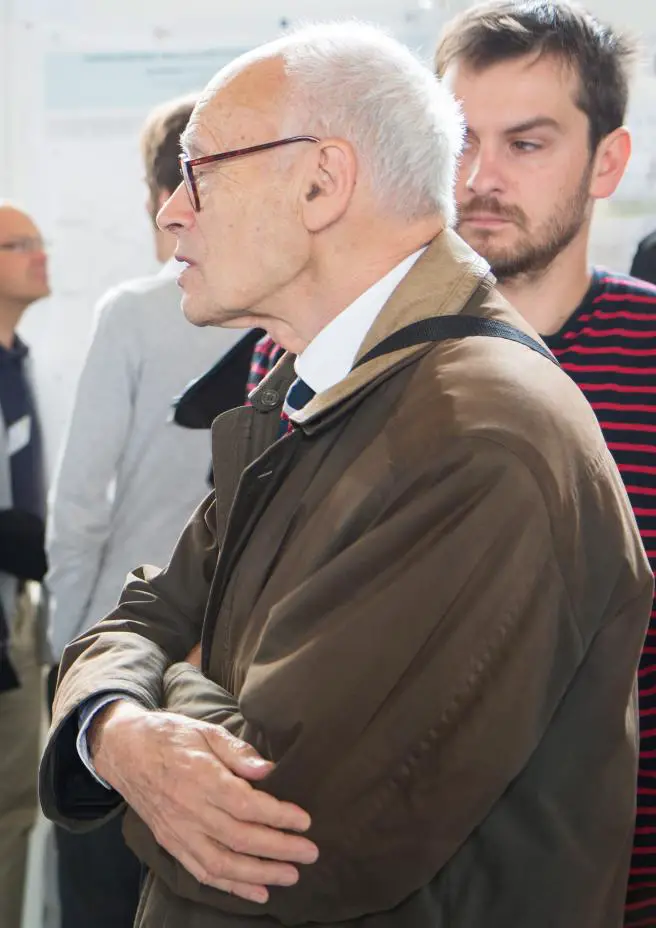
Henri B. Kagan is a French Jewish chemist, a pioneer of asymmetric catalysis, and a recipient of the 2026 Nobel Prize in Chemistry. His research helped chemists control the “handedness” of molecules, with major consequences for pharmaceutical manufacturing.
Kagan was born on December 15, 1930, in Boulogne-Billancourt, near Paris. He grew up in a Jewish family that hid under assumed names in a village in southern France during World War II.
He studied at the Sorbonne and the École Nationale Supérieure de Chimie de Paris, graduating from the latter in 1954. He completed his doctorate in 1960 under Jean Jacques at the Collège de France, researching steroid chemistry and stereochemistry. He subsequently worked with Alain Horeau. In 1968, Kagan established a laboratory at Orsay, where he developed his career at Université Paris-Sud, now part of Université Paris-Saclay. He became a professor emeritus in 1999.
Much of Kagan’s work concerned chirality: the existence of molecules in two forms that are mirror images of one another, like left and right hands. These forms, called enantiomers, can have different biological effects, making it especially important to favor one form in drug manufacturing. In 1971, Kagan reported a breakthrough using DIOP, a chiral molecule that binds to a metal catalyst. Combined with rhodium, it enabled hydrogenation reactions to produce a substantial excess of one enantiomer. The discovery helped establish principles that influenced later generations of asymmetric catalysts.
In 1986, Kagan demonstrated nonlinear effects in asymmetric synthesis. Chemists had generally assumed that the proportions of the two mirror-image forms in a catalyst would translate proportionally into the reaction product. His experiments showed that this relationship could be nonlinear, allowing a modest imbalance in the catalyst to produce a much greater imbalance in the product. This amplification became an important tool for understanding reaction mechanisms and improving molecular synthesis. He also made pioneering contributions to using lanthanides, or rare-earth elements, in organic synthesis.
Kagan was elected a corresponding member of the French Academy of Sciences in 1978 and a full member in 1991. In 2001, he shared Israel’s Wolf Prize in Chemistry with Ryoji Noyori and K. Barry Sharpless. That year’s Chemistry Nobel, however, went to Noyori, Sharpless, and William S. Knowles. Kagan’s omission prompted objections from French scientists and a protest to the Nobel Foundation by France’s research minister, Roger-Gérard Schwartzenberg.
His other honors included the inaugural Ryoji Noyori Prize in 2002, the Franklin Institute’s Bower Award and Prize for Achievement in Science in 2005, and the French Chemical Society’s Lavoisier Medal in 2013. He was also named a chevalier of the Legion of Honor.
On October 7, 2026, at age 95, Kagan was awarded the Nobel Prize in Chemistry jointly with Japanese chemist Kenso Soai “for the discovery of nonlinear effects and autocatalysis in asymmetric organic synthesis.” Kagan’s discovery of nonlinear effects and Soai’s subsequent development of asymmetric autocatalysis showed how chemical processes could strongly amplify molecular asymmetry. Their work helped explain how homochirality—the predominance of one molecular handedness, characteristic of life’s chemistry—can emerge and provided important tools for pharmaceutical synthesis.
Sources: “Henri Kagan,” Académie des sciences.
“Henri B. Kagan,” Wolf Foundation.
“Ryoji Noyori Prize,” The Society of Synthetic Organic Chemistry, Japan.
Sally Goodman, “French Nobel protest makes chemist a cause célèbre,” Nature, (November 15, 2001).
“Henri B. Kagan,” Franklin Institute, (April 2005).
Gilbert Balavoine, “Sur la route d’Henri Kagan, dialogue…,” L’Actualité Chimique, (September 2013).
“They solved chemistry’s asymmetric mystery,” Royal Swedish Academy of Sciences, (2026).
“Henri B. Kagan, prix Nobel de Chimie 2026,” Société Chimique de France, (October 7, 2026).
“Nobel Prize in chemistry awarded for research solving ‘mirror image’ mystery,” Times of Israel, (October 7, 2026).
“The Nobel Prize in Chemistry 2026: They made chemistry choose a mirror image,” Royal Swedish Academy of Sciences, (October 7, 2026).
Photo: Ecole polytechnique from Paris, CC BY-SA 2.0, via Wikimedia Commons.