
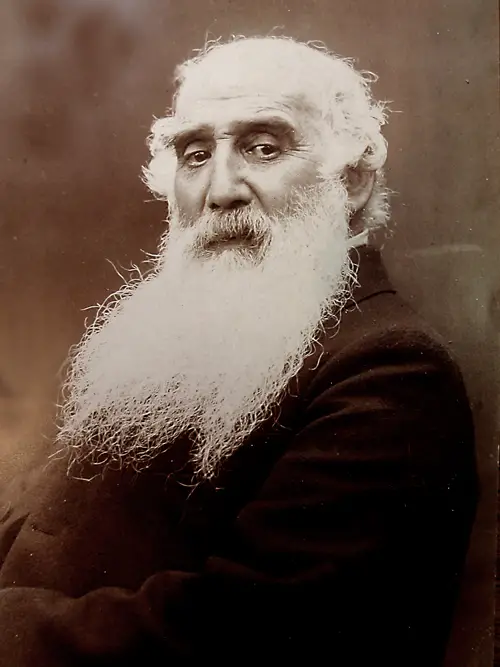
Jacob Abraham Camille Pissarro was born on July 10, 1830, in Charlotte Amalie on the island of St. Thomas, then part of the Danish West Indies. He was born into a Sephardic Jewish family of French and Portuguese descent. His father, Abraham Gabriel Pissarro, was a Jewish merchant, and his mother, Rachel Manzano-Pomié, came from a Jewish family with Caribbean roots. Pissarro’s Jewish background placed him within a cosmopolitan mercantile milieu, and his early life unfolded at the crossroads of Europe, the Caribbean, and Latin America.
At the age of twelve, Pissarro was sent to boarding school in France, where he was introduced to European art and culture. After completing his studies, he returned to St. Thomas and worked in his family’s business, while continuing to draw and paint in his spare time. In 1852, he left the island with the Danish painter Fritz Melbye and traveled to Venezuela, where the two lived and worked for several years. This period proved formative, exposing Pissarro to direct observation of nature and everyday life, themes that would remain central to his art.
In 1855, Pissarro settled permanently in Paris to pursue an artistic career. He studied at institutions including the École des Beaux-Arts and the Académie Suisse. He was influenced by painters such as Jean-Baptiste-Camille Corot, Gustave Courbet, and Charles-François Daubigny. During the 1860s, his works were regularly accepted to the official Paris Salon, though he increasingly grew critical of academic conventions. He participated in the 1863 Salon des Refusés, aligning himself with artists who challenged the established art world.
During this period, Pissarro lived in rural areas around Paris, including Louveciennes and Pontoise, and focused on landscapes and scenes of peasant life. He formed close relationships with younger artists, notably Claude Monet, Pierre-Auguste Renoir, Alfred Sisley, and Paul Cézanne. The outbreak of the Franco-Prussian War in 1870 forced Pissarro to flee to London, where he met the art dealer Paul Durand-Ruel, who later became a crucial supporter of the Impressionists. Upon returning to France, Pissarro discovered that many of his early works had been destroyed during the war.
Pissarro played a central role in the Impressionist movement. He participated in and helped organize the first Impressionist exhibition in 1874 and was the only artist to exhibit in all eight Impressionist group exhibitions held between 1874 and 1886. Settled in Pontoise and later in Éragny-sur-Epte, he became a mentor to several artists, including Cézanne and Paul Gauguin, earning a reputation as a guiding figure within the movement.
In the mid-1880s, Pissarro experienced a stylistic crisis and briefly adopted the Neo-Impressionist, or pointillist, techniques associated with Georges Seurat and Paul Signac. Although he later returned to a freer Impressionist style, this period reflected his lifelong openness to experimentation. His work often depicted rural laborers, markets, and urban streets, themes that also reflected his interest in social justice and his sympathy for anarchist ideas.
In the final years of his life, Pissarro suffered from chronic eye problems that limited his ability to paint outdoors. He continued to work from indoor vantage points, producing a series of urban views of Paris. Pissarro died in Paris on November 13, 1903, and was buried in Père Lachaise Cemetery. Today, he is remembered as a foundational figure of Impressionism and as a Jewish artist whose life and work were shaped by migration, marginality, and sustained engagement with modern life.
Sources: Kathleen Adler, “Camille Pissarro,” Britannica.
“Camille Pissarro,” biography.com, (April 13, 2021).
Adam Gopnik, “How Camille Pissarro Went from Mediocrity to Magnificence,” New Yorker, (December 25, 2023).
Photo: Public domain, via Wikimedia Commons.