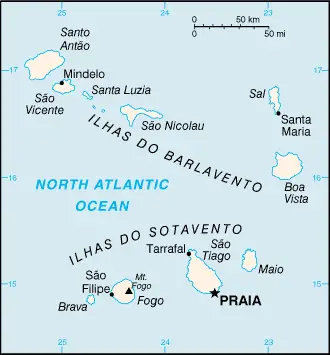
 The Republic of Cape Verde is an archipelago of ten islands off the west coast of Africa. Over the centuries, Cape Verde became a harbor of Jews fleeing European persecution or in search of economic opportunities. Cape Verde was a Portuguese colony from 1463 to 1975, when it gained its independence. Following the Portuguese Inquisition, in 1496 by King Manuel I, many Jews converted to Christianity and became known as Marronos, New Christians. Many of these New Christians escaped to the Cape Verde islands. Jews first came to the island of Sao Tiago and were immediately placed into a ghetto in the Cape Verdean capital, Praia. Nonetheless, these new immigrants were influential in Cape Verde’s development; they worked as merchants and in a few cases as slave traders to the New World. The New Christians were permitted to trade as long as they did not compete relentlessly with the Portuguese trading monopolies. By 1548, Jews were being disposed of on the island of Santo Antao, sent as convicts and exiles (degregados) by the Portuguese government. Then in 1672, a branch of the Portuguese Inquisition was established in Cape Verde resulting in the confiscation of Jewish trading centers. Many of these Christaos Novos hid their true Jewish identity until the late 1700's, when the ideas of the Inquisition and religious persecution had subsided. Then in the late 19th century, Jews began immigrating to Cape Verde from Morocco, fleeing persecution and in search of commercial endeavors. According to the Cape Verde Jewish Heritage Project, Sephardi Jews from Morocco and Gibraltar settled in Cape Verde in the mid-19th century, after Portugal abolished the Inquisition in 1821 and after Portugal and Britain signed a trade and navigation treaty in 1842. Some Moroccan Jews traded through Gibraltar and arrived with British passports. Many of these Moroccan Jews began working in coal industry or trading in hides and pelts, settling especially in Boa Vista and Maio. Many of these new immigrants were single men and began to intermarry with the local population. Jewish communities began to thrive on the islands of Santiago, San Vincente, and Santo Antao. Tombstone inscriptions in Hebrew and Portuguese identify family origins in Moroccan cities, including Tangier, Tetouan, Rabat, and Mogador (now Essaouira). Reported surnames include Anahory, Auday, Benoliel, Benrós, Benathar, Benchimol, Brigham, Cohen, Levy, Maman, Pinto, Seruya, and Wahnon. However, by the late 20th century most of the Jewish community had either left Cape Verde for the State of Israel or assimilated into the predominately Catholic nation. There remain four Jewish cemeteries in existence on the islands of Cape Verde:
In 1995, the Cape Verde-Israel Friendship Society was established to revitalize Jewish life in the islands. Today, however, there are no visibly practicing Jews remaining in the country and no organized Jewish community. The most prominent Cape Verdean with Jewish ancestry was Carlos Alberto Wahnon de Carvalho Veiga, Prime Minister of the Cape from 1991 to 2000, who is the grandson of Jewish immigrants from Gibraltar in the mid 19th century. A few descendants of the earlier Jewish population initiated a project called the “Cape Verde Jewish Heritage Project,” whose main goal is to restore the Jewish cemeteries on various islands and create an archive detailing their Jewish ancestors of Cape Verde. In April 2013, John Wahnon, a board member of the Jewish Heritage Project, announced that the group - with financial backing by the King of Morocco - plan to rededicate a burial plot in Praia. The Moroccan government has been a “major benefactor, along with a variety of other Jewish and non-Jewish donors, for efforts to preserve and restore its heritage sites," according to Carol Castiel, president of the Cape Verde Jewish Heritage Project. In 2017, Cabo Verde listed Jewish cemeteries and several Jewish-associated structures as part of its National Historical Patrimony, helping protect the cemeteries from destruction and limiting alterations to related buildings. Cemeteries at Ponta do Sol and Penha de Franca were rededicated in 2018 in a ceremony attended by descendants of Cape Verde’s Jewish community, Cape Verdean officials, U.S. and Israeli representatives, Lisbon’s chief rabbi, and residents. The Jewish section of Praia’s cemetery, dating from the 19th century, was restored in 2013 by the Municipal Chamber of Praia and the Cape Verde Jewish Heritage Project with funding from Morocco’s King Mohammed VI. The World Monuments Fund has also worked with the Heritage Project to survey archives in Cape Verde, Portugal, Morocco, and Gibraltar and to interview descendants, because earlier research on the community had been scattered and incomplete. Sources: “Cape Verde, the FIFA World Cup 2026 underdog with unexpected Moroccan Jewish roots,” Jerusalem Post, (June 25, 2026). Photo: CIA Factbook. |