
No examination of Jewish folk narrative is complete without a discussion of the Wise Men of Chelm. Tales of the supreme foolishness of the Wise Men emerged from Eastern Europe upwards of 500, and, as far as anyone can tell, perhaps 700 years ago, since Jews first settled in the city. Chelm is located about fifteen miles from the border of Ukraine in eastern Poland. A few Jewish residents had good businesses, although most were extremely poor. At one point, in 1939, the Jewish community totaled as many as 15,000. Now, out of a total population of 60,000, there are none. Some left on their own in 1939, when war broke out. Most were killed.
Several prominent Jewish scholars, including Reb Shlaymeh Khelma, a student of the great philosopher Maimonides, were Chelmites. This little-known fact may help explain the long-lasting appeal of these stories, which are shared in books and with audiences to this day. While it is the characters’ illogical logic that first and foremost makes the tales well-loved, anyone, after all, can be silly, misguided, or just plain wrong. But the underlying humor of the Chelmites appears to be in the implication that Jews should, by virtue of their dedication to learning, know better. What’s more, there is a certain learned seriousness of purpose with which the so-called “wise men” employ their crazy reasoning to solve the problems facing the community, and it is that very learning at which the stories poke fun. You think you smart guys know so much? they seem to say. In fact, you are as much a fool as we are! This story adds to all of that the use of mathematics, a nod to the mystical practice of gematria, and is a near-perfect satire of Jewish thought.
The following story is a retelling of part of “The Rabbi,” which appears in Steve Sanfield’s collection The Feather Merchants & Other Tales of the Fools of Chelm.
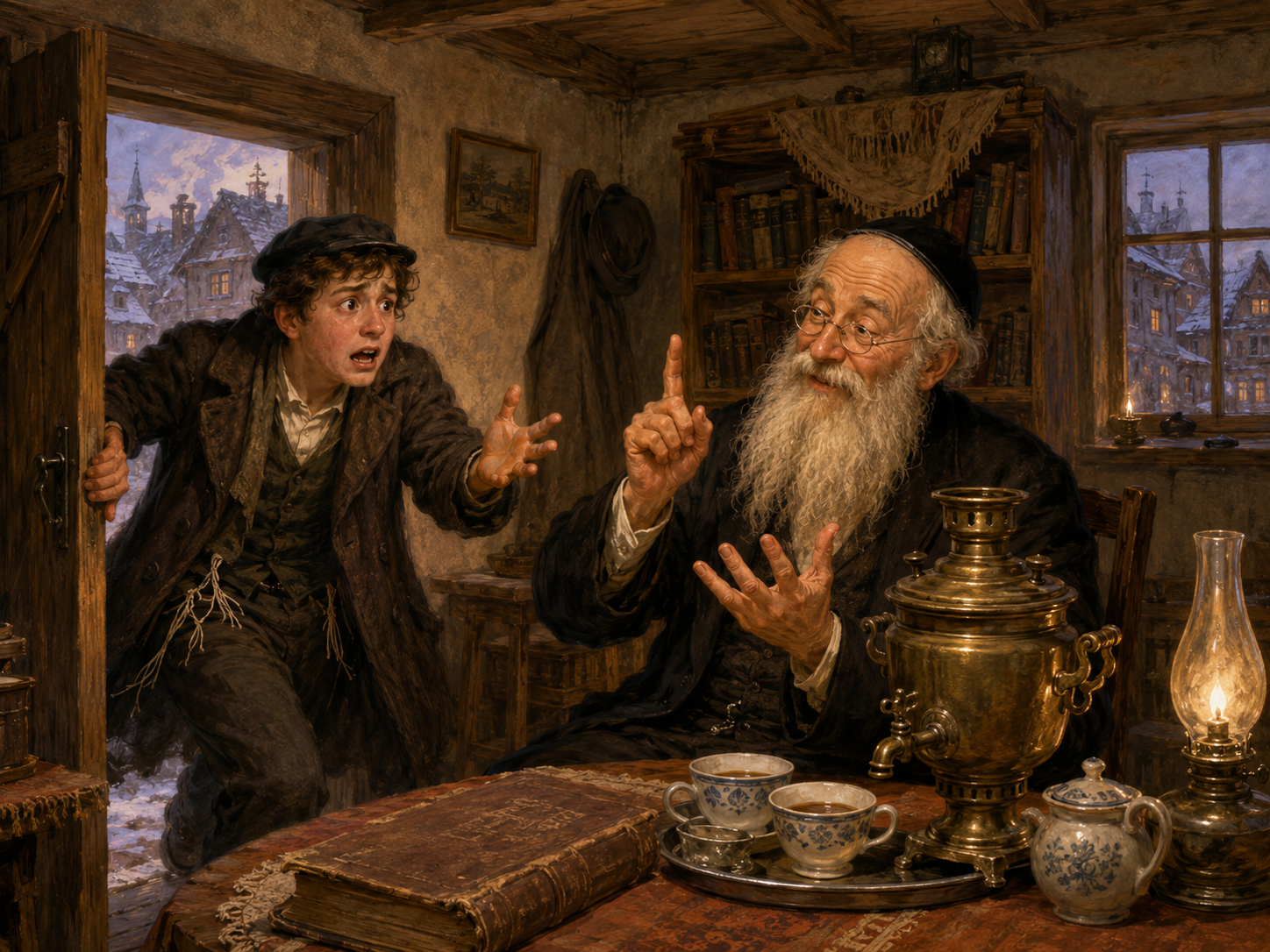
Sixteen-year-old Yossel was beside himself with worry. He had just married his fifteen-year-old beloved Sossel, and now he was faced with the greatest problem of his young life. Like everyone else he knew, there was only one place to turn to for advice. He ran to the Rabbi’s house as fast as his legs would carry him.
The Rabbi, who had been taking a nap, awoke at the sound of wild banging. He opened the door to the frantic young man. “What can be the trouble, Yossele?” he asked, still rubbing the sleep from his eyes.
“Oh Rabbi,” the young man began, nearly falling into the room. “Please help me! Oy, I am in such trouble!”
“Of course!” The Rabbi ushered the groom to a seat and reached for the samovar to pour them both a cup of tea. “What can I do for you?”
“It’s too awful,” wailed Yossel. “My wife has had a baby!”
“Mazel tov!” the Rabbi replied. “Nu, what’s the problem? Is the baby not healthy, God forbid?”
“Thank God! He is a strong, beautiful boy.”
“And your wife, may I ask?” The Rabbi took a sip of his tea. “Is Sossel not well, God forbid?”
“Thank God!” the groom answered through his tears. “My Sossel is as strong as an ox!”
The Rabbi furrowed his brow. “Then tell me, what could be the matter?”
“Rabbi,” the distraught young man stammered. Sossel and I were wed exactly three months ago. And my father assures me that it takes nine months between—until a baby is born. So tell me, how can she have just given birth?”
Indeed, this was a question to ponder. Deep in thought, the Rabbi got up from his chair. He sat back down. He arose once, twice again, and each time he sat back down.
At last he smiled slowly. “Yossele,” he said, “you say it’s been exactly three months since your wedding?”
“Exactly,” the groom replied. “It was you who married us.”
“And Sossel, your bride, she has also been married exactly three months?”
The young man nodded. “Exactly, Rabbi.”
“And then you and she together,” the Rabbi continued, “you together have been married three months?”
“Exactly, Rabbi.”
The old man grinned. “There then is the answer! Exactly three months for you, exactly three months for her, exactly three months together—it all equals exactly nine months! All is well, Yossele, my son! May you both live to bring many more fine children into the world!”
And that is what they did. Exactly.
Source: Caren Schnur Neile, PhD., MFA, is a performance storyteller. She taught storytelling studies at Florida Atlantic University for twenty years. A graduate of the Jewish Theological Seminary, she has published seven books, and her work appears in The Encyclopedia of Jewish-American Literature, Elie Wiesel and the Art of Storytelling, The Oxford Handbook of American Folklore & Folklife Studies, and other publications
Photo: AI-generated illustration.