
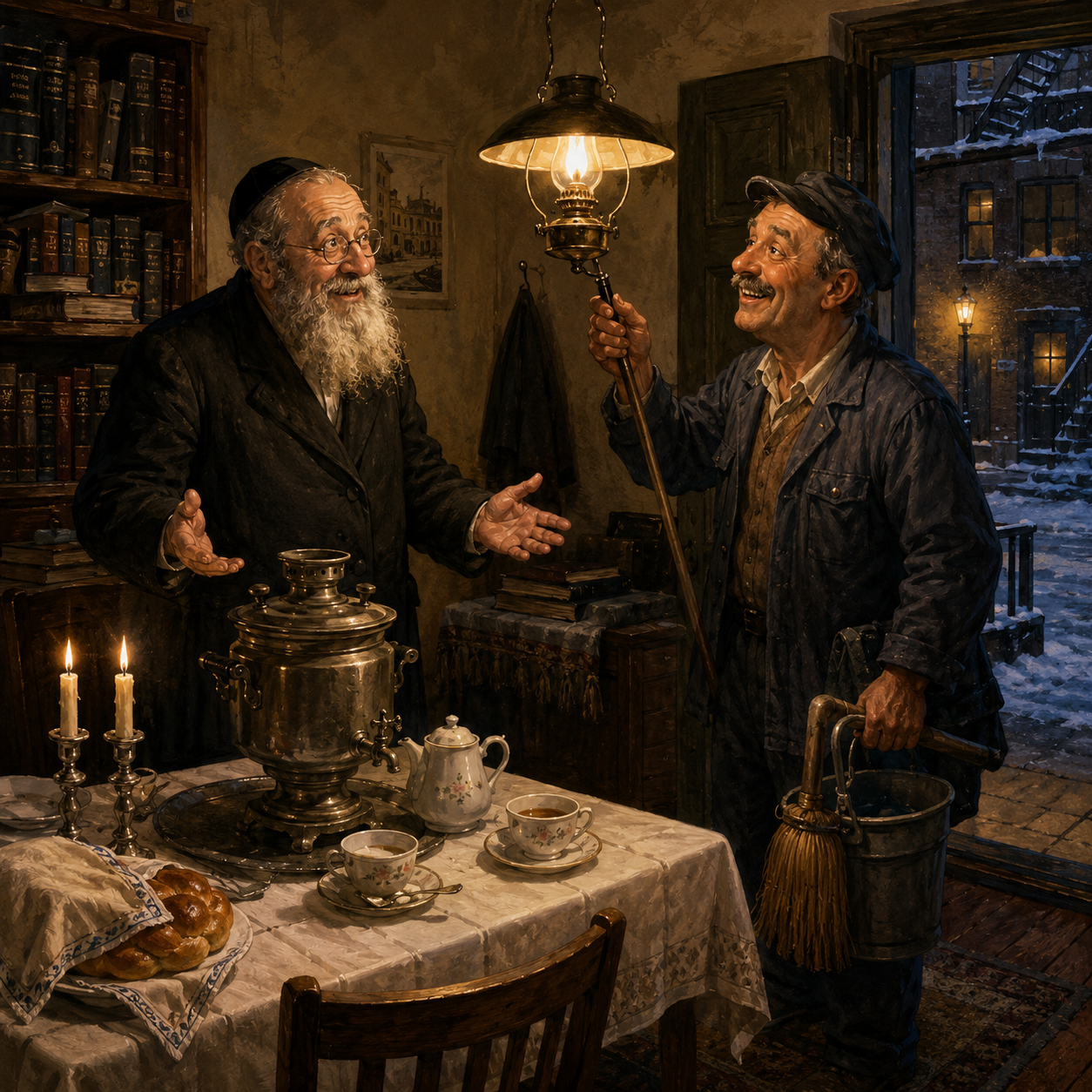
Jokes, riddles, and other forms of humor are, like folktales, types of folklore if, like folktales, they are generally shared without knowledge of a source and change with every transmission. Jewish humor tends to have a bit of an edge, as in the story below. A pious man attempts a workaround to the law? We’ll see about that. But first, a bit of context.
The practice of employing a “Shabbos goy” to perform forbidden activities for a Jew on the Sabbath is generally looked down upon by Orthodox rabbis in all but a few circumstances, such as in the case of illness or if the non-Jew were doing the work on his own behalf, as well. The rationale for this injunction is simple: what constitutes a violation of the law for a Jew should, the rabbis argue, likewise be forbidden for a Gentile to do on behalf of a Jew. Nevertheless, in Eastern Europe, Jews would regularly ask their non-Jewish neighbors to extinguish candles, light fires, and perform other simple tasks on the Sabbath that they themselves were not permitted to do. In the US, before the advent of programmable timers, Gentile neighbors were likewise often called upon to turn off lights and electrical appliances.
While the prohibition against using a Shabbos goy helps Jews adhere not only to the letter of the law but also to its spirit, there is an interesting implication attached to the concept. Jews are not expected to proselytize. The seven laws that apply to all humankind since the time of Noah—the sheva mitzvot bnei Noa—such as idol worship, cursing God, and eating live flesh—do not include observing the Sabbath. That means, in effect, the existence of a Shabbos goy highlights Jewish tolerance for differences between Jews and non-Jews—the right of non-Jews to work on the Sabbath rather than be shamed into abstaining. Needless to say, it helps the Jews, as well.
This background helps explain the humor behind a Shabbos goy tale from Henry Spalding’s Joys of Jewish Humor. The following retelling of his version captures both its wit and its theme of Jewish karma.
Over the course of his life, a rabbi in Brooklyn did everything in his power to follow Jewish law to the letter. He was not only a pious man, but also a great scholar. Each morning, he rose before dawn to study the holy books. After his wife died in childbirth, he took on the simple tasks around his home. On Fridays, for example, just before he lit the candles, he made sure to turn on a light to burn until Havdalah, the end of the Sabbath on Saturday evening.
Over the years, the rabbi earned a reputation far and wide for his piety and his scholarship. But alas, one wintry Friday evening on his return from synagogue, he faced a true crisis: somehow the lamp he had lit before sundown had gone out. Had he turned it off without thinking? It made no difference. The real question was, how was he to study? How was he to live without light?
It was then that the rabbi heard the Gentile janitor of his apartment building humming to himself as he made his way down the hall. If only he could ask the man to light the light! But the rules for the Shabbos goy are clear: If a Jew must employ one at all, he needs to arrange for assistance before the holy day begins. How was he to overcome this problem?
It was then that the rabbi, known for his brilliance, had an idea. He was so pleased with himself that he rubbed his hands and fairly chortled out loud. When the janitor passed the rabbi’s apartment, the holy man opened the door.
“How are you this evening, my good man?” he asked.
“Freezing,” replied the janitor. “There’s already snow in the air.”
“As am I,” said the rabbi. “Why don’t you come in for a nice hot cup of tea?”
The janitor grinned. When was the last time a tenant had invited him in for anything but a clogged drain? He readily entered the dark apartment.
“Why thank you,” he said, struggling to see where he was going. “Thanks very much!”
“I’m just feeling around for the tea,” explained the rabbi. “I know it’s here somewhere.”
“Why don’t I light the lamp?” the man suggested. He did so, then sat in the closest chair to the door. The delighted rabbi handed him a hot cup of tea from the samovar he always left on during the Sabbath.
The two men spent several minutes sipping their tea, speaking about this and that. The janitor marveled all the while that this strange Jewish rabbi was such a mensch.
When they finished, the janitor thanked the rabbi for the tea and rose to his feet, explaining that he had to get back to his wife. As he made his way out of the apartment, he turned once more, thanked his host again, and then, oh so thoughtfully, shut off the light.
Source: Caren Schnur Neile, PhD., MFA, is a performance storyteller. She taught storytelling studies at Florida Atlantic University for twenty years. A graduate of the Jewish Theological Seminary, she has published seven books, and her work appears in The Encyclopedia of Jewish-American Literature, Elie Wiesel and the Art of Storytelling, The Oxford Handbook of American Folklore & Folklife Studies, and other publications.
Photo: AI-generated illustration.