
 Dana Internationa | 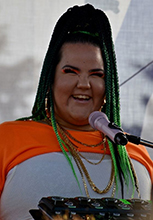 Netta |
The Eurovision Song Contest is the longest-running international television contest of all time, currently in its 70th year. It was started in the wake of World War II, as the European Broadcasting Union sought to bring the communities of Europe together through light-hearted wholesome entertainment. The competitors, typically member countries of the European Broadcasting Union, submit one original song to be performed on live television during the competition.
Each country selects a jury of five entertainment professionals to represent them and vote on their behalf, and viewers can also televote by sending text messages from their cellular phones. The winning country is chosen by tallying up the total points from the jury votes and the televotes. The first year that televotes were allowed was 1998. More than 100 million viewers watch the competition annually, making it one of the most watched non-sporting events in the world.
Although most competitors are from the continent of Europe, many other nations have competed over the years, including Australia, Cyprus, Armenia, Turkey, Russia, Azerbaijan, and Israel. Currently, the competition features approximately 40 countries, with 52 countries having participated at least once.
Notable winners of the contest include ABBA, who won the competition in 1974 representing Sweden, and Celine Dion, who won in 1988 while representing Switzerland.
Israel at Eurovision
Israel has hosted the contest in Jerusalem twice: in 1979, the first time it was held outside Europe, and in 1999. In 2019, because of political objections to holding it in Jerusalem, it was held in Tel Aviv. The Israel Broadcasting Authority is a member organization of the European Broadcasting Union and Israel has participated in the contest 41 times, beginning in 1973. That first entry finished fourth out of seventeen contestants.
Israel has won the contest four times: in 1978 (“A-Ba-ni-bi,” performed by Izhar Cohen and Alphabeta), March 31, 1979 (“Hallelujah,” performed by Gali Atari and Milk and Honey), May 9, 1988, (“Diva” by Dana International), and 2018 (“Toy” by Netta Barzilai). The competition in 1980 fell on Yom HaZikaron, and Israel declined to participate. This was the only time in the contest’s history that the winner sat out the following year. Israel holds the record for the most entries in the contest without ever coming in last place.
Because Israel won the Eurovision Song Contest in 2018, it hosted the competition in 2019 in what was a hugely successful event viewed by millions throughout Europe and highlighted by a performance by Madonna.
In December 2025, Spain, Ireland, the Netherlands, and Slovenia announced they will boycott the 2026 Eurovision Song Contest after the European Broadcasting Union declined to vote on suspending Israel from the competition. The broadcasters called Israel’s inclusion “unconscionable,” given the humanitarian crisis, while Israel’s KAN condemned the effort to remove it as a political “cultural boycott.” The withdrawals, involving major Eurovision contributors and past champions, have eroded the event’s 70th-anniversary edition, raising doubts about unity within the contest.
Four months later, more than 1,000 entertainment industry figures—including prominent actors, musicians, and executives—signed an open letter organized by Creative Community for Peace opposing efforts to exclude Israel from the Eurovision Song Contest, arguing that music should remain a unifying, apolitical space and that targeting Israeli artists constitutes discrimination; the letter emphasizes Eurovision’s role in fostering cultural exchange, cites the October 7 Hamas attack as context for Israel’s participation, and frames boycott campaigns as divisive actions that undermine both artistic collaboration and the contest’s core mission of unity.
For the first time since joining in 1961, Spain did not broadcast the event in 2026, citing opposition to Israel’s continued participation and arguing that the contest’s neutrality is no longer sustainable. The move, announced by Spain’s public broadcaster RTVE, reflects broader political tensions surrounding the competition and marks an unprecedented step for a “big five” country, which not only declined to participate but also withdrew its financial contribution—breaking with past boycotts in which countries typically still aired the event despite abstaining.
Ireland and Slovenia joined Spain in refusing to broadcast the 2026 Eurovision Song Contest due to Israel’s participation, with Ireland’s RTÉ opting not only to boycott but also to avoid airing the event altogether, while Slovenia replaced it with pro-Palestinian programming titled “Voices of Palestine.” Other countries, like Iceland and the Netherlands, also boycotted the event but still broadcast it, reflecting varying levels of protest.
Israeli singer Noam Bettan finished second at Eurovision 2026 in Vienna with his song “Michelle,” despite a year of boycott efforts and calls by several countries to bar Israel from the contest. Bettan received 123 jury points and 220 public-vote points, briefly putting Israel in first place and drawing some boos from the audience. The result was a major achievement for Israel after rule changes that made audience support less decisive and amid anti-Israel protests in Vienna, while noting that Bettan’s polished performance, public composure, and upbeat song gave Israel a strong showing on the Eurovision stage.
In August 2026, the Netherlands announced it would boycott the 2027 Eurovision Song Contest, arguing that international conflicts - particularly the Gaza war and disputes over Israel’s participation - had turned the competition into “a platform for division” that could “no longer be considered neutral.” Dutch broadcaster AVROTROS said recent rule changes, including barring countries involved in armed conflicts from hosting, had failed to restore confidence in the event’s independence.
Sources: Alex Marshall, “Spain, Ireland and Others Boycott Eurovision Over Israel’s Participation,” New York Times, (December 4, 2025).
“Eurovision – Open Letter,” CCFP, (April 15, 2026).
Hannah Brown, “Spain announces it will not broadcast Eurovision due to Israel’s participation,” Jerusalem Post, (April 19, 2026).
Hannah Brown, “Ireland joins Spain and Slovenia in refusing to broadcast Eurovision,” Jerusalem Post, (April 26, 2026).
Hannah Brown, “Israel’s Noam Bettan takes second place in Eurovision 2026, Bulgaria wins,” Jerusalem Post, (May 17, 2026).
Gavin Blackburn, “Netherlands withdraws from 2027 Eurovision Song Contest, says competition 'no longer' neutral,” EuroNews, (August 24, 2026).
Photos: Dana International - Daniel Kruczyński, CC BY-SA 2.0 via Wikimedia Commons.
Netta - Zahari Baharov, CC BY-SA 4.0 via Wikimedia Commons.