 Jerusalem International YMCA, July 2026
The YMCA began operating in Jerusalem in 1878, during Ottoman rule, in a bookstore near Jaffa Gate. After moving among several locations, it purchased a small building near Damascus Gate in 1909. Ottoman authorities closed the branch during World War I, but the British later reopened it to serve soldiers and residents. In 1920, American YMCA official Archibald Clinton Harte became its general secretary and promoted a permanent center open to Jerusalem’s different national and religious communities.
With major financial support from New Jersey philanthropist James Newbegin Jarvie and additional British and American donations, the YMCA acquired land from the Greek Orthodox Patriarchate. British High Commissioner Lord Plumer laid the cornerstone in 1928, and General Edmund Allenby dedicated the complex at 26 King David Street on April 18, 1933. Designed by Arthur Loomis Harmon, a partner in the firm responsible for the Empire State Building, the neo-Byzantine complex included an auditorium, gymnasium, swimming pool and 152-foot tower. Its decoration incorporated Jewish, Christian and Muslim motifs, including inscriptions in Hebrew, Aramaic and Arabic. At the dedication, Allenby described it as “a place whose atmosphere is peace.”
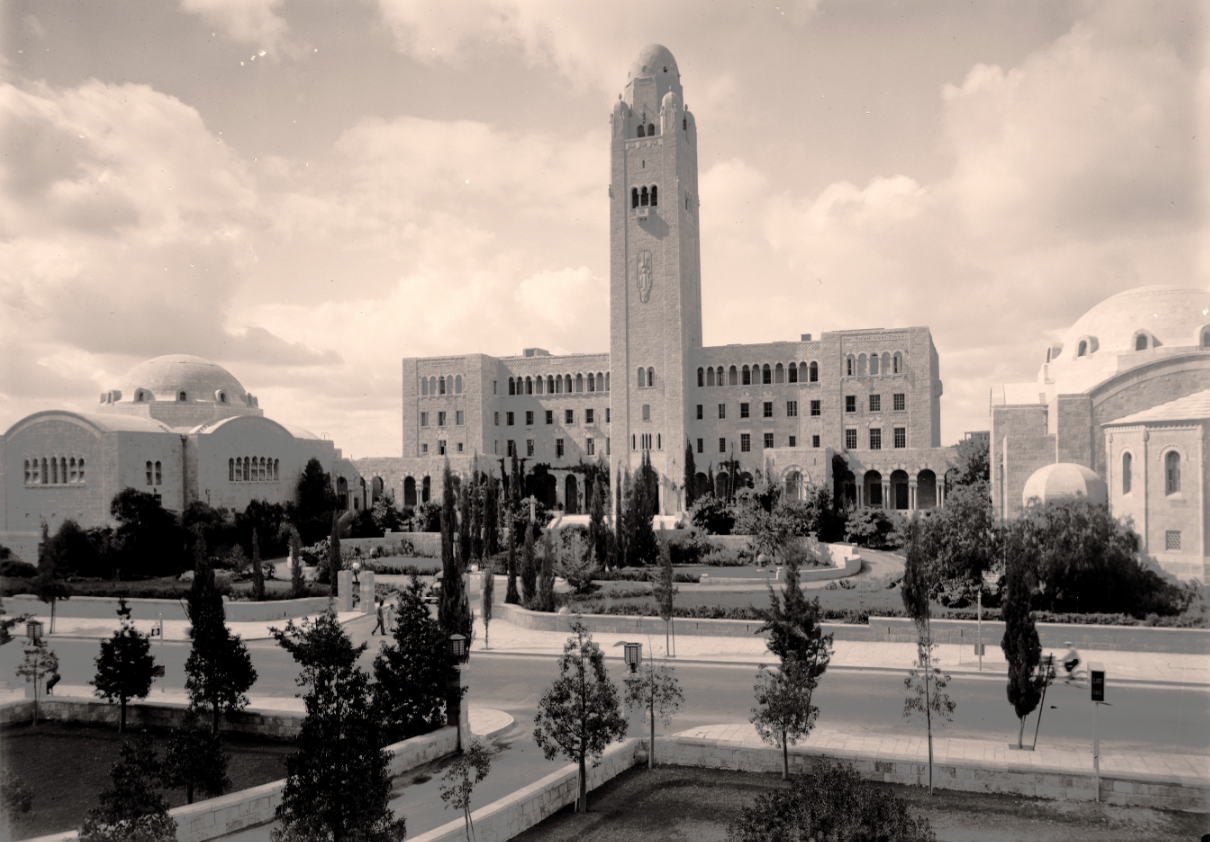 The YMCA building in the 1930s
During the British Mandate, the YMCA became an important cultural, athletic and social center for British, Arab and Jewish residents. Its meeting halls also acquired a diplomatic and political function. The Anglo-American Committee of Inquiry, which investigated Jewish immigration and conditions in Mandatory Palestine, operated from the building in 1946. The United Nations Special Committee on Palestine held numerous meetings and hearings there in 1947 before recommending the termination of the Mandate and, by majority vote, partition. The YMCA did not formulate these proposals; it served as a large, internationally recognized and nominally neutral venue.
During the 1948 war, the building was successively used by the International Committee of the Red Cross, the United Nations mediation mission headed by Count Folke Bernadotte, and American consular personnel. It was returned to the YMCA in April 1949. Following the Six-Day War in 1967, the United Nations Truce Supervision Organization temporarily established its headquarters there. These episodes represented the institution’s most direct governmental and diplomatic functions.
In subsequent decades, the YMCA continued operating as a nonprofit community institution. Its stadium, used by Beitar Jerusalem and Hapoel Jerusalem, remained the city’s principal soccer venue until the opening of Teddy Stadium in 1991. The YMCA established the Erna D. Leir Peace Preschool in 1981; it developed into an integrated, bilingual program that teaches Jewish, Muslim, and Christian children about each community’s traditions. Later initiatives included the Jerusalem Youth Chorus, founded in 2012 to combine Israeli-Palestinian dialogue with music, and Moderate Voices for Progress, which provided young adults with training in conflict transformation and community building. A renovated sports center opened in 2017.
In the contemporary era, the complex contains the Three Arches Hotel, an auditorium, conference facilities, educational programs, and a sports center used by Jewish and Arab residents. Its political significance is principally civic rather than governmental: it promotes interfaith contact, coexistence and dialogue without serving as an official negotiating body.
The Jerusalem International YMCA should not be confused with the East Jerusalem YMCA, a separate Palestinian organization established in a refugee camp near Jericho in 1948 and headquartered in East Jerusalem since 1952. The latter operates its own social-service programs and political advocacy initiatives, although both institutions belong to the wider international YMCA movement.
Sources: “History and Architecture,” Jerusalem International YMCA.
Idah Audeh, “The YMCA: A Cherished Social Hub during the Mandate Years,” Jerusalem Story, (September 5, 2023).
“Supplemental Information Concerning the United Nations Truce Supervision Organization,” United Nations, (June 14, 1967).
Shanna Fuld, “YMCA Jerusalem: A Diamond of Diversity in a Contentious City,” Jerusalem Post, (September 30, 2023).
“Erna D. Leir Peace Kindergarten - YMCA,” Jerusalem Foundation.
“Jerusalem International YMCA,” Alliance for Middle East Peace.
“History,” East Jerusalem YMCA.
Photos: Personal collection of Mitchell Bard.
American Colony (Jerusalem), photo dept. photographer, via Wikimedia Commons.