Christians of the early Byzantine period built monasteries,
churches and shrines in Galilee and on the shores of the Sea of Galilee to
commemorate the ministry of Jesus and the miracles ascribed to him. Tabgha
– an Arabic corruption of the Greek name Heptapegon (Seven Springs) –
is the traditional site of the Miracle of the Multiplication of the Loaves
and the Fishes. (Matt. 14: 13-21)
It is situated in a narrow, fertile valley on the northern shore of the
lake, watered by several springs.
The earliest building at Tabgha was a small chapel (18 x
9.6 m) from the 4th century CE; only a part of its foundations was
uncovered. This was probably the shrine described by the pilgrim Egeria at
the end of the 4th century:
In the same place (not far from Capernaum) facing the
Sea of Galilee is a well watered land in which lush grasses grow, with
numerous trees and palms. Nearby are seven springs which provide abundant
water. In this fruitful garden Jesus fed five thousand people with five
loaves of bread and two fish. The stone upon which the Master placed the
bread became an altar. The many pilgrims to the site broke off pieces of it
as a cure for their ailments.
During the fifth century, a large monastery and a church
decorated with exquisite mosaic floors was built on the site. The complex
covered an area of 56 x 33 m. and included courtyards and many
rooms used as workshops for a variety of crafts as well as for lodging for
the monks and the many pilgrims who came to visit.
The monastery and church at Tabgha were destroyed in the
7th century, probably during the Arab conquest of the country, and buried
beneath a thick layer of silt and stones. In the 1980s, after excavation,
the church was restored to its Byzantine form, incorporating portions of
the original mosaics.
The basilical church is divided by two rows of columns
into a central hall and two aisles. In the eastern wall is a semi-circular
apse and on either side of it, rooms for the officiating clergy. A raised
platform in front of the apse is surrounded by a chancel screen and at its
center an untrimmed stone was preserved under the altar. This is the
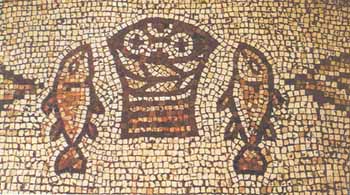
traditional site of the miracle of the Loaves and the Fishes. A mosaic
depicting a basket of bread flanked by two fish was found behind the
untrimmed stone. It was added in the 6th century, suggesting the stone’s
significance; today it is displayed in front of the altar.
The church is famous for its mosaics, unique among
Byzantine churches in the Holy Land. Most of the floor of the church is
decorated in ordinary geometric patterns. The unique principal mosaics
decorate both sides of the transept. Particularly well preserved is the one
on the left of the platform, a square carpet (6.5 x 5.5 m.) bordered with a
band of lotus flowers.
The carpets are decorated with multi-colored
representations of the local flora and fauna, interspersed with several
buildings. The flowers and animals, mainly birds, are so naturalistically
depicted that it is possible to identify lotus, oleander and lily; also
duck, snipe, heron, goose, dove, swan, cormorant, flamingo and stork. A
tower marked with bands bearing Greek letters, probably for measuring the
water level of the Sea of Galilee (known as a "nilometer"), is
also depicted.
The church belongs to the Order of the Benedictines and
is open to visitors. Today, as in Byzantine times, large numbers of
pilgrims come to visit.
The main structure of the Tabgha, the Church of the Multiplication of the Loaves and Fishes, was severely damaged in an arson attack on June 18, 2015. The famous mosaic floors of the church were unharmed, although the surrounding structures including shops suffered significant damage. The attack was treated as a hate crime in Israel perpetuated by Jewish extremists after a Hebrew prayer verse forbidding the worship of idols was found spray-painted on the church walls.