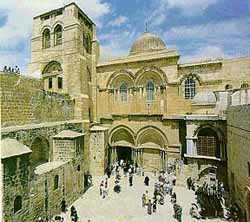
The Church of the Holy Sepulcher
"At the place where Jesus was crucified, there was a garden, and in the garden, a new tomb... and since the tomb was nearby, they laid Jesus there." ( John 19:41-42)
Constantine the Great was the first Roman emperor to adopt Christianity;
he made it the official religion of the Roman
Empire. Constantine started
his career as ruler of the western region of the Roman empire (306); after
defeating his three co-regents, he emerged in 324 as sole emperor,
retaining unrivaled power until his death in 337. He made Byzantium his
capital, rebuilt it and renamed it Constantinople.
In 326, involved with Christianity and ecclesiastical controversy, he
called a meeting of bishops of all the parts of the empire, including
Macarius, Bishop of Aelia Capitolina, as Jerusalem was still called. The
emperor's mother, Queen Helena, who had converted to Christianity, was
much impressed with the bishop's tale of the sad neglect of the sites
hallowed by the life and death of Jesus and, with her son's blessings,
authority and funds, left to visit the Holy Land.
In Jerusalem she identified the place of crucifixion (the rock held to be
Golgotha) and the nearby tomb known as Anastasis (Greek for resurrection).
The emperor decided to build an appropriate shrine on the site, which was then
occupied by a 2nd-century Roman temple and shrine that,
according to local tradition, was built over the place where Jesus had been
crucified and buried. When the Roman buildings were demolished, a series of
rock-cut tombs was discovered. One of the tombs was identified as that of Joseph
of Armithea. The sloping bedrock was cut away around this tomb, leaving a
freestanding shell (at the site of the present Edicule).
Little remains of the original Byzantine structure, which
was burned and looted by the Persians in 614, partially rebuilt by the Patriarch
Modestos, damaged by earthquake in 808, and destroyed in 1009 by order of the
Fatamid Caliph al-Hakim. A portion was rebuilt again by the Byzantine Emperor
Constantine Monomachus in 1048, but most of the present building is the result
of 12th-century (1144 to be precise) Crusader reconstruction as well as later
renovations (the most recent work of restoration and preservation began in 1959
and is not yet completed) made after several centuries during which the church
fell into disrepair. The present building encompasses half the area of the
original Byzantine church, and only the Rotunda replicates the approximate shape
and design of the 4th-century original.
During the late 1950's representatives from the 3 religious groups officiating the remains of the area agreed to begin a wide excavation and restoration project of the church grounds. After the Catholic, Greek, and Armenian religious officials came to this agreement, the complete archaeological exploration of the Church of the Holy Sepulchre was undertaken begining in 1960. Overseeing the operation was Franciscan archaeologist Father Virgilio Corbo. Corbo was meticulous and the exploration was carried out in a step-by-step manner, with every event and finding properly recorded for release to the public. The findings of the excavation were published in 1982 in Italian, and were titled "The Church of the Holy Sepulchre in Jerusalem: archaeological aspects from its origins to the Crusader period". Corbo has been praised for his work during this excavation and the presentation of such a large amount of information in a succinct and "bare-bones" style.
Based on the written sources, architectural evidence and discoveries made
during the survey, the plan of the large complex of the original church
was reconstructed. It was composed of four distinct elements: The entrance
from the main street - the Cardo - (today the main market street of the
Old City), led to the courtyard (the eastern atrium); from there to the
basilica (the martyrion); to an inner atrium (the Holy Garden); and to the
westernmost building, the rotunda (the anastasis) with the sepulcher.
The first papal visit to the church site happened in January 1964 when Pope Paul VI spoke before the empty tomb. The next papal visit occurred in the year 2,000 when Pope John Paul II made history by visiting the church twice in the same day. Following the 6 Day War in 1967, the church came under Israeli control, where it has remained since. Armed Israeli gaurds stand watch at the entrances to the church grounds, keeping order and supervising the influx of pilgrims.
Chronological list of underground research projects and excavations at the church:
- 1960: exploration and ground floor excavation in the area of the Patriarch’s residence and the garden
- 1963: excavation of the Chapel of St. Mary
- 1963-64: excavation of water/sewage systems between the Patriarch’s residence to the north and the Parvis (entrance courtyard) in front of the church on the south; discovery of the Hadrian underground
- 1965: excavation in the rock-cut Chapel of the Finding of the Cross. Partial excavation of the Parvis facing the south facade of the church
- 1966-67: excavation in the area south of the transept of the Anastasis (Armenian Divan)
- 1968: excavation in the area north of the transept of the Anastasis (now the Altar of Mary Magdalene)
- 1969: excavation in the gallery of the Anastasis and above the the Arches of the Virgin
- 1969-70: excavations in the eastern area of the Triportico (now the Katholikon)
- 1974: excavation of the trenches to the south of the Edicule in the Anastasis
- 1970-1980: extremely long excavation, carried out in segments, behind the apse of the Chapel of St. Helena in the area of the Martyrium
The Present-Day Courtyard
This courtyard, outside the present-day Church of the Holy Sepulcher, is
partly supported by a large, vaulted cistern. The northern wall of this
cistern is very impressive, consisting of large blocks with dressed
margins, still standing several meters high. It has been suggested that
this early wall served as the retaining wall of the second century
Hadrianic raised platform (podium). This appears to support Eusebius'
statement that the Temple of Venus, which Hadrian erected on the site of
Jesus' tomb, stood here before the original church was built.
The Basilica
Early masonry below the catholicon of the Crusader period was exposed
during the excavations. This made possible the reconstruction of the
original design of the 4th century basilica. The position of the two
central rows of columns in the basilica (out of the four rows) may be
determined by the remains of their foundations, which can be seen along
the northern and southern sides of the chapel of St. Helena. In a small
underground space north of this chapel, a massive foundation wall of the
early basilica was exposed. On a large, smoothed stone which was
incorporated in this wall, a pilgrim to the original church left a drawing
of a merchant ship and the Latin inscription: "O Lord, we shall go."
Beneath the apse of the present-day catholicon, part of the apse that
marked the western end of the original church was exposed. Eusebius
described this apse as being surrounded by twelve columns, symbolizing the
twelve apostles.
The Rotunda and Sepulcher
The most important element of the complex is the rotunda which contains
the sepulcher itself. The sepulcher stands in an elaborate structure
within the rotunda, surrounded by columns supporting an ornamented, domed
roof.
Some masonry remains were revealed below the floor and around the
perimeter of the rotunda. Wherever bedrock was exposed, there were
indications of stone-quarrying in earlier periods. The quarrying operation
lowered the surface level around the sepulcher, which thus stood well
above its surroundings. An architectural survey of the outer wall of the
rotunda - 35 m. in diameter and in some sections preserved to a height of
10 m. - shows that it maintains its original 4th century shape. The
sepulcher itself is
surrounded by a circle of twelve columns - groups of three columns between
four pairs of square piers. It is possible that the columns for the 4th
century rotunda were removed from their original location on the facade of
the Roman temple. Renovation of the piers exposed evidence that the
columns had originally been much higher and that the Crusaders cut them in
half for use in the 12th century rotunda.
The renovation of the Church of the Holy Sepulcher is still in progress,
but after generations of neglect, the building has already regained most
of its former beauty.
Politics of the Church
Since the Crusades, the precincts and fabric of the
Church of the Holy Sepulcher have come into the possession of three major
denominations: the Greek Orthodox, the Armenian Orthodox and the (Latin) Roman
Catholic. Other communities - the Egyptian Coptic Orthodox, the Ethiopian
Orthodox and the Syrian Orthodox - also possess certain rights and small
properties in or about the building. The rights and privileges of all of these
communities are protected by the Status Quo of the Holy Places (1852), as
guaranteed in Article LXII of the Treaty of Berlin (1878).
Following the earthquake in 1927, the prevailing
political authority (as provided by the Status Quo) had to intervene in order to
carry out emergency structural repairs. Such intervention has not been necessary
since 1959, when the three principal communities established a Common Technical
Bureau.
Some issues, however, remain unresolved; one of these
is the continuing dispute between the Coptic and Ethiopian Orthodox concerning
ownership rights in the Chapel of the Ethiopians (on the roof of the Chapel of
St. Helena). Since the dispute began, the government (as the prevailing
political authority) has chosen not to intervene, in the hope that the two
communities will resolve the matter between themselves.
Sources: Israeli Foreign Ministry. Photo
courtesy of Israeli Government Press Office and Ministry
of Tourism, all
rights reserved to Albatross/Itamar Greenberg and to the Israeli Ministry
of Tourism. Holy Sepulchre Website
|