One
of the most important trade routes in the Middle East during ancient
times was the Via Maris. The Latin term, meaning "Way of the Sea"
is referenced in Isaiah 8:23 in the Tanakh (in the Christian
Old Testament it is Isaiah 9:1) as "Derech HaYam" or "Way
of the Sea." The Latin name comes from the Vulgate, the Latin translation
of the New Testament, in Matthew
4:15. The term "Via Maris" comes from the Romans and hence the terminology "Via Maris" tends to be an exclusively
Christian reference to the Sea Road. Other names for the Derech HaYam/Via
Maris include "Coastal Road" and "Way of the Philistines."
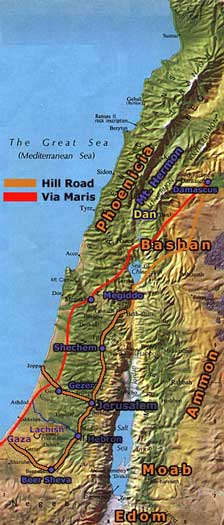
From the coast to Damascus, the route is called the Trunk Road. The
Via Maris travels and is also known as the International Coastal Highway.
The International Coastal Highway is still a major route in modern-day
Israel.
The "Way of the Sea" is one of three major
trade routes in ancient Israel – the
Via Maris, Ridge Route, and the King's Highway. It is situated from
the Galilee to the North to Samaria to the South, running through the Jezreel Valley.
At the Philistine Plain, the Way broke into two branches, one on the
coast and one inland (through the Jezreel Valley, the Sea
of Galilee, and Dan), which unites at Megiddo ("Armageddon"). The location of Megiddo vis a vis the Via
Maris explains why Megiddo was a very important route for travel and
trading city in ancient Israel. The Way of the Sea connected the major
routes from the Fertile Cresent to Mesopotamia (from Egypt to modern
day Iran, Iraq, Turkey and Syria).The road was the main thoroughfare
running north/south from the Sinai along the coastal plain through the
Jezreel valley, Beit Shean and on until Damascus
Throughout the centuries, once the Jews were exiled
from Israel, the Jezreel Valley, in which the route traverses, became
abandoned and the area became an infested swamp. Zionist pioneers, however, drained the swamp from the time of the first land
acquisition in 1921, and the valley has been transformed into a fertile,
fruit-bearing plain.