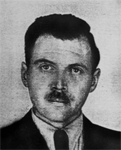
Much debate is focused on Josef Mengele, the
infamous doctor of Auschwitz,
commonly referred to as the "Angel of Death". His most
famous role was played out as the selector on the platform at
Auschwitz whose whims sent one either to the gas
chambers or to the camp.
Mengele was the eldest son of a well-to-do
Bavarian industrialist whose family still runs an implement factory
in Germany. He is described by those who knew him in his youth as a
serious student and a young person with obvious intelligence and
ambition.
In 1931 at the age of 20 he joined the Stahlhelm (Steel
Helmet); he joined the SA in 1923 and upon being accepted into the Nazi party, he
applied for membership in the SS.
In his university studies, Mengele chose to
concentrate on physical anthropology and genetics, eventually working
under Otmar von Verschuer at the Frankfurt University Institute of
Hereditary Biology and Racial Hygiene.
Prior to his arrival at Auschwitz, he had
published three articles, one of which was his dissertation in the
Anthropological Institute at the University of Munich and which was
entitled "Racial-Morphological Examination of the Anterior
Portion of the Lower Jaw in Four Racial Groups". His medical
dissertation, published in 1938, was entitled "Genealogical
Studies in the Cases of Cleft Lip-Jaw-Palate". This was a
predecessor to his work on genetic abnormalities and indirectly on
twins which was to take place at Auschwitz. The third article -
entitled "Hereditary Transmission of Fistulae Auris" was
published in conjunction with research done on the Lenz-Vershuer
principle of "irregular, dominant hereditary process". It
appeared in 1928 that Mengele was destined for the academia.
However, the route to a professorship was
interrupted in 1938-1939 when he began his military experience by
serving six months with a specially trained mountain light-infantry
regiment. In 1940 he was placed in the reserve medical corps,
following which he served three years with a Waffen SS unit.
It was during this time period he was wounded and declared medically
unfit for combat. Because he had acquitted himself brilliantly in the
face of the enemy during the Eastern Campaign, he was promoted to the
rank of captain.
According to Dr.
Hans Münch, a colleague of Mengele’s at Auschwitz, Mengele
arrived at the camp in a somewhat privileged position - he had been
wounded on the Eastern front and was the recipient of an array of
medals, including the Iron Cross. It would also appear that Mengele
selected Auschwitz because of the opportunities there to continue his
research. According to one source (Lifton, The
Nazi Doctors) he did receive financial support for his work
there. Support for continuing his professional career in genetics
appears in another book, And the Violins Stopped Playing written by Alexander Ramati, where it is reported that a Professor
Epstein told a comrade that "he (Mengele) has offered to prolong
my life. Mind you, not to save it, just to prolong it, if I prepare a
scientific paper on noma, which he would publish under his own name.
It will keep him away from the front, he said, and justify his
presence here as a scientist."
No
doubt exists that Mengele was a very active commandant of the
Auschwitz camp after he arrived there in 1943. Most doctors who have
testified and prisoners who have testified have indicated he was
ubiquitous, and, indeed, stories do exist of his selection activities
and of his medical involvement. The Frankfurt Court which indicted
him charged him with "hideous crimes" committed alone or
with others "willfully and with bloodlust". Included in the
crimes against humanity were selections, lethal injections,
shootings, beatings and other forms of deliberate killing. He was
religiously involved in all aspects, but particularly in the twins
experiments, according to members of C.A.N.D.L.E.S., twins who
survived the experiments.
Descriptions of him indicate he was a very
attractive man, always well groomed and very aristocratic in stature.
Prisoners remember him as the man with the riding crop in his right
hand and as the man who wore immaculately clean uniforms and boots
with a high polish.
Of all the aspects of Mengele’s character which
are of interest, his research on twins is the focus of the
C.A.N.D.L.E.S. organization. Beginning in 1944, twins were selected
and placed in special barracks. Some of those selected - like Irene
and Rene Guttman were already in the camp. Others like Eva and Miriam
Mozes were selected on the ramp and placed in the twins barracks. It
is believed that Mengele had worked with twins under Verschuer at the
University of Frankfurt. Auschwitz offered Mengele unlimited number
of specimens where twins could be studied at random. According to Dr.
Miklos Nyiszli in Auschwitz:
A Doctor's Eyewitness Account, twins provided the perfect
experimental specimens. One could serve as a control while the other
endured the experiments.
It was well known in the camp that when a twin went to the infirmary,
(s)he never returned and that the other twin disappeared too (Eva
Mozes Kor, Echoes
from Auschwitz). Nyiszli describes the shots of phenol which
were used to kill the second twin.
Twins in the experiments describe three days of
what must have been psychological examination and three days of
laboratory experiments. "Three times a week we were marched to
Auschwitz to a big brick building, sort of like a big gymnasium. They
would keep us there for about six or eight hours at a time - most of
the days. ..... We would have to sit naked in the large room where we
first entered, and people in white jackets would observe us and write
down notes. They also would study every part of our bodies. They
would photograph, measure our heads and arms and bodies, and compare
the measurements of one twin to another. The process seemed to go on
and on." (Echoes from Auschwitz, Kor).
The laboratory experiments were described by Kor
as follows: "Most of the time, they would take blood from one
arm, and they gave us shots in the other." (Echoes
from Auschwitz, Kor).
Experiments did not end with the death of the
twins. Dissection of the corpses for final medical analysis is well
documented by Nyiszli and by Lifton.
Being a twin, regardless of age, meant survival in
1944. Some 3,000 children (or about 1,500 sets of twins) were
selected for the experiments. They were not terrified of him but
rather they were often intimidated by some of what he did. They knew
of his temper and his passion for his work. Yet, they were also aware
of his role in their survival. "Being on Mengele’s list was
better than being on no list," said Eva Mozes Kor.
Of the children involved, only about 200 were
alive when the camp was liberated by the Soviet Army on January 27,
1945. These are the children shown so often in documentaries walking
between the wires of the Auschwitz I camp. Today they reside all over
the world and they seek information on what was done to them. Their
files have never been located and what was done to them remains a
mystery today.
To these twins, what happened to Mengele remains a
mystery as well. While the bones found in 1985 have been identified
by the authorities in charge of the investigation as Mengele’s,
many do not believe that he is dead.