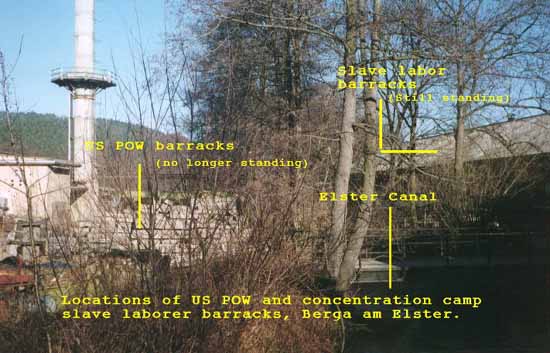
Conditions in Stalag IX-B were the worst of any POW camp, but they were recalled fondly by the Americans transferred to Berga, who discovered the main purpose for their imprisonment was to serve as slave laborers. Each day, the men trudged approximately two miles through the snow to a mountainside in which 17 mine shafts were dug 100 feet apart. There, under the direction of brutal civilian overseers, the Americans were required to help the Nazis build an underground armament factory. The men worked in shafts as deep as 150 feet that were so dusty it was impossible to see more than a few feet in front of you. The Germans would blast the slate loose with dynamite and then, before the dust settled, the prisoners would go down to break up the rock so that it could be shoveled into mining cars. The men did what they could to sustain each other. "You kept each other warm at night by huddling together," said Daniel Steckler. "We maintained each other's welfare by sharing body heat, by sharing the paper-thin blankets that were given to us, by sharing the soup, by sharing the bread, by sharing everything." "Surviving was all you thought about,"
Winfield Rosenberg agreed. "You were so worn down you didn't
even think of all the death that was around you." He said his
faith sustained him. "I knew I'd go to heaven if I died, because
I was already in hell." On April 4, 1945, the commandant received an order to evacuate Berga. This was but the end of a chapter of the Americans' ordeal. The human skeletons who had survived found no cause to rejoice in this flight from hell. They were leaving friends behind and returning to the unknown. Fewer than 300 men survived the 50 days they had spent in Berga. Over the next two-and-a-half weeks, before the survivors were liberated, at least 36 more GIs died on a march to avoid the approaching Allied armies. The fatality rate in Berga, including the march, was the highest of any camp where American POWs were held—nearly 20 percent—and the 70-73 men who were killed represented approximately six percent of all Americans who perished as POWs during World War II. This was not the only case where American Jewish soldiers were segregated or otherwise mistreated, but it was the most dramatic. The U.S. Government never publicly acknowledged they were mistreated. In fact, one survivor was told he should go to a psychiatrist. Officials at the VA told him he had made up the whole story. Two of the Nazis responsible for the murder and mistreatment of American soldiers were tried. They were found guilty and sentenced to hang, despite the fact that none of the survivors testified at the trial . Later, the case was reviewed and the verdicts upheld. Nevertheless, five years after being tried, the Chief of the War Crimes Branch unilaterally decided the evidence was insufficient to sustain the charges and commuted the sentences to time served — about six years. Sources: � Mitchell G. Bard. Forgotten
Victims: The Abandonment of Americans in Hitler's Camps..
CO: Westview Press, 1994. |