Ford Motor Company & the Third Reich
by Simon Reich
Introduction
In 1990 I published a book entitled The Fruits of Fascism (Cornell
University Press), in which I attempted to offer a compelling and novel
thesis. I argued that the different degrees of success enjoyed by the Ford
Motor Company's subsidiaries in Britain and Germany in the 1930s and 1940s
were heavily influenced by the policies of each country's government. Ford in
Britain was then favored by a government seeking to encourage foreign
investment in order to boost the nation's floundering manufacturing base. The
British government often gave Ford preferential treatment, especially when it
vocally complained about the allocation of scarce wartime resources. Such
allocations enabled it to support its widespread claim that it acted as the
"arsenal of democracy" for the wartime Allies.
 Ford-Werke plant, Cologne (1947)
 |
In contrast, Ford had continual problems in Germany, fueled by
growing German nationalism, from the time it established a presence in that
country in 1925. (The German subsidiary was renamed Fordwerke in 1939.) For
instance, when a new plant was constructed in Cologne in 1931, the business
faced immediate criticism because its owners were Ford's American company and
British subsidiary, most of its directors were foreigners, and its exports
were limited. The advent of a Nazi government in 1933 only exacerbated Ford's
problems with nationalist sentiments in Germany. The company became alarmed by
slumping sales and responded by trying to placate the Nazi government. But it
remained an isolated and marginalized business, despite Hitler's personal
admiration for the anti-Semitism of Henry Ford (1863-1947) and the mass
production techniques Ford had made famous. Ford's foreign ownership meant
that it lacked the "authenticity" and "credibility" of
other businesses; furthermore, Ford lacked the size and, thus, the strategic
importance of Opel, General Motors' German subsidiary. Ford was treated by the
Nazi government as "the producer of last resort" when it came to the
allocation of government contracts. Ford's very existence in Nazi Germany was
constantly threatened by low sales to a nationalistic general public and by
the fear that the government would confiscate its facilities.
If my account was correct, then how could an article appear in
the Washington Post (March 5, 1998) declaring that Ford had been the
"arsenal of fascism" rather than the "arsenal of
democracy" -- thus staining an appellation that the company had sported
with pride? Why, five decades after the end of the Second World War, is Ford
(like GM) accused in a lawsuit (initiated on March 4, 1998) of using slave
labor in its German subsidiary in the Forties, and of gaining "unjust
enrichments"? To what extent -- if any -- and in what ways, did Ford in
Germany cooperate with the Nazi regime? And, if it did, what motivated such
cooperation: racist ideology, or a concern for corporate profitability?
The Ford Motor Company responded
to the lawsuit and the attendant public scrutiny
by appointing an investigative team made up
of historians and professional archivists
whose mandate, company officials promised,
was to provide an uncompromising assessment
and report about Fordwerke's wartime activities. I was
hired, in November 1998, as a consultant;
my role was to assist investigators in locating
relevant material, to read and comment upon
the research team's findings, and to provide
"correctives" to any misplaced assumptions
that the team adopted. I continue to work
in that role at this point, acting as an informed
and critical outsider rather than as an intrinsic
member of Ford's efforts. While my participation
probably raises questions about my objectivity
(and, more generally, about whether scholars
should be paid for such work; in my own case
the general suggestion of a lucrative windfall
has been grossly exaggerated), I believe that
the skills and knowledge that scholars supply
to companies that find themselves in Ford's
position are truly indispensable for clarifying
past conduct.
Some aspects of Fordwerke's policies are largely undisputed:
slave laborers were used at its Cologne plant between 1941 and 1945. So were
prisoners of war and foreign laborers, mostly from Eastern Europe and the
Soviet Union, but also from France and Italy. But I had written about this a
decade ago and discussions then about my findings had not progressed beyond
academic circles. So why has this issue been raised now?
 French forced workers at Ford-Werke plant in Cologne (1943)
 |
I believe that financial considerations are not the motives of
the former slave laborers who are now suing Ford. For many, I suspect,
justice, recognition and accountability are of paramount importance. I am
sympathetic to them because my own parents were Viennese refugees, and many
members of my family were victims of the Holocaust -- including three of my
four grandparents. I am also sympathetic because the former slave laborers are
paying a price in coming forward now, because, by doing so, they have to
relive the painful horror of their wartime treatment in public.
Faced with the passage of time, many of the individuals suing
Ford -- and many men and women who endured similar adversity -- feel that
history has given insufficient legitimacy and credence to their suffering. For
them, the lawsuit is an instrument to ensure that their past afflictions will
be recognized and acknowledged both in the history books and by the general
public. The timing of the suit is not accidental. It is occurring in a
particular period: many aging Holocaust survivors are dying, and Germany's
political leadership and citizenry appear determined to relegate the Holocaust
to the margins of their society's consciousness. Germans label this process
"normalization." The Germans want to exchange physical monuments for
the uncomfortable and protracted public discourse that they must currently
endure. The cost of the latter on the national psyche is enormous and
debilitating.
 French forced workers at Ford-Werke plant in Cologne (1943)
 |
The victims of slave labor -- at Fordwerke and elsewhere --
reject the notion that Germany should enshrine its past inhumanity in
monuments and thereby consign it to convenient boxes, rather than relive it on
a daily basis. The lawsuit represents a way of keeping the past alive. The
money, for the victims, becomes an indicator of their degree of vindication,
and a way in which the behavior of the perpetrators can be made explicit. But
financial rewards are not, I suspect, the overriding consideration of those
pursuing the lawsuit. [Editors' note: In September 1999, a Federal District
Court judge in New Jersey dismissed a class action lawsuit against Ford
concerning Fordwerke's use of forced and slave labor. The New York Times of
September 14, 1999 stated that the judge concluded (in the Times's words)
that "the issues . . . concerned international treaties between nations
and foreign policy and were thus in the realm of the executive branch."
An appeal is expected.]
In the Thirties, the management of Ford's German subsidiary
felt so threatened by the hostility of the Third Reich that it consistently
sought to ingratiate itself with the Nazi regime in order to keep the company
viable. The importance of the government's good will for the Ford subsidiary's
prosperity cannot be overstated; it became apparent as early as 1936, when
Ford in Germany was denied certification as a national producer, a
certification necessary if it was to be awarded government contracts for
manufacturing. With such contracts steadily growing to constitute the vast
majority of all sales in Germany, denial of certification was a grievous blow
to the subsidiary. The subsidiary's management knew that the road to economic
salvation meant submitting to government demands, even if that meant lying to
or limiting contact with the Dearborn head office.
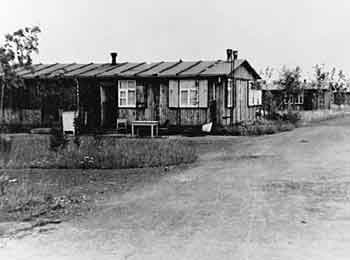 Postwar
photograph of forced labor barracks
at Ford-Werke plant in Cologne.
Postwar
photograph of forced labor barracks
at Ford-Werke plant in Cologne. |
The company's managers at Cologne also feared for their own
individual jobs -- feared that they would be replaced by political appointees.
So Cologne's management attempted to assuage the Nazis' concerns about their
and the company's loyalties in at least three ways. First, they introduced a
racial criterion for the hiring of management staff. Foreign and Jewish
members of the subsidiary's management board were removed, despite,
interestingly, the strenuous opposition of Henry Ford. The first time that a
Jewish manager was fired (in 1936), Ford himself was successfully able to
reverse the decision. Subsequently, however (certainly by 1940), control of
the subsidiary effectively shifted to Cologne, and Ford was unable to thwart
further dismissals.
Second, the Nazi government, before the war, wanted to
increase the import of raw materials that were in short supply. It also
limited Ford's access to the raw materials it did have (generally, rubber).
The company attempted to appease the Nazi regime and relieve its own shortages
by importing as much scarce raw material as possible.
Finally, the Nazi government desperately needed foreign
currency to fund the purchase of raw materials. Ford in Germany responded by
attempting to maximize the export of its finished products -- negotiating with
U.S. and U.K. Ford in order to secure profitable export markets. The company's
German managers hoped that a favorable outcome for these ventures would mean
that the German government would look upon their business more positively and
that success would save their jobs.
All of these efforts failed to prevent the government from
appointing executives at Ford in Germany who were more attuned and indebted to
the Nazi Party than loyal to the company. A few members of management did
retain their positions through the period spanning the Weimar Republic, the
early Nazi period, and the war. But the power within the company clearly
shifted from pre-Nazi or non-Nazi managers to government-sponsored managers,
most pointedly Robert Schmidt, who was selected and appointed by the Nazi
government. (Because, I believe, Fordwerke's senior management did not contest
Schmidt's appointment, the company was officially allowed to remain under
nominal American ownership.)
Who was in charge of Fordwerke when it used slave labor (it is
now generally accepted that this occurred between 1941 and 1945)? By the time
that slave labor was introduced, Fordwerke was clearly under the direct
control of the Nazi government, though administered through the company
headquarters in Cologne (albeit by Robert Schmidt). The meetings of the board
of directors had already been suspended, and didn't resume until after the
war. Although the American parent company desperately sought to retain
control of their German assets, they failed to do so. Fordwerke became an
instrument of the Nazi state. I certainly found no evidence that American
management ever sanctioned the use of slave labor or that it even knew of the use of slave labor.
Did Fordwerke materially benefit from its economic activities
in Nazi Germany, particularly during the period when it employed slave
laborers? Here, the arcane nature of old German accounting systems, the
contestable methods by which destruction of property is calculated, and the
means by which the losses of trade due to war are determined, all become
vitally important.
I personally have found little evidence that Fordwerke made
money during the war. The net-profit figures I have uncovered reveal that
while modest profits were recorded during the first few years of the conflict,
these were wiped out by enormous losses during the last three years. Fordwerke
received compensation from the Nazi government for bombing damage in 1941. But
a 1942 German law denied such recompense to businesses whose majority
ownership was held by foreigners from hostile nations. In 1967, the Foreign
Claims Settlement Commission of the U.S. Congress made a compensatory award to
Ford for its German subsidiary's wartime losses after extended negotiation and
deliberation. The gross figure was almost $1.1 million. This award for damages
stands as important evidence of Ford's claim that it did not enjoy
"unjust enrichment" in Germany during the war, and that it did not
profit, even inadvertently, from the use of slave labor. Even if this figure
is only approximately accurate, when coupled with the profit and loss figures
I located, it appears that there were no Fordwerke "profits" to
share with the victims of slave labor.
The current management of the Ford Motor Company has publicly
asserted that its investigation of Ford's relationship with the Third Reich
will be comprehensive, honest and objective. I will be the first to criticize
the company publicly if it suppresses information and does not address the
claims of those who were slave laborers for Fordwerke. I have seen no evidence
to date that Ford has been behaving irresponsibly in its scrutiny of its
conduct in the Thirties and Forties.
Sources: Dimensions: A Journal of Holocaust Studies, Volume 13, Number 2. Copyright Anti-Defamation League(ADL). All rights reserved. Reprinted with permission; Photographs courtesy of Ford Motor Company
Simon Reich is a professor at the Graduate School of Public
and International Affairs at the University of Pittsburgh. He is the author of The
Fruits of Fascism: Postwar Prosperity in Historical Perspective (Cornell
University Press, 1990) and the coauthor of The German Predicament: Memory
and Power in the New Europe (Cornell University Press, 1997).
|