Marty Glickman
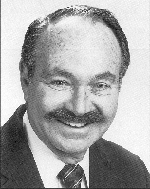
(1917 - 2001)
Perhaps the most famous of all modern Olympics was
the 1936 "Nazi
Olympics," held in Berlin. Hitler tried to use the Olympic Games to demonstrate the superiority of
"pure Aryans" over nations that allowed Jews, blacks and
other "mongrel" races to compete on their behalf. Jesse
Owens and other African-American track stars embarrassed the Fuhrer
by winning most of the gold medals in the men’s track sprints and
relays, defeating their German rivals easily.
What is less remembered about the Nazi Olympics is
the saga of two American Jewish sprinters, Marty Glickman and Sam
Stoller. The 18-year-old Glickman had been a track and football star
at Syracuse University, while Stoller competed for the University of
Michigan. The two young men made the U. S. Olympic squad as members
of the 400-yard relay team. Glickman and Stoller traveled to Germany
and prepared diligently for the relay race. The day before the race,
however, with little explanation, the U.S. track team coaches
replaced Glickman and Stoller with two other runners, Jesse Owens and
Ralph Metcalfe, both African-Americans.
By Glickman’s own account, the last-minute
switch was a straightforward case of anti-Semitism. Avery Brundage,
chairman of the United States Olympic Committee, was an enthusiastic
supporter of Hitler’s regime and denied that the Nazis followed
anti-Semitic policies. Brundage and assistant U. S. Olympic track
coach Dean Cromwell were members of America First, an isolationist
political movement that attracted American Nazi sympathizers.
Additionally, Cromwell coached two of the other Olympic sprinters,
Foy Draper and Frank Wyckoff, at the University of Southern
California and openly favored those two over Glickman and Stoller.
Glickman’s
suspicions about the fairness of the relay team selection process
began at the American Olympic team trials in New York, when he was
told he placed fifth of the seven runners competing in the sprint
finals. Finish-line photography was not yet in use at that time, but
films of the race seem to indicate that Glickman actually finished
third behind Owens and Metcalfe. The judges, apparently under
pressure from Cromwell, placed Glickman fifth behind Draper and
Wyckoff. As a result, Glickman was not one of the three sprinters
entered in the 100-yard dash, a premiere Olympic event. Instead,
Glickman and Stoller traveled to Berlin as part of the 400-yard relay
team, each scheduled to run a 100-yard leg of the race.
As an 18 year old, Glickman was grateful to be
going to the Olympics, even if he felt that he’d been robbed of his
chance at a medal in the 100 yard dash. There was an effort made by
some American Jewish organizations to convince the U. S. Olympic
committee to boycott the Nazi Olympics, but Brundage prevailed and
the team went. Glickman, like most American Jews, thought that the
anti-Semitism he might encounter in Berlin would be no worse than
what he faced growing up in Brooklyn. Like many Americans, Glickman
had no inkling of the horrific fate awaiting German Jewry in the
years after 1936.
Once in Germany, Glickman, Stoller, Draper and
Wyckoff spent two weeks practicing as the 400-yard relay team. They
were confident of victory. Then, on the day of the qualifying trials,
head track coach Lawson Robertson told Glickman and Stoller that
Owens and Metcalfe would be replacing them. To his credit, Owens
protested to Robertson that Glickman and Stoller deserved to run.
Glickman pointed out to Robertson that any combination of the seven
teammates could win the race by 15 yards. Robertson replied that he
would enter his four best athletes in the relay and that, in his
judgment, Owens and Metcalfe were better than Stoller and Glickman.
Robertson said his goal was winning, nothing more. Glickman turned to
assistant coach Cromwell and said, "Coach, you know that Sam and
I are the only two Jews on the track team. If we don’t run
there’s bound to be a lot of criticism back home." Cromwell
retorted, "We’ll take our chances." The American team won
in record time as Glickman watched from the stands.
Glickman (who remained a close friend of Owens until
the latter’s death) and Stoller were devastated by the decision.
Stoller, age 21, announced his retirement from track competition but
later recanted. Later that year he won an NCAA sprint championship.
Glickman returned to college and became a football All-American. After
a brief professional career in football and basketball, Glickman went
on to become a distinguished sportscaster, best known as the voice of
the New York Knicks and football Giants. Despite his later success,
the disillusionment of the 1936 Olympics always loomed large for Glickman.
He recalled returning to Olympic Stadium in Berlin in 1985 as part of
a tribute to Jesse Owens. Glickman was surprised by his reactions. He
told historian Peter Levine:
As I walked into the stadium, I began to get so angry.
I began to get so mad. It shocked the hell out of me that this thing
of forty-nine years ago could still evoke this anger… I was cussing...I
was really amazed at myself, at this feeling of anger. Not about the
German Nazis …that was a given. But the anger at Avery Brundage and
Dean Cromwell for not allowing an eighteen-year-old kid to compete
in the Olympic Games just because he was Jewish.
Glickman had been in Syracuse one year when he made the 1936 Olympic
team. After he graduated in 1939, he joined the radio station WHN and
by 1943 was its sports director. A long, distinguished broadcasting
career followed. When the New York Knickerbockers were formed in 1946,
Glickman was their radio announcer. Later, he was the National Basketball
Association's first announcer for TV. He was the voice of the football
Giants, for 23 years, of the Knicks for 21, Yonkers Raceway for 12,
the New York Jets for 11. Glickman did pre- and postgame shows for the
Dodgers and Yankees for 22 years; he broadcast track meets, wrestling
matches, roller derbies and rodeos, even a marbles tournament. NBC employed
him as a critic and teacher of its sports announcers. In 1988 WCBS hired
him for his second tour as the Jets' play-by-play announcer on radio.
It was from that position that Glickman quietly said goodbye to his
last audience in December 1992, at age 74.
In 1996, his autobiography, The
Fastest Kid on the Block, was published.
Glickman underwent heart bypass surgery Dec. 14. He
died of complications from the operation on January 3, 2001. He was
83.
Sources: American
Jewish Historical Society (AJHS), New
York Times, (January 4, 2001). |