Hebrew Alphabet (Aleph-Bet)
Hebrew (and Yiddish) uses
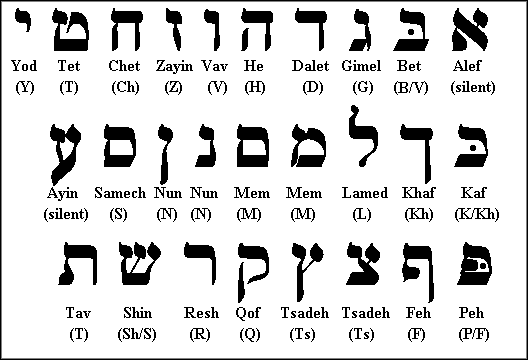
a different alphabet than English. The picture to the right illustrates the
Hebrew alphabet, in Hebrew alphabetical order. Note that Hebrew is written
from right to left, rather than left to right as in English, so Alef is the first letter of the Hebrew alphabet and Tav is the last.
The Hebrew alphabet is often called the "alef-bet,"
because of its first two letters.
Note that there are two versions of some letters. Kaf, Mem, Nun, Peh and Tzadeh all are written
differently when they appear at the end of a word than when they appear
in the beginning or middle of the word. The version used at the end
of a word is referred to as Final Kaf, Final Mem, etc.
The version of the letter on the left is the final version. In all cases
except Final Mem, the final version has a long tail.
- Vowels and Points
- Styles of Writing
- Transliteration
- Numerical Values of Words
Vowels
and Points
Like most early Semitic alphabetic writing systems,
the alef-bet has no vowels. People who are fluent in the language
do not need vowels to read Hebrew, and most things written in Hebrew
in Israel are written without vowels.
However, as Hebrew literacy declined, particularly
after the Romans expelled the Jews
from Israel, the Rabbis realized
the need for aids to pronunciation, so they developed a system of dots
and dashes known as nikkudim (points). These dots and dashes
are written above or below the letter, in ways that do not alter the
spacing of the line. Text containing these markings is referred to as
"pointed" text.
Most
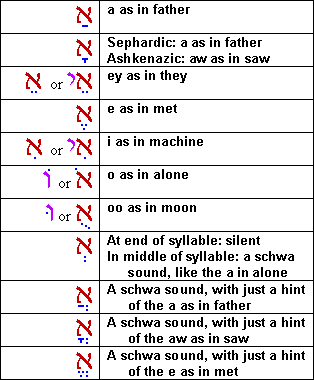
nikkudim are used to indicate vowels. The table at right illustrates
the vowel points, along with their pronunciations. Pronunciations are
approximate; I have heard quite a bit of variation in vowel pronunciation.
Vowel points are shown in blue. The letter Alef, shown in red, is
used to illustrate the position of the points relative to the consonents.
The letters shown in purple are technically consonents and would appear
in unpointed texts, but they function as vowels in this context.
There are a few other nikkudim, illustrated and explained below.
The dot that appears in the center of some letters is called a dagesh.
With most letters, the dagesh does not significantly affect pronunciation.
With the letters Bet, Kaf and Pe, however, the dagesh indicates that
the letter should be pronounced with its hard sound (the first sound)
rather than the soft sound (the second sound). In Ashkenazic pronunciation (the pronunciation used by many Orthodox
Jews and by older Jews), Tav also has a soft sound, and is pronounced
as an "s" when it does not have a dagesh.
Vav, usually a consonant pronounced as a "v," is sometimes a vowel
pronounced "oo" (u) or "oh" (o). When it is pronounced "oo", pointed
texts have a dagesh. When it is pronounced "oh", pointed texts have
a dot on top.
Shin is pronounced "sh" when it has a dot over the right branch and
"s" when it has a dot over the left branch.

The style of writing illustrated above is the one most commonly seen in Hebrew
books. It is referred to as block print or sometimes Assyrian text.
For sacred documents, such as Torah scrolls or the scrolls inside tefillin and mezuzot, there is a
special writing style with "crowns" (crows-foot-like marks coming up
from the upper points) on many of the letters. This style of writing
is known as STA"M (an abbreviation for "Sifrei Torah, Tefillin and Mezuzot,"
which is where you will see that style of writing.
There is another style used for handwriting, in
much the same way that cursive is used for the Roman (English) alphabet.
This modern script style is illustrated below, at right.
Another style is used in certain texts to distinguish
the body of the text from commentary upon the text. This style is known
as Rashi Script, in honor of Rashi,
the greatest commentator on the Torah and the Talmud.
The alefbet at left is an example of Rashi Script
The process of writing Hebrew words in the Roman
(English) alphabet is known as transliteration.
Transliteration is
more an art than a science, and opinions on the correct way to
transliterate words vary widely. This is why the Jewish festival
of lights (in Hebrew, Chet-Nun-Kaf-Heh) is spelled
Chanukah, Channukkah, Hanuka, and many other interesting ways. Each
spelling has a legitimate phonetic and orthographic basis; none is
right or wrong.
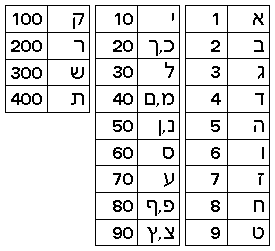 Each
letter in the alefbet has a numerical value. These values can be used
to write numbers, as the Romans used some of their letters (I, V, X,
L, C, M) to represent numbers. Alef through Yod have the values 1 through
10. Yod through Qof have the values 10 through 100, counting by 10s.
Qof through Tav have the values 100 through 400, counting by 100s. Final
letters have the same value as their non-final counterparts. Each
letter in the alefbet has a numerical value. These values can be used
to write numbers, as the Romans used some of their letters (I, V, X,
L, C, M) to represent numbers. Alef through Yod have the values 1 through
10. Yod through Qof have the values 10 through 100, counting by 10s.
Qof through Tav have the values 100 through 400, counting by 100s. Final
letters have the same value as their non-final counterparts.
The number 11 would be rendered Yod-Alef, the number 12 would be Yod-Bet,
the number 21 would be Kaf-Alef, the word Torah (Tav-Vav-Resh-He) has
the numerical value 611, etc. The only significant oddity in this pattern
is the number 15, which if rendered as 10+5 would be a name
of G-d, so it is normally written Tet-Vav (9+6). The order of the
letters is irrelevant to their value; letters are simply added to determine
the total numerical value. The number 11 could be written as Yod-Alef,
Alef-Yod, Heh-Vav, Dalet-Dalet-Gimmel or many other combinations of
letters.
Because of this system of assigning numerical values to letters, every
word has a numerical value. There is an entire discipline of Jewish mysticism known as Gematria
that is devoted to finding hidden meanings in the numerical values of
words. For example, the number 18 is very significant, because it is
the numerical value of the word Chai, meaning life. Donations to Jewish
charities are routinely made in denominations of 18 for that reason.
Sources: Judaism 101
|