Annex I
(September 28, 1995)
Protocol Concerning Redeployment and Security Agents
INDEX
- ARTICLE I - Redeployment of Israeli Military Forces and Transfer of
Responsibility
- ARTICLE II- Security Policy for the Prevention of Terrorism and Violence
- ARTICLE III - Coordination and Cooperation in Mutual Security Matters
- ARTICLE IV - The Palestinian Police
- ARTICLE V - Security Arrangements in the West Bank
- ARTICLE VI - Security Arrangements in the Gaza Strip
- ARTICLE VII - Guidelines for Hebron
- ARTICLE VIII - Passages
- ARTICLE IX - Movement Into, Within and Outside the West Bank and the Gaza
Strip
- ARTICLE X - Safe Passage
- ARTICLE XI - Rules of Conduct in Mutual Security Matters
- ARTICLE XII - Security Arrangements Concerning Planning, Building and
Zoning
- ARTICLE XIII - Security of the Airspace
- ARTICLE XIV - Security along the Coastline to the Sea of Gaza
- APPENDIX 1 - Redeployment of Israeli Military Forces
- APPENDIX 2 - Deployment of Palestinian Policemen
- APPENDIX 3 - Palestinian Civil Police Stations and Posts
- APPENDIX 4 - Jewish Holy Sites
- APPENDIX 5 - Protocol Regarding Arrangements with Respect to Passages
- APPENDIX 6 - List of Hamlets included in Area B
Redeployment of Israeli Military Forces and Transfer of Responsibility
First Phase of Redeployment
- The first phase of Israeli military forces redeployment will cover
populated areas in the West Bank - cities, towns, villages, refugee camps
and hamlets, as shown on map No. 1. This redeployment will be effected in
stages, as set out in the schedule attached to this Annex as Appendix 1,
and will be completed prior to the eve of the Palestinian elections, i.e.,
22 days before the day of elections.
- In order to maintain the territorial integrity of the West Bank and the
Gaza Strip as a single territorial unit, and to promote their economic
growth and the demographic and geographical links between them, both sides
shall implement the provisions of this Annex, while respecting and
preserving without obstacles, normal and smooth movement of people,
vehicles, and goods within the West Bank, and between the West Bank and
the Gaza Strip.
- Any security arrangements and measures which become effective
commensurate with the redeployment of the Israeli military forces will not
undermine the importance of, nor will they prejudice, the Palestinian
development programs and projects for reconstruction and development of
the West Bank and the Gaza Strip, as well as the moral and physical
dignity of the Palestinian people in the West Bank and the Gaza Strip.
- After the inauguration of the Palestinian Council, the unity and
integrity of the Palestinian people in the West Bank and the Gaza Strip
shall be maintained and respected. All Palestinian people residing in the
West Bank and the Gaza Strip will be accountable to the Palestinian
Council only, unless otherwise provided in this Agreement.
- After the inauguration of the Palestinian Council, the Israeli Civil
Administration will be dissolved and the Israeli military government will
be withdrawn.
- The Council will assume powers and responsibilities for civil affairs,
as well as for public order and internal security, according to this
Agreement.
- Nothing in this Article shall derogate from Israel's security powers
and responsibilities in accordance with this Agreement.
- There will be a period of 10 days prior to each stage of redeployment
according to paragraph 1 of this Article, during which the commanders of
the Israeli military forces will acquaint the respective commanders of the
different echelons of the Palestinian Police with the respective area and
its specific problems.
Further Redeployments After the Inauguration of the Palestinian Council
- The further redeployments of Israeli military forces to specified
military locations will be gradually implemented in accordance with the
DOP in three phases, each to take place after an interval of six months,
after the inauguration of the Council, to be completed within 18 months
from the date of the inauguration of the Council.
- The specified military locations referred to in Article X, paragraph 2
of this Agreement will be determined in the further redeployment phases
within the specified time-frame ending not later than 18 months from the
date of the inauguration of the Council, and will be negotiated in the
permanent status negotiations.
Security Policy for the Prevention of Terrorism and Violence
- The Palestinian security policy as defined by the Palestinian Authority
on March 9, 1995, for the Gaza Strip and the Jericho Area will also be
implemented in the rest of the West Bank in areas which come under
Palestinian security responsibility as follows:
- The Palestinian Police is the only Palestinian security authority.
- The Palestinian Police will act systematically against all
expressions of violence and terror.
- The Council will issue permits in order to legalize the possession
and carrying of arms by civilians. Any illegal arms will be confiscated by
the Palestinian Police.
- The Palestinian Police will arrest and prosecute individuals who are
suspected of perpetrating acts of violence and terror.
- Both sides will, in accordance with this Agreement, act to ensure the
immediate, efficient and effective handling of any incident involving a
threat or act of terrorism, violence or incitement, whether committed by
Palestinians or Israelis. To this end, they will cooperate in the exchange
of information and coordinate policies and activities. Each side shall
immediately and effectively respond to the occurrence or anticipated
occurrence of an act of terrorism, violence or incitement and shall take
all necessary measures to prevent such an occurrence.
- With a view to implementing the above, each side shall, in accordance
with the provisions of this Agreement, carry out the following functions
in the areas under its security responsibility:
- protect all residents of, and all other persons present in, these
areas;
- actively prevent incitement to violence, including violence against
the other side or persons under the authority of the other side;
- apprehend, investigate and prosecute perpetrators and all other
persons directly or indirectly involved in acts of terrorism, violence and
incitement; and
- prevent and deal with any attempt to cause damage or harm to
infrastructure serving the other side, including, inter alia, roads,
water, electricity, telecommunications and sewage infrastructure.
- Both sides undertake to deal with the issue of persons who are present
in the areas in violation of this Agreement, and to take further measures
in accordance with procedures to be determined by the JSC.
Coordination and Cooperation In Mutual Security Matters
- Joint Security Coordination and Cooperation Committee
- A Joint Coordination and Cooperation Committee for Mutual Security
Purposes is hereby established (hereinafter "the JSC"). It will deal with
all security matters of mutual concern regarding this Agreement in the
West Bank and the Gaza Strip.
- The JSC shall:
- recommend security policy guidelines for the approval of the Joint
Israeli-Palestinian Liaison Committee and implement such approved
guidelines;
- deal with security issues raised by either side;
- provide the proper channel for exchanging information between the
two sides, needed to solve security problems;
- provide directives for the Joint Regional Security Committees
(hereinafter "the RSCs") and for the Joint District Coordination
Offices (hereinafter "the DCOs"); and
- subject to the provisions of Article XXVI (the Joint Israeli
Palestinian Liaison Committee), and Article XXI (Settlement of
Differences and Disputes) of this Agreement, deal with alleged
violations, as well as differences relating to the application or
implementation of the security arrangements set out in this Agreement.
- The JSC shall comprise between five and seven members from each
side. Decisions of the JSC will be reached by agreement between the two
sides.
- The JSC shall determine its rules of procedure. Meetings of the JSC
shall be held every two weeks. In the event that either side requests a
special meeting, it shall be convened within forty-eight (48) hours.
- Unless otherwise agreed by the two sides, JSC meetings will be
hosted by each of the sides alternately.
- The JSC shall develop a comprehensive plan to ensure full
coordination between the Israeli military forces and the Palestinian
Police during the interim period, starting from the date of signing of
this Agreement.
- This coordination will be implemented through the RSCs in the West
Bank and the Gaza Strip and the DCOs, as mentioned hereafter in this
Article.
- The comprehensive plan will include a plan for the West Bank,
consisting of arrangements for the entry of the Palestinian Police and the
introduction of police arms, ammunition and equipment, as well as
arrangements intended to facilitate the smooth transfer of authority and
assumption by the Palestinian Police of its security responsibilities
according to this Agreement.
- The above mentioned comprehensive plan will also include two
regional plans that will include arrangements for coordination and
cooperation in security matters after the redeployment is effected.
- These regional plans will be reviewed every six months, or whenever
needed, by the JSC and the relevant RSC.
- Regional Security Committees
- Two RSCs are hereby established, one in the West Bank and one in the
Gaza Strip.
- Each RSC shall:
- guide the relevant DCOs with security policy guidelines;
- deal with security issues referred to it by the DCOs;
- ensure proper transfer of information and guidelines to the
relevant DCOs; and
- propose to the JSC security policy guidelines, and forward issues
to the JSC for determination.
- The Israeli side and the Palestinian side in the RSCs will maintain
contact with each other as follows:
- regular as well as special meetings shall be held between the
commander of the Israeli military forces and the commander of the
Palestinian Police in the West Bank or in the Gaza Strip, as
appropriate; and
- each side will operate a regional security coordination office 24
hours a day, with direct and constant communication links between the
two sides.
- The RSCs shall commence operations immediately upon the signing of
this Agreement and shall determine by agreement their mode of procedure.
- District Coordination Offices
- DCOs are hereby established in the West Bank and the Gaza Strip, as
set out below.
- The location of the DCOs is as detailed on attached map Nos. 2 and
4.
- Each DCO shall:
- monitor and manage matters requiring coordination as determined by
the JSC and/or the relevant RSC, according to the policy and guidelines
established by either of them;
- monitor and manage all matters of a joint nature within the
respective district of the DCO, including the coordination of
activities by one side which may affect the other side;
- review, investigate and report to the relevant RSC on the overall
situation within the DCO's respective district, with special regard to
specific events, incidents and activities occurring in the district;
and
- direct the Joint Patrols and the Joint Mobile Units set up in
accordance with paragraphs 4 and 5 of this Article and Article V,
paragraph 2.c below, operating within the DCO's respective district.
- The DCOs shall commence operations immediately upon the signing of
this Agreement.
- Each DCO will be continuously staffed by a team of up to six
officers from each side, comprising one commander and five duty officers.
- The DCOs will be operated jointly by both sides, 24 hours a day. At
least one duty officer from each side, as well as the necessary number of
assistants, will be present during each eight-hour shift.
- With a view to preventing friction and to enabling the two sides to
deal with possible incidents, both sides shall ensure that the relevant
DCO shall immediately be notified of any of the following events:
- routine, scheduled or unscheduled activity or deployment by the
Israeli military forces or the Palestinian Police that directly affects
the security responsibility of the other side. This includes activity
or deployment in the proximity of Settlements or Palestinian populated
localities, as the case may be;
- events that pose a threat to public order;
- activities that disturb the regular flow of traffic on the main
roads, including roadblocks and roadworks;
- incidents involving both Israelis and Palestinians, such as road
accidents, rescue of casualties or persons in mortal danger, engagement
steps or any incident in which a weapon is used;
- a terrorist action of any kind and from any source;
- infiltrations between the West Bank, the Gaza Strip and Israel; and
- all cases in which Israelis are hospitalized in the West Bank or
the Gaza Strip, or in which Palestinians of the West Bank or the Gaza
Strip are hospitalized in Israel.
- Each DCO shall notify the relevant Israeli and Palestinian
headquarters, as well as the Joint Patrols operating in the relevant
district, of the occurrence of any of the events listed in subparagraph g.
above.
- The JSC may modify the content of the list of events included in
subparagraph g. above.
- Any event involving injury to Israelis, at any location within the
West Bank or the Gaza Strip, shall be immediately reported to Israel
through the relevant DCO. Israel may employ any means necessary for the
evacuation and treatment of such injured persons, and will coordinate such
activity through the relevant DCO.
- The DCOs shall be equipped with the necessary means of communication
to enable direct and immediate contact both with the Joint Patrols and the
relevant RSC, as well as with each side's respective police or military
district headquarters.
- Joint Patrols
- The mission of the Joint Patrols shall be to assist in ensuring
free, unimpeded and secure movement along the roads designated in Articles
V and VI below.
- Unless the JSC decides otherwise, the Joint Patrols shall each be
composed of two 4-wheel drive vehicles, one Palestinian and one Israeli,
equipped with adequate communications systems. The vehicles shall be
marked so as to be easily distinguishable from all other vehicles in the
area. In each vehicle there will be an officer and three uniformed and
armed guards.
- The Joint Patrols will patrol 24 hours a day, in vehicles along
their routes of activity, or as directed by the relevant DCO. Joint
Patrols on the Lateral Roads in the Gaza Strip will also patrol on foot
along their routes of activity, and on the adjacent sides of the roads
upon which the security of the traffic along these roads is dependent.
- On roads under Israeli security responsibility, the Israeli vehicle
will be the leading vehicle. On roads under Palestinian security
responsibility, the Palestinian vehicle will be the leading vehicle. The
Joint Patrols will be under the direction of the relevant DCO.
- The Joint Patrols shall continuously monitor movement within their
area of operation and shall act to prevent and deal with incidents that
may threaten or endanger persons using the roads. They shall report any
such incident or threat thereof, as well as any action taken, to the
relevant DCO, and to the respective Israeli military and Palestinian
police district headquarters.
- On reaching the scene of an incident, the Joint Patrol will take all
measures necessary to deal with the incident, and provide assistance as
necessary. The Joint Patrol shall verify that the appropriate measures
have been taken and report to the relevant DCO accordingly.
- Joint Mobile Units
- The mission of the Joint Mobile Units (hereinafter "JMUs") is to
provide rapid response in the event of incidents and emergency situations,
in order to ensure free, unimpeded and secure movement along their
designated routes of activity, or in their areas of activity.
- The composition of the JMUs will be similar to that of the Joint
Patrols.
- In areas under Israeli security responsibility, the Israeli vehicle
will be the leading vehicle. In areas under Palestinian security
responsibility, the Palestinian vehicle will be the leading vehicle. The
Joint Mobile Units will be under the direction of the relevant DCO.
- The functions of the JMUs are:
- to monitor movement along their designated routes of activity from
their stationary locations, from where they may patrol on agreed roads
as directed by the relevant DCO, in which case their duties will be the
same as those of the Joint Patrols;
- in the event of an incident involving both Israelis and
Palestinians, to reach the site of the incident in order to provide
assistance and to investigate; and
- any other function determined by the relevant DCO.
- Joint Liaison Bureaus
Joint Liaison Bureaus established by the two sides shall operate at
crossing points and at terminals as described in Articles V, VI and VIII
of this Annex.
- Other joint activities may be agreed upon in the JSC and/or the RSC.
The Palestinian Police
- Duties and Functions
As detailed in the Palestinian law, the Palestinian Police shall carry out
its duties and functions in accordance with this Agreement as follows:
- maintaining internal security and public order;
- protecting the public and all other persons present in the areas, as
well as protecting their property, and acting to provide a feeling of
security, safety and stability;
- adopting all measures necessary for preventing crime in accordance
with the law;
- protecting public installations, infrastructure and places of
special importance;
- preventing acts of harassment and retribution;
- combating terrorism and violence, and preventing incitement to
violence; and
- performing any other normal police functions.
- Structure and Composition
- The Palestinian Police shall consist of one integral unit under the
control of the Council. It shall be composed of six branches:
- Civil Police (Al Shurta);
- Public Security;
- Preventive Security;
- Amn Al Ri'asah;
- Intelligence; and
- Emergency Services and Rescue (Al Difa'a Al Madani).
In each district, all members of the six Police branches shall be
subordinate to one central command.
- The Palestinian Police shall have a Palestinian Coastal Police unit
in accordance with Article XIV of this Annex.
- Deployment
- During the interim period, the total number of policemen of the
Palestinian Police in all its branches in the West Bank and the Gaza Strip
will be no more than 30,000 out of which up to 12,000 policemen may be
deployed in the West Bank and up to 18,000 policemen in the Gaza Strip.
These numbers may be changed by agreement, if necessary. The Palestinian
side will notify Israel of the names of the policemen recruited to the
Palestinian Police in the Gaza Strip.
- In accordance with the stages of the first phase of redeployment of
Israeli forces in the West Bank, up to 6,000 of the above-mentioned 12,000
Palestinian policemen may be deployed in the West Bank in Area A and, as
set out in paragraph 3 of Article V, in Area B, as detailed in Appendix 2.
- The remaining 6,000 Palestinian policemen will be deployed in the
West Bank according to the phases of the further redeployments or as
needed, as agreed upon by the two Parties.
- The Palestinian Police shall be deployed as shown on attached map
Nos. 3 and 5.
- Recruitment
- The Palestinian Police shall consist of policemen recruited locally,
and from abroad (from among individuals holding Jordanian passports or
Palestinian documents issued by Egypt). The number of Palestinian recruits
from abroad shall not exceed 5,000 in the West Bank and 7,000 in the Gaza
Strip.
- Palestinian policemen coming from abroad may be accompanied by their
spouse and sons and daughters.
- The Palestinian policemen to be recruited pursuant to this Agreement
shall be West Bank or Gaza Strip residents who will be duly trained to
perform police functions.
- The Palestinian side will notify Israel of any candidate for
recruitment to the Palestinian Police. Should Israel object to the
recruitment of any such candidate, that person shall not be recruited.
- In accordance with Palestinian law, the employment of policemen who
have been convicted of serious crimes, or have been found to be actively
involved in terrorist activities subsequent to their recruitment, will be
immediately terminated, and their weapons and police identification
documentation will be confiscated.
- Arms, Ammunition and Equipment
- In the West Bank and the Gaza Strip, uniformed policemen may carry
arms, and plainclothes policemen on duty who hold special accreditation
may carry personal light arms concealed in their clothing, in accordance
with this Agreement.
- In the West Bank, the Palestinian Police will possess the following
arms and equipment:
- up to 4,000 rifles;
- up to 4,000 pistols;
- up to 120 machine guns of 0.3" or 0.5" caliber; and
- up to 15 light, unarmed riot vehicles of a type to be agreed on
between the two sides in the JSC.
- In the Gaza Strip, the Palestinian Police will possess the following
arms and equipment:
- 7,000 light personal weapons;
- up to 120 machine guns of 0.3" or 0.5" caliber; and
- up to 45 wheeled armored vehicles of a type to be agreed on between
the two sides, and of which 22 will be deployed in protecting Council
installations. The use of wheeled armored vehicles in the Security
Perimeter, on the Lateral Roads and on their adjacent sides, or in the
vicinity of the Settlements shall be approved through the relevant DCO.
Movement of such vehicles along the central North-South road (Road No.
4) in the Gaza Strip may take place only after providing notification
to the relevant DCO.
- The number of arms or items of equipment specified in subparagraphs
b. and c. above may be increased subject to the agreement of both sides.
- The Palestinian Police will maintain an updated register of all
weapons held by its personnel.
- The Palestinian Police may possess communication systems, subject to
Article 36 of Annex III, and distinctive uniforms, identification badges
and vehicle markings.
- In this Annex, the term "weapons" includes firearms, ammunition and
explosives of all kinds.
- Introduction of Arms, Equipment and Foreign Assistance
All foreign contributions and other forms of assistance to the
Palestinian Police must comply with the provisions of this Agreement.
- The introduction of arms, ammunition or equipment intended for the
Palestinian Police shall be coordinated through the JSC, in accordance
with its established practices.
- Movement
Movement of Palestinian policemen between the West Bank and the Gaza Strip
will be conducted in accordance with Article X of this Annex.
Security Arrangements in the West Bank
- Coordination and Cooperation in the West Bank
As shown on map No. 4, eight DCOs will function in the West Bank, as
follows:
- a DCO for the Jenin District, located at the Quabatiya junction or
in its vicinity;
- a DCO for the Nablus District, located at the Hawara Junction;
- a DCO for the Tulkarm District, located at the Kaddouri Junction;
- a DCO for the Qalqilya District located at Tsufin Junction;
- a DCO for the Ramallah District, located at the Beth El junction or
in its vicinity;
- a DCO for the Bethlehem District, located at the Panorama Hills in
Beit Jala;
- a DCO for the Hebron District, located at Har Manoakh (Jabal
Manoah); and
- a DCO for the Jericho District, located at Vered Yericho, that will
maintain a subordinate Joint Liaison Bureau in the Allenby Terminal.
- Area A
- The Council will, upon completion of the redeployment of Israeli
military forces in each district, as set out in Appendix 1 to this Annex,
assume the powers and responsibilities for internal security and public
order in Area A in that district.
- Jewish Holy Sites
- The following provisions will apply with respect to the security
arrangements in Jewish holy sites in Area A which are listed in
Appendix 4 to this Annex:
- While the protection of these sites, as well as of persons
visiting them, will be under the responsibility of the Palestinian
Police, a JMU shall function in the vicinity of, and on the access
routes to, each such site, as directed by the relevant DCO.
- The functions of each such JMU shall be as follows:
- to ensure free, unimpeded and secure access to the relevant
Jewish holy site; and
- to ensure the peaceful use of such site, to prevent any
potential instances of disorder and to respond to any incident.
- Given the Jewish religious nature of such sites, Israeli
plainclothes guards may be present inside such sites.
- The present situation and the existing religious practices shall be
preserved.
- Clarifications Concerning the Jericho Area
With regard to the definition of the Jericho Area, as delineated on
attached map No. 1, it is hereby clarified that Route No. 90 crossing Auja
from South to North and the East-West road connecting Route No. 90 with
Yitav, and their adjacent sides, shall remain under Israeli authority. For
the purpose of this Article, the width of each such road and its adjacent
sides, as shown on attached map No. 1, shall extend at least 12 meters on
each side measured from its center.
- Areas B and C
- There will be a complete redeployment of Israeli military forces
from Area B. Israel will transfer to the Council and the Council will
assume responsibility for public order for Palestinians. Israel shall have
the overriding responsibility for security for the purpose of protecting
Israelis and confronting the threat of terrorism.
- In Area B the Palestinian Police shall assume the responsibility for
public order for Palestinians and shall be deployed in order to
accommodate the Palestinian needs and requirements in the following
manner:
- The Palestinian Police shall establish 25 police stations and posts
in towns, villages, and other places listed in Appendix 3 to this Annex
and as delineated on map No. 3. The West Bank RSC may agree on the
establishment of additional police stations and posts, if required.
- The Palestinian Police shall be responsible for handling public
order incidents in which only Palestinians are involved.
- The Palestinian Police shall operate freely in populated places
where police stations and posts are located, as set out in paragraph
b.1 above.
- While the movement of uniformed Palestinian policemen in Area B
outside places where there is a Palestinian police station or post will
be carried out after coordination and confirmation through the relevant
DCO, three months after the completion of redeployment from Area B, the
DCOs may decide that movement of Palestinian policemen from the police
stations in Area B to Palestinian towns and villages in Area B on roads
that are used only by Palestinian traffic will take place after
notifying the DCO.
- The coordination of such planned movement prior to confirmation
through the relevant DCO shall include a scheduled plan, including the
number of policemen, as well as the type and number of weapons and
vehicles intended to take part. It shall also include details of
arrangements for ensuring continued coordination through appropriate
communication links, the exact schedule of movement to the area of the
planned operation, including the destination and routes thereto, its
proposed duration and the schedule for returning to the police station
or post.
The Israeli side of the DCO will provide the Palestinian side with its
response, following a request for movement of policemen in accordance
with this paragraph, in normal or routine cases within one day and in
emergency cases no later than 2 hours.
- The Palestinian Police and the Israeli military forces will conduct
joint security activities on the main roads as set out in this Annex.
- The Palestinian Police will notify the West Bank RSC of the names
of the policemen, number plates of police vehicles and serial numbers
of weapons, with respect to each police station and post in Area B.
- Further redeployments from Area C and transfer of internal security
responsibility to the Palestinian Police in Areas B and C will be
carried out in three phases, each to take place after an interval of
six months, to be completed 18 months after the inauguration of the
Council, except for the issues of permanent status negotiations and of
Israel's overriding responsibility for Israelis and borders.
- The procedures detailed in this paragraph will be reviewed within
six months of the completion of the first phase of redeployment.
- Joint Patrols
- Joint Patrols led by a Palestinian vehicle will operate on each of
the following roads, as indicated on map No. 4:
- the main north-south road (Route No. 60) crossing Jenin;
- the main north-south road (Route No. 60) crossing Nablus;
- the main east-west road (Route Nos. 57 and 60) crossing Nablus;
- the main east-west road (Route No. 57) crossing Tulkarm;
- the main east-west road (Route No. 55) crossing Qalqilya;
- the main north-south road (Route No. 60) crossing Ramallah;
- the main east-west road (Route No. 3) crossing Ramallah;
- the main north-south road (Route No. 60) crossing Bethlehem;
- the main east-west road crossing Beit Jala;
- the main north-south road (Route No. 90) crossing Jericho; and
- the road crossing Hebron, as set out in Article VII (Hebron)
below.
The operation of the Joint Patrols in each district will commence after
the completion of redeployment in the respective district.
- Each DCO will be allowed, within 3 months after the completion of
the redeployment in its respective district, to decide that Joint Patrols
will function on roads crossing areas A, B and C.
- Joint Mobile Units
- Joint Mobile Units will operate in Area B and will be led by the
Israeli vehicle. Three such Joint Mobile Units shall be located at each
DCO. One will be on alert 24 hours a day. The two others will perform
missions as directed by the DCO during daylight hours.
- A Joint Mobile Unit shall be located at the Auja junction being the
intersection of Route No. 90 and the road to Yitav. This unit shall be led
by the Israeli vehicle, and may be directed by the DCO to deal with
certain incidents occurring on the road between Auja and Jericho in which
Palestinians are involved.
- A Joint Mobile Unit shall be located at the Nahal Elisha junction on
the road from Jericho to the Mousa Allami project.
- Movement of Palestinian Policemen
Movement of uniformed policemen, whether armed or unarmed, as well as
armed on-duty plainclothes policemen, in Area C, will be confirmed and
coordinated by the relevant DCO. Movement of such policemen between Area A
and Area B will be approved by the relevant DCO.
- Rachel's Tomb
- Without derogating from Palestinian security responsibility in the
City of Bethlehem, the two sides hereby agree on the following security
arrangements regarding Rachel's Tomb which will be considered a special
case during the Interim Period:
- While the Tomb, as well as the main road leading from Jerusalem to
the Tomb, as indicated on map No.1, will be under the security
responsibility of Israel, the free movement of Palestinians on the main
road will continue.
- For the purpose of protecting the Tomb, three Israeli guard posts
may be located in the Tomb, the roof of the Waqf building, and the
parking lot.
- The present situation and existing practices in the Tomb shall be
preserved.
Security Arrangements in the Gaza Strip
- The Delimiting Line
- For the purpose of the present Agreement only, and without prejudice
to the permanent status negotiations on borders, the line delimiting the
northern and eastern edge of the Gaza Strip follows the fence on the
ground, as delineated on attached map No. 2 by an unbroken green line
(hereinafter "the Delimiting Line") and shall have no other effect.
- The Parties reaffirm that, as long as this Agreement is in force,
the security fence between the Gaza Strip and Israel shall remain in
place, and that the line demarcated by the fence shall be authoritative
only for the purpose of this Agreement.
- Security Perimeter
- There will be a security perimeter along the Delimiting Line inside
the Gaza Strip as delineated on attached map No. 2 by a broken green line
(hereinafter "the Security Perimeter").
- In accordance with the provisions of this Agreement, the Palestinian
Police will be responsible for security in the Security Perimeter.
- The Palestinian Police will enforce special security measures aimed
at preventing infiltrations across the Delimiting Line or the introduction
into the Security Perimeter of any arms, ammunition or related equipment,
except for the arms, ammunitions or equipment of the Palestinian Police,
authorized through the relevant DCO.
- Activities of the Palestinian Police inside the Security Perimeter
will be coordinated through the relevant DCO. Security activities in
Israel in the vicinity of the Delimiting Line that directly affect the
other side will be coordinated with the Palestinian Police through the
relevant DCO.
- The Israeli Settlements
- In accordance with the DOP, during the interim period, the Gush
Katif and Erez settlement areas, as well as the other settlements in the
Gaza Strip, as delineated on attached map No. 2 by a blue line, will be
under Israeli authority.
- Palestinians will be free to move along the coast road and along the
road from the Netzarim Junction to the seashore.
- The Yellow Area
- In the areas delineated by a broken red line and shaded in yellow in
attached map No. 2 (hereinafter "the Yellow Area"), and without derogating
from Palestinian authority, responsibility will be shared as follows: the
Israeli authorities will have the overriding responsibility and powers for
security, and the Council will have the responsibility and powers for
civil affairs, subject to this Agreement. In addition, with regard to the
Yellow Area, cooperation and coordination in security matters, including
Joint Patrols, as agreed, will be implemented.
- Entry of Palestinian policemen into the Yellow Area and their
activity therein may take place as agreed upon through the relevant DCO.
- Without derogating from the above, while the Palestinian side shall
have responsibility and powers for public order for Palestinians in the
Mawasi Area, Israel shall retain the responsibility and powers for
internal security. Accordingly, the area shall be treated as Area B
throughout the interim period in accordance with the provisions of
paragraph 3 of Article V above. For the purpose of exercising Palestinian
public order responsibility and powers, Palestinian uniformed Civil Police
(Al Shurta) policemen may enter the Mawasi Area after coordination and
confirmation of their movement and activity through the relevant DCO.
- The Mawasi Area
- As shown on map No. 2, two Joint Patrols will operate in the Mawasi
area, the fishermen's wharves of Rafah and Khan Yunis and along the coast
road, led by the Israeli vehicle.
- Access of Palestinians to the Mawasi area, as delineated on attached
map No. 2, will be by the following roads:
- Rafah - Tel Sultan - Mawasi;
- Khan Yunis - El Bahr Village; and
- Deir El Ballah - along the beach to the Mawasi.
- The Mawasi Beach
- Notwithstanding Israeli authority over the Gush Katif settlement
area, the Council may operate sections of the Mawasi beach extending to
the east up to the coast road, totaling, together with the Rafah and
Khan Yunis wharves, five (5) kilometers. Israel has notified the
Palestinian Authority of the locations of these sections.
- These sections may be used for the following purposes:
- sport and recreation, including boat hire facilities;
- operating food establishments;
- enlarging the wharves;
- expanding the facilities for fishermen, such as offices,
warehouses and cold storage facilities; and
- an hotel.
- In these sections, the Council, in exercising its civil authority,
will be able to grant licenses for businesses, collect fees and taxes,
set and enforce public health standards and develop and manage the
tourist sector.
- In each of the fishermen's wharves, the Council may have an office
building which shall be protected.
- There will not be any construction by Israelis of new sites along
the beach.
- During a period of three months from the signing of this Agreement,
Israel may consider, in light of the security situation, the use by the
Council of additional beach sections.
- The Egyptian Border
The Military Installation Area along the Egyptian border in the Gaza
Strip, as delineated on attached map No. 2 by a blue line and shaded in
pink, will be under Israeli authority.
The village of Dahaniya will remain part of the Military Installation Area
pending a declaration of a general amnesty for the residents of the
village, and provision having been made for their protection. Upon
realization of the above amnesty and protection, the village of Dahaniya
will become part of the Yellow Area.
- Lateral Roads to the Settlements
- Without derogating from Palestinian authority and in accordance with
the Declaration of Principles:
- On the three lateral roads connecting the Israeli settlements in
the Gaza Strip to Israel, namely: the Kissufim-Gush Katif road; the
Sufa- Gush Katif road; and the Karni-Netzarim road, as indicated by a
light blue line on attached map No. 2, including the adjacent sides
upon which the security of traffic along these roads is dependent
(hereinafter "the Lateral Roads"), the Israeli authorities will have
all necessary responsibilities and powers in order to conduct
independent security activity, including Israeli patrols.
- Joint Patrols will operate along the Lateral Roads. Such joint
patrols will be led by the Israeli vehicle.
- Where the Israeli authorities carry out engagement steps, they will
do so with a view to transferring, at the earliest opportunity, the
continued handling of the incidents falling within the Palestinian
responsibility, to the Palestinian Police.
- Overpasses will be constructed on intersections between the Lateral
Roads and the central North- South road (Road No. 4).
- Where the Lateral Roads overlap the Security Perimeter, the two
sides, in the exercise of their respective powers and responsibilities,
will fully coordinate their activity in order to prevent friction.
- The Central North-South Road (Road No. 4)
A Joint Patrol led by the Palestinian vehicle will be operated along the
central North-South road (Road No. 4) in the Gaza Strip between Kfar Darom
and Wadi Gaza.
- Joint Mobile Units
- Joint Mobile Units will be located at the following junctions:
- the Nissanit junction;
- the Netzarim junction;
- the Deir el-Ballah junction; and
- the Sufa-Morag junction.
- At the Netzarim junction, the Israeli side of this Joint Mobile Unit
will check Israeli vehicles, which will then be able to continue their
journey without interference. This Joint Mobile Unit will also operate as
a Joint Patrol between the Netzarim junction and Wadi Gaza under the
direction of the relevant DCO.
- Coordination and Cooperation in the Gaza Strip
Two DCOs will function in the Gaza Strip as follows:
- A DCO for the Gaza district, located at the Erez crossing point with
subordinate Joint Liaison Bureaus at the Erez and Nahal Oz crossing
points.
- A DCO for the Khan Yunis district, located at the Nuriya Camp with
subordinate Joint Liaison Bureaus at the Sufa crossing points and at the
Rafah Terminal.
Guidelines for Hebron
-
- There will be a redeployment of Israeli military forces in the city
of Hebron except for places and roads where arrangements are necessary for
the security and protection of Israelis and their movements. The areas of
such redeployment are delineated by red and blue lines and shaded in
orange stripes on a yellow background on attached map No. 9 (hereinafter
"Area H-1").
- This redeployment will be completed not later than six months after
the signing of this Agreement.
-
- The Palestinian Police will assume responsibilities in Area H-1
similar to those in other cities in the West Bank.
- All civil powers and responsibilities, set out in Annex III of this
Agreement, will be transferred to the Council in the City of Hebron as in
the other cities in the West Bank.
- Palestinian police stations or posts will be established in Area
H-1, manned by a total of up to 400 policemen, equipped with 20 vehicles
and armed with 200 pistols, and 100 rifles for the protection of those
stations.
- The Palestinian Police shall operate freely in Area H-1. Any
activity or movement by it outside this area will be carried out after
coordination and confirmation through the DCO established in paragraph 6
of this Article.
- The Imara will be turned over to the Palestinian side upon the
completion of the redeployment, and will become the headquarters of the
Palestinian Police in the city of Hebron.
- According to the DOP, Israel will continue to carry the responsibility
for overall security of Israelis for the purpose of safeguarding their
internal security and public order.
-
- In the area of the city of Hebron from which Israel military forces
will not redeploy, as delineated by red and blue lines on attached map No.
9 (hereinafter "Area H-2"), Israel will retain all powers and
responsibilities for internal security and public order.
- In Area H-2, the civil powers and responsibilities will be
transferred to the Council, except for those relating to Israelis and
their property which shall continue to be exercised by Israeli Military
Government.
- In Area H-2, plainclothes unarmed municipal inspectors will monitor
and enforce vis-a-vis Palestinians, compliance with the laws and
regulations, within the civil powers and responsibilities transferred to
the Council in Hebron.
- The municipality of Hebron will continue to provide all municipal
services to all parts of the city of Hebron.
-
- A DCO will be located at Har Manoakh (Jabal Manoah).
- Upon completion of the redeployment of Israeli military forces, a
JMU will operate throughout the city of Hebron, including in the Old City,
if required to do so by the abovementioned DCO.
- A Joint Patrol will function in Hebron on the road from Ras e-Jura
to the north of the Dura junction via E-Salaam road and on Route No. 35.
- Three months after the completion of the redeployment, the DCO will
consider the reassignment of the Joint Patrol to other parts of Hebron.
- Measures and procedures for normalizing life in the Old City and on the
roads of Hebron will be taken immediately after the signing of this
Agreement, as follows:
- opening of the wholesale market - Hasbahe, as a retail market;
- removal of the barrier on the road leading from Abu Sneineh to
Shuhada Road in order to facilitate the movement on these roads;
- reopening of the main entrance to the Islamic College;
- replacement of the closed roadblock at the Ras e-Jura junction by a
normally open traffic supervision system;
- replacement of the roadblock at the Harsina junction by a regular
position;
- opening of the route from the Sa,air Shiukh road to Hebron;
- opening of the Tnuva Road; and
- removal of the two barriers in the vicinity of the Raranta School
near the North Dura junction.
- A high level Joint Liaison Committee will be established in order to
deal with the security situation in Hebron after completion of the
redeployment.
-
- Since the two sides are unable to reach agreement regarding the Tomb
of the Patriarchs / Al Haram Al Ibrahimi, they have agreed to keep the
present situation as is.
- Three months after the redeployment the high level Joint Liaison
Committee will review the situation.
- There will be a Temporary International Presence in Hebron (TIPH).
Both sides will agree on the modalities of the TIPH, including the number
of its members and its area of operation.
- Immediately after the completion of the redeployment, measures must be
taken to ensure a stable and secure situation throughout the Hebron area,
free from efforts to undermine this Agreement or the peace process.
- Hebron will continue to be one city, and the division of security
responsibility will not divide the city.
Passages
- General
- While Israel remains responsible during the interim period for
external security, including along the Egyptian and Jordanian borders,
border crossing shall take place according to the arrangements included in
this Article. These arrangements aim at creating a mechanism that
facilitates the entry and exit of people and goods, reflecting the new
reality created by the DOP, while providing full security for both sides.
- The arrangements included in this Article shall apply to the
following border crossings:
- the Allenby Bridge crossing; and
- the Rafah crossing.
- A joint Israeli-Palestinian committee will decide on applying the
arrangements included in this Article to the Damya Bridge crossing and, in
parallel, on alternatives.
- The provisions of the Protocol Regarding Arrangements with Respect
to Passages, signed on October 31, 1994 in Casablanca, as amended and
attached to this Annex as Appendix 5 (hereinafter "Appendix 5"), will
continue to be applicable for the duration of this Agreement, unless
otherwise agreed upon. Immediately upon the signing of this Agreement, the
CAC shall review the amended Protocol and, in this context, consider the
Palestinian request that with regard to the administration of the
passages, the Israel Airport Authority be replaced by the Israeli military
government.
- The same arrangements will be applied by the Parties, with the
necessary adjustments, to agreed seaports, airports or other international
crossings, such as the Abdullah bridge.
- The two sides are determined to do their utmost to maintain the
dignity of persons passing through the border crossings. To this end, the
mechanism created will rely heavily on brief and modern procedures.
- In each border crossing there will be one terminal, consisting of
two wings. The first wing will serve Palestinian residents of the West
Bank and the Gaza Strip and visitors to these areas (hereinafter "the
Palestinian Wing"). The second wing will serve Israelis and others
(hereinafter "the Israeli Wing"). There will be a closed Israeli checking
area and a closed Palestinian checking area, as set out below.
- Special arrangements applicable to VIPs crossing through the
Palestinian Wing, are set out in Appendix 5.
- Control and Management of the Passages
- For the purpose of this Article, "passage" is defined to mean the
area from the crossing barrier at the Egyptian border or the Allenby
Bridge, passing through and including the terminal and:
- with regard to the Allenby Bridge crossing, from the terminal up to
the Jericho Area; and
- with regard to the Rafah crossing, from the terminal up to the
outer limit of the Israel military location along the Egyptian border.
-
- Israel will have the responsibility for security throughout the
passage, including for the terminal.
- An Israeli director-general will have the responsibility for the
management and security of the terminal.
- The director-general will have two deputies who will report to him:
- an Israeli deputy who will be the manager of the Israeli Wing.
Israel will have exclusive responsibility for the management of the
Israeli Wing; and
- a Palestinian deputy, appointed by the Council, who will be the
manager of the Palestinian Wing.
- Each deputy will have an assistant for security and an assistant
for administration. The assignments of the Palestinian deputies for
security and administration are set out in Appendix 5.
- The Palestinian deputy director-general at the Allenby Bridge
terminal will be able to travel between this terminal and the Jordanian
terminal for the purpose of exercising his functions.
- There will be maximum coordination between the two sides. Both
sides will maintain cooperation and coordination on matters of mutual
concern.
- The director-general will continue to use Palestinian contractors
to provide bus services and other administrative and logistical
services.
- Palestinian policemen present at the terminal will be armed with
handguns. Their deployment is set out in Appendix 5. Other Palestinian
officials present at the terminal will be unarmed.
- The details of management and security including those relating to
the Liaison Bureau referred to in subparagraph 5 below, are set out in
Appendix 5.
- The two sides will work together in order to seek ways for
additional arrangements in the Rafah terminal.
- Except for all the arrangements included in this Article, the
current procedures and arrangements applicable outside the terminal shall
continue to apply throughout the passage.
-
- Once incoming passengers have crossed the terminal, they will
proceed to the West Bank or the Gaza Strip, as appropriate, without any
interference from Israeli authorities (safe passage).
- Outgoing passengers may proceed to the terminal without any
interference from Israeli authorities after joint verification that
such passengers hold the necessary documentation for exiting the area
to Jordan or Egypt, as set out in this Agreement.
- Arrangements for Entry from Egypt and Jordan Through the Palestinian
Wing
- At the entrance to the Palestinian Wing there will be a Palestinian
policeman and a raised Palestinian flag.
- Before entering the Palestinian Wing, passengers will identify their
personal luggage and it will be placed on a conveyor belt. Each side will
be able to inspect such luggage inside its own checking area, using its
own personnel and, if necessary, may open the luggage for inspection in
the presence of the owner and a Palestinian policeman.
- Persons entering the Palestinian Wing will pass through a magnetic
gate. An Israeli policeman and a Palestinian policeman will be posted on
each side of this gate. In the event of suspicion, each side will be
entitled to require a physical inspection to be conducted in inspection
booths to be located adjacent to the gate. Passengers will be inspected by
a Palestinian policeman in the presence of an Israeli policeman.
Accompanying personal belongings may also be inspected at this point.
- Having completed the above phase, persons entering the Palestinian
Wing will pass through one of two lanes for the purpose of identification
and document control, as follows:
- The first lane will be used by Palestinian residents of the West
Bank and the Gaza Strip. These passengers will pass via a Palestinian
counter, where their documents and identity will be checked. Their
documents will be checked by an Israeli officer who will also check
their identity indirectly in an invisible manner.
- The second lane will serve visitors to the West Bank and the Gaza
Strip. These passengers will first pass via an Israeli counter, where
their documents and identity will be checked. Then they will continue
via Palestinian counter, where their documents and identity will be
checked. The two counters will be separated by tinted glass and a
revolving door.
- In the event of suspicion regarding a passenger in any of the two
lanes described in subparagraph d. above, each side may question such
passengers in its closed checking area. Suspicion justifying questioning
in the closed checking area may be one of the following:
- the passenger was involved, directly or indirectly, in criminal or
planned criminal activity, or in terrorist or planned terrorist
activity, and is not a beneficiary of the amnesty provisions of this
Agreement;
- the passenger conceals arms, explosives or related equipment;
- the passenger holds forged or non-valid documentation or the
details included in the documentation are inconsistent with those
included in the population registry (in case of a resident) or in the
data base (in case of a visitor), except that questions relating to
such inconsistency will initially be raised at the counter and the
passenger will be questioned in the closed checking area only if the
suspicion has not been removed; or
- the passenger acts in an obviously suspicious behavior during the
passage via the terminal.
If, at the conclusion of this questioning, the suspicion has not been
removed, such passenger may be apprehended, after the other side has been
notified. In case of a Palestinian suspect being apprehended by the
Israeli side, a Palestinian policeman will be asked to meet with the
suspect. Following notification to the Liaison Bureau, any further
treatment of the apprehended person will be in accordance with Annex IV.
- In the Palestinian Wing, each side will have the authority to deny
the entry of persons who are not residents of the West Bank and the Gaza
Strip.
For the purpose of this Agreement, "residents of the West Bank and the
Gaza Strip" means persons who, on the date of entry into force of this
Agreement, are registered as residents of these areas in the population
registry maintained by the military government of the West Bank and the
Gaza Strip and by the Council, as well as persons who have subsequently
obtained permanent residency in these areas with the approval of Israel,
as set out in this Agreement.
- Following the above procedure, the passengers will collect their
luggage and proceed to the customs area as described in Annex V, and as
set out in Appendix 5.
- The Palestinian side will provide passengers whose entry is approved
with an entry permit stamped by the Palestinian side and attached to their
documents.
At the conclusion of the direct and indirect checking of the documents and
identity of passengers passing via the first lane and stamping their entry
permits, the Palestinian officer will provide the passenger with a white
card issued by the Israeli officer. A Palestinian official posted at the
exit if the Palestinian Wing will verify that the passenger holds such
white card and will collect the cards with indirect and invisible Israeli
checking.
For passengers going through the second lane, the Israeli officer will
provide the passengers with a blue card, after checking their documents
and identity, and verifying their entry permits. An Israeli and a
Palestinian official posted at the exit of the Palestinian Wing will
verify and collect the cards. White and blue cards collected will be
checked by Israeli and Palestinian officials.
In cases where either side denies the entry of a non-resident passenger,
that passenger will be escorted out of the terminal and sent back to
Jordan or Egypt, as appropriate, after notifying the other side.
- Arrangements for Exit to Egypt and Jordan Through the Palestinian Wing
Passengers exiting to Egypt or Jordan through the Palestinian Wing will
enter the terminal without their luggage. Thereafter, the same procedures
described in paragraph 3 above will apply to them, except that the order
of passing via the Israeli and Palestinian counters will be reversed.
- Joint Liaison Bureau
- There will be a Joint Liaison Bureau at each crossing point in order
to deal with matters arising regarding passengers passing through the
Palestinian Wing, issues regarding coordination, and differences regarding
the implementation of these arrangements. Without derogating from Israel's
responsibility for security, the bureau will also deal with incidents.
- This bureau will be comprised of an equal number of representatives
from each side and will be located at a specified location inside each
terminal.
- This bureau will be subordinate to the relevant subcommittee of the
CAC.
- Miscellaneous
- Special arrangements will be agreed upon by the two sides regarding
the passage of goods, buses, trucks and privately-owned vehicles. Pending
this Agreement, the current arrangements will continue to apply. The
above- mentioned arrangements will be agreed upon within six months from
the date of signing this Agreement.
- In order to cross through the border crossings into and out of the
West Bank and the Gaza Strip, residents of these areas will use documents
as detailed in Annex III.
- The Allenby Bridge terminal will operate from Sunday through
Thursday, between the hours of 08:00 and 24:00, and on Fridays and
Saturdays, between the hours of 08:00 and 15:00, except on Yom Kippur.
Movement Into, Within and Outside the West Bank and the Gaza Strip
- General
- Israel declares that work to relocate the Erez crossing point
currently within the Gaza Strip to a location within Israel adjacent to
the Delimiting Line, is underway. Israel will make every effort to
complete this work as soon as possible. A joint Israeli-Palestinian
committee will decide, within one month from the signing of this
Agreement, the timeframe for completing this work and all related issues.
Pending the completion of this work, Israel shall retain control over this
crossing point and operate it in accordance with the provisions of this
Article.
- Israelis entering the West Bank and the Gaza Strip shall carry
Israeli documentation (if they are above the age of 16) and, if driving a
vehicle, a driving license and vehicle registration documentation
recognized in Israel. Tourists to Israel entering the West Bank and the
Gaza Strip shall be subject to Palestinian laws in accordance with the
provisions of this Agreement, shall carry their passports and other
relevant documentation, and may be required by the Palestinian Police to
identify themselves by presenting their passport or documentation, unless
otherwise provided in this Article.
- Entry of persons from the West Bank and the Gaza Strip to Israel
shall be subject to Israeli laws and procedures regulating entry into
Israel, and residents of these areas shall be required to carry the
identity card as agreed upon in this Agreement, as well as documentation
specified by Israel and notified through the CAC to the Council.
- The provisions of this Agreement shall not prejudice Israel's right,
for security and safety considerations, to close the crossing points to
Israel and to prohibit or limit the entry into Israel of persons and of
vehicles from the West Bank and the Gaza Strip. In addition, the
provisions of this Agreement shall not prejudice the use of safe passage.
- Tourists to the West Bank and the Gaza Strip from countries having
diplomatic relations with Israel, who have passed through an international
crossing, will not be required to pass any additional entry control before
entry into Israel.
- Passage within the West Bank and between the West Bank and Israel
- Without derogating from Israel's security powers and
responsibilities in accordance with this Agreement, movement of people,
vehicles and goods in the West Bank, between cities, towns, villages and
refugee camps, will be free and normal, and shall not need to be effected
through checkpoints or roadblocks.
- Movement between the West Bank and Israel shall be governed by the
applicable laws, regulations and rules regulating the movement of persons
and vehicles between the West Bank and Israel, while respecting the
importance of the economic and social life, development programs and
projects, and emergency health care services of the Palestinian
population.
- The Palestinian Police shall set up checkpoints in areas under its
security responsibility on roads connecting the West Bank and Israel, for
the purpose of inspection and identification of Palestinian vehicles and
passengers, in order to prevent illegal introduction of weapons into or
from Israel.
- Passage between the Gaza Strip and Israel
- Passage between the Gaza Strip and Israel will be via one or more of
the following crossing points:
- the Erez crossing point;
- the Nahal Oz crossing point;
- the Sufa crossing point; and
- the Karni (commercial) crossing point (for goods only).
- The Council may set up a checkpoint, within the Gaza Strip, on the
road leading to the Erez crossing point and on the road leading to the
Nahal Oz crossing point, at locations to be coordinated between the two
sides, for the purpose of inspection and identification of passengers and
vehicles. Israelis and tourists to Israel passing through these
checkpoints may be only required to identify themselves by presenting
Israeli documentation or a passport, as set out in subparagraph 1.b above.
The above requirements shall not apply to uniformed members of the Israeli
military forces.
- The Council may set up a checkpoint, within the Gaza Strip, on the
road leading to the Sufa crossing point, at a location acceptable to both
sides, for the purpose of inspection and identification of Palestinian
passengers and vehicles. Israeli vehicles may bypass this checkpoint
unimpeded.
- The Council will allow passage of Israelis and tourists to Israel
between the Gaza Strip and Israel, in addition, via the following crossing
points:
- the Karni (non-commercial) crossing point;
- the Kisufim crossing point;
- the Kerem Shalom crossing point; and
- the Elei Sinai crossing point.
- Israelis, and tourists to Israel, who have passed through any of the
above crossing points into the West Bank and the Gaza Strip shall not be
required to undergo inspection, identification or other requirements in
addition to the stated provisions for entry into the West Bank and the
Gaza Strip outlined in this Article.
- Arrangements for the movement of goods between the Gaza Strip and
Israel through the crossing points are set out in Annex V.
- A Palestinian liaison officer will be present at each of the
crossing points on the Lateral Roads.
Safe Passage
- General
- There shall be a safe passage connecting the West Bank with the Gaza
Strip for movement of persons, vehicles and goods, as detailed in this
Article.
- Israel will ensure safe passage for persons and transportation
during daylight hours (from sunrise to sunset) or as otherwise agreed by
the JSC, but in any event not less than 10 hours a day.
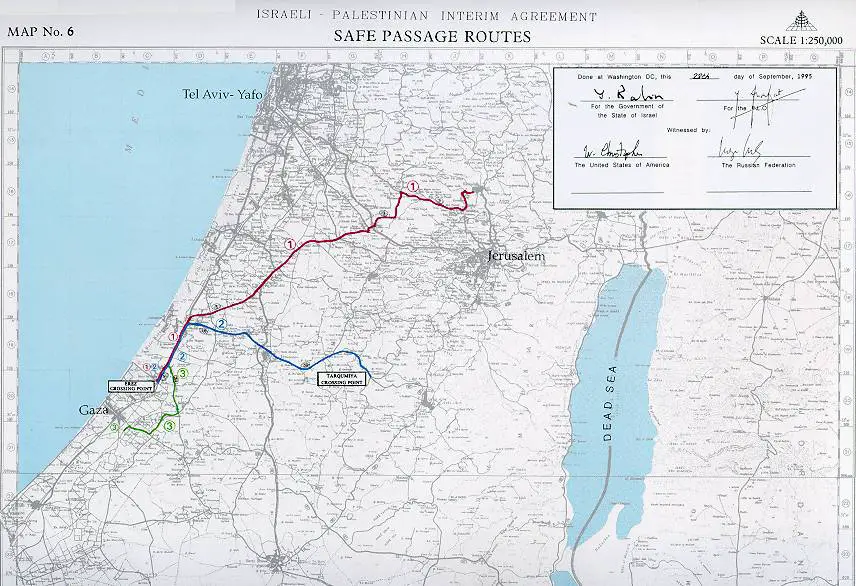
- Safe passage through Israel between the West Bank and the Gaza Strip
will be effected via the following designated crossing points:
- he Erez crossing point (for persons and vehicles only);
- the Karni (commercial) crossing point (for goods only);
- the Tarkumya crossing point; and
- an additional crossing point around Mevo Horon.
- Israel will make such passage available through the routes indicated
on attached map No. 6.
- Consistent with Article XXXI, paragraph 6 of the Agreement, the
arrangements included in this Article are without prejudice to the
permanent status negotiations.
- Use of Safe Passage
- As detailed below, persons using the safe passage shall carry, in
addition to personal and vehicle documentation, the following documents:
- a safe passage card; and
- (for drivers only) a vehicle safe passage permit.
Arrangements for the implementation of the safe passage usage, as well as
modalities for the issuance by Israel of safe passage cards and vehicle
safe passage permits, shall be discussed and agreed in the JSC, in
consultation with the CAC.
- Residents of the West Bank and the Gaza Strip in possession of a
permit enabling them to enter Israel will be able to use this permit as a
safe passage card.
- Safe passage cards and vehicle safe passage permits shall be stamped
by the Israeli authorities at the crossing point, with the time of
departure from the crossing point and the estimated time of arrival.
- Israel may deny the use of its territory for safe passage by persons
who have seriously or repeatedly violated the safe passage provisions
detailed in this Article.
- Persons who are denied entry into Israel will use safe passage by
means of shuttle buses which will be escorted by the Israel Police and
which will operate from 7:00 AM to 2:00 PM on two days of every week. The
exact date and times of such operation will be coordinated through the
JSC. Applications by persons denied entry to Israel to use safe passage
must be submitted to, and agreed upon in, the relevant DCO at least five
days prior to the planned journey.
- Special arrangements will apply with respect to the passage of
Palestinian leaders, senior Council officials, distinguished personalities
and guests of the Ra'ees of the Council. The CAC will define the scope and
nature of the special arrangements, in consultation with the JSC.
- The movement of Palestinian policemen on duty through the safe
passage between the West Bank and the Gaza Strip will be coordinated
through the JSC.
- Any additional matters relating to the usage of safe passage will be
coordinated through the JSC.
- Mode of Use of Safe Passage
- Persons and vehicles using safe passage under these arrangements
shall neither break their journey nor depart from the designated routes,
and shall complete the passage within the designated time stamped on their
safe passage cards and permits, unless a delay is caused by a medical
emergency or a technical breakdown.
- Persons using the safe passage through Israel shall be subject to
Israeli law.
- Persons and vehicles using the safe passage shall not carry
explosives, firearms or other weapons or ammunition, except for special
cases that may be agreed in the JSC.
- General Provisions Regarding the Safe Passage Routes
- The above arrangements shall in no way affect the status of the safe
passage and its routes.
- The safe passage arrangements will not be available on Yom Kippur,
Israel's Memorial Day and Israel's Independence Day.
- Israel may, for security or safety reasons, temporarily halt the
operation of a safe passage route or modify the passage arrangements while
ensuring that one of the routes is open for safe passage. Notice of such
temporary closure or modification shall be given to the JSC.
- Israel shall notify the Council of incidents involving persons using
safe passage routes, through the JSC.
Rules of Conduct in Mutual Security Matters
- Human Rights and the Rule of Law
Subject to the provisions of this Agreement, the Palestinian Police and
the Israeli military forces shall exercise their powers and
responsibilities pursuant to this Agreement with due regard to
internationally-accepted norms of human rights and the rule of law, and
shall be guided by the need to protect the public, respect human dignity
and avoid harassment.
- Weapons
- Each side shall enforce upon civilians, Palestinians or Israelis, in
the West Bank and the Gaza Strip, in accordance with their security
responsibility, a prohibition on possession or carrying of weapons without
a license.
- The Palestinian Police may grant licenses to possess or carry
pistols for civilian use. The modalities for granting such licenses, as
well as categories of persons who may be granted such licenses, will be
agreed upon in the JSC.
- Upon the assumption of security responsibility, and in accordance
with the Palestinian law, the Palestinian Police shall declare a period of
grace of one month, during which period holders of unlicensed weapons will
be required to declare that they hold such weapons and to apply for
licenses. The Palestinian Police may grant such licenses in accordance
with subparagraph b. above, and will enforce the Palestinian security
policy set out in Article II, paragraph 1 of this Annex, against persons
who hold unlicensed weapons.
- Israelis may carry weapons licensed in accordance with subparagraph
a. above.
- The Palestinian Police will maintain an updated register of all
weapons licensed by it.
- The Palestinian Police will prevent the manufacture of weapons as
well as the transfer of weapons to persons not licensed to possess them.
- The use of explosives in quarries and for other civilian purposes
will be only in accordance with modalities and procedures agreed upon in
the JSC.
- Engagement Steps
- For the purpose of this Article, "engagement" shall mean an
immediate response to an act or an incident constituting a danger to life
or property that is aimed at preventing or terminating such an act or
incident, or at apprehending its perpetrators.
- Within the territory under the security responsibility of the
Council, in places where Israeli authorities exercise their security
functions in accordance with this Annex and in their immediate vicinities,
the Israeli authorities may carry out engagement steps in cases where an
act or incident requires such action. In such cases, the Israeli
authorities will take any measures necessary to bring to an end such an
act or incident with a view to transferring, at the earliest opportunity,
the continued handling of the incident falling within the Palestinian
responsibility to the Palestinian Police. The Palestinian Police will
immediately be notified, through the relevant DCO, of such engagement
steps.
- Engagement with the use of firearms in responding to such acts or
incidents shall not be allowed, except as a last resort after all attempts
at controlling the act or the incident, such as warning the perpetrator or
shooting in the air, have failed, or are ineffective or without any
promise of achieving the intended result in the circumstances. Use of
firearms should be aimed at deterring or apprehending, and not at killing,
the perpetrator. The use of firearms shall cease once the danger is past.
- Any activity involving the use of firearms other than for immediate
operational purposes shall be subject to prior notification to the
relevant DCO.
- If a person is injured or otherwise in need of assistance, such
assistance will be provided by the side that first reaches the site. If
such a person is under the security responsibility of the other side, the
assisting side shall notify the relevant DCO and appropriate arrangements
shall be made, pursuant to this Agreement, for treatment and
hospitalization.
- Rules of Conduct on Roads for Israelis
- Israeli military forces and Israeli civilians may continue to use
roads freely within the West Bank and the Gaza Strip.
- On the main roads that are jointly patrolled, vehicles bearing
Israeli license plates shall not be stopped except for identification,
which shall be conducted by a Joint Patrol, pursuant to the provisions of
Article III of this Annex. The Israeli side of such a patrol may carry out
identity and vehicle documentation checks. In the event that a vehicle
bearing a license plate issued by either the Council or the Civil
Administration is stopped, the Palestinian side of the Joint Patrol may
carry out identity and vehicle documentation checks.
- On other roads, vehicles bearing Israeli license plates shall not be
stopped by the Palestinian Police, except that such vehicles may be
stopped in the Gaza Strip, in Area A or in places in Area B where there is
a police station or post, for the purpose of identification checks of the
above-mentioned documentation.
- Israelis shall under no circumstances be apprehended or placed in
custody or prison by Palestinian authorities. However, where an Israeli is
suspected of having committed an offense, he or she may be detained in
place by the Palestinian Police while ensuring his or her protection, in
accordance with the provisions of Annex IV, until the arrival of a Joint
Patrol, called immediately by the Palestinian Police, or of other Israeli
representatives dispatched by the relevant DCO.
- Israeli pedestrians may be required to produce identity
documentation (if above the age of sixteen). Thereafter, they shall be
treated in accordance with the provisions of this Article.
- Uniformed members of the Israeli military forces, as well as
vehicles of the Israeli military forces, shall not be stopped by the
Palestinian Police in any circumstances, and shall not be subject to any
identification requirements. Without derogating from the above, in the
event of suspicion regarding such a person or vehicle, the Palestinian
Police may notify the Israeli authorities through the relevant DCO, in
order to request appropriate assistance.
- Verification, pursuant to this Article, of the identity of persons
who claim to be Israelis but cannot present appropriate identification
documentation, will be confirmed by the Israeli side of a Joint Patrol,
called by the Palestinian Police, or by other Israeli representatives
dispatched by the relevant DCO.
Security Arrangements Concerning Planning, Building and Zoning
- General Provisions
- Notwithstanding the provisions relating to planning, building and
zoning set out elsewhere in this Agreement, the provisions of this Article
shall apply with respect to the areas specified below.
- These arrangements will be reviewed within a period of six months
from the signing of this Agreement, and, thereafter, every six months,
with a view to modifying them, with due consideration to Palestinian plans
for establishing economic projects, and to the security concerns of both
sides.
- The limitations set out below on the construction of buildings and
installations in specific areas shall not require the demolition or
removal of existing buildings or installations.
- Provisions regarding the West Bank
- Buildings or installations shall not be constructed or erected and
natural and artificial culture shall not be altered, on either side of the
roads delineated in blue on map No. 7 up to a distance of 50 meters from
the center of these roads.
- Bridges or other structures will not be built which may prevent the
movement on roads of vehicles of a height of up to 5.25 meters.
- In the areas shaded in purple on map No. 7, construction will be
limited to a height of 15 meters.
- Any buildings or installations constructed or erected contrary to
this paragraph shall be dismantled.
- Provisions regarding the Gaza Strip
- The existing buildings, installations and natural and artificial
culture in the Gaza Strip within a distance of 100 meters from the
Delimiting Line shall remain as they are at present.
- Within the next 500 meters of the Security Perimeter, and within the
Yellow Area, buildings or installations may be constructed, provided that:
- one building or installation may be constructed on each plot, the
size of which shall not be less than 25 dunams; and
- such building or installation shall not exceed two floors, of a
size not exceeding 180 sq. meters per floor.
The Council shall maintain the predominantly agricultural character of the
remaining areas of the Security Perimeter.
- Buildings or installations shall not be constructed on either side
of the Lateral Roads up to a distance of 75 meters from the center of
these Roads.
- For the purpose of enforcing this Article, the United States has
provided both sides with satellite photographs of the Gaza Strip depicting
the buildings, installations and natural and artificial culture existing
at the time of the signing of the Gaza-Jericho Agreement.
Security of the Airspace
- Operation of aircraft for the use of the Council in the West Bank and
the Gaza Strip shall be initially as follows:
- Two (2) transport helicopters for VIP transportation within and
between the West Bank and the Gaza Strip.
- Up to 3 helicopters for the purpose of transport missions to
approved landing pads.
- 3 fixed-wing transport aircraft with up to 35 persons capacity, for
transporting persons between the West Bank and the Gaza Strip.
- Changes in the number, type and capacity of aircraft may be discussed
and agreed upon in a Joint Aviation Subcommittee of the JSC (hereinafter
"the JAC").
- The Council may immediately establish and operate in the West Bank and
the Gaza Strip provisional airstrips for the helicopters and fixed wing
aircraft referred to in paragraph 1 above, in accordance with arrangements
and modalities to be discussed and agreed upon in the JAC.
- All aviation activity or use of the airspace by any aerial vehicle in
the West Bank and the Gaza Strip shall require prior approval of Israel.
It shall be subject to Israeli air traffic control including, inter alia,
monitoring and regulation of air routes as well as relevant regulations
and requirements to be implemented in accordance with the Israel
Aeronautical Information Publication, the relevant parts of which will be
issued after consultation with the Council.
- Aircraft taking off from, and landing in the West Bank and the Gaza
Strip shall be registered and licensed in Israel or in other states
members of International Civil Aviation Organization (ICAO). Air crews of
such aircraft shall be licensed in Israel or in such other states,
provided that such licenses have been approved and recommended by the
Council and validated by Israel.
- Palestinian Civil Aviation and airline staff may be recruited locally
and from abroad. The number of Palestinians recruited from abroad shall
not exceed 400. This number may be changed by agreement, if necessary.
- Aircraft referred to in this Article shall not carry firearms,
ammunition, explosives or weapons systems, unless otherwise approved by
both sides. Special arrangements for armed guards escorting high ranking
officials, will be agreed upon in the JAC.
- The location of navigational aids and other aviation equipment will be
approved by Israel through the JAC.
-
- The Council shall ensure that only the aviation activity in
accordance with this Agreement will take place in the West Bank and the
Gaza Strip.
- Further powers and responsibilities may be transferred to the
Council through the JAC.
- The Council may establish a Palestinian Civil Aviation Department to
act on its behalf in accordance with the provisions in this Article and of
this Agreement.
-
- Aviation activity by Israel will continue to be operated above the
West Bank and the Gaza Strip, with the same limitations applicable in
Israel regarding civil and military flights over densely-populated areas.
- Israel will notify the Council of emergency rescue operations,
searches and investigation of aerial accidents in the West Bank and the
Gaza Strip. Searches and investigations of civilian aircraft accidents in
which Palestinians or their property are involved, will be conducted by
Israel with the participation of the Council.
- Guided by the principle that the two sides view the West Bank and Gaza
Strip as a single territorial unit, as set out in Article IV of the DOP,
and in order to enable the smooth operation of flights between the West
Bank and the Gaza Strip:
- The JAC will agree on special arrangements to facilitate flights of
the Ra'ees of the Executive Authority of the Council between the West Bank
and the Gaza Strip. The Ra'ees and his spouse, and family members of the
Ra'ees, his body guards and VIPs when accompanying the Ra'ees will fly
without prior inspection of their person, personal belongings, and
luggage.
- The minimum time of notification of VIPs, flights will be four
hours. The notification will include the list of passengers.
- Flights of other persons will be handled in accordance with the
procedures agreed in the JAC.
- Flights between the West Bank and the Gaza Strip may be operated
through the Gaza-Tel Aviv (sea shore) corridor.
Monitoring and regulations of this air route will be discussed in the JAC.
- Commercial, domestic and international air services to, from and
between the West Bank and the Gaza Strip may be operated by Palestinian,
Israeli or foreign operators approved by both sides, certified and
licensed in Israel or in ICAO member states maintaining bilateral aviation
relations with Israel. Arrangements for such air services, beginning with
a service between Gaza and Cairo using two (2) fixed-wing aircraft with
capacity up to fifty passengers each, as well as arrangements regarding
the establishment and operation of airports and air terminals in the West
Bank and the Gaza Strip, will be discussed and agreed upon by the two
sides in the JAC.
Any such international commercial air services will be carried out in
accordance with Israel's bilateral aviation agreements. The implementation
phase will be discussed and agreed on in the JAC.
Security along the Coastline to the Sea of Gaza
- Maritime Activity Zones
- Extent of Maritime Activity Zones
The sea off the coast of the Gaza Strip will be divided into three
Maritime Activity Zones, K, L, and M as shown on map No. 8 attached to
this Agreement, and as detailed below:
- Zones K and M
- Zone K extends to 20 nautical miles in the sea from the coast
in the northern part of the sea of Gaza and 1.5 nautical miles wide
southwards.
- Zone M extends to 20 nautical miles in the sea from the coast,
and one (1) nautical mile wide from the Egyptian waters.
- Subject to the provisions of this paragraph, Zones K and M will
be closed areas, in which navigation will be restricted to activity
of the Israel Navy.
- Zone L
- Zone L bounded to the south by Zone M and to the north by Zone
K extends 20 nautical miles into the sea from the coast.
- Zone L will be open for fishing, recreation and economic
activities, in accordance with the following provisions:
- Fishing boats will not exit Zone L into the open sea and
may have engines of up to a limit of 25 HP for outboard motors
and up to a maximum speed of 18 knots for inboard motors. Four
months after the signing of this Agreement the Maritime
Coordination and Cooperation Center (hereinafter "the MC"), as
referred to in paragraph 3 below, will consider raising the
limit for outboard motors up to 40 hp. in accordance with the
types of the boats. The boats will neither carry weapons nor
ammunition nor will they fish with the use of explosives.
- Recreational boats will be permitted to sail up to a
distance of 6 nautical miles from the coast unless, in special
cases, otherwise agreed within the Maritime Coordination and
Cooperation Center as referred to in paragraph 3 below.
Recreational boats may have engines up to a limit of 10
horsepower. Marine motor bikes and water jets will neither be
introduced into Zone L nor be operated therein.
- Yachts may sail up to a distance of 6 nautical miles from
the coast at a maximum speed of 15 knots.
- Foreign vessels entering Zone L will not approach closer
than 12 nautical miles from the coast except as regards
activities covered in paragraph 4 below.
- General Rules of the Maritime Activity Zones
- The aforementioned fishing boats and recreational boats and their
skippers sailing in Zone L shall carry licenses issued by the Council,
the format and standards of which will be coordinated through the JSC.
- The boats shall have identification markings determined by the
Council. The Israeli authorities will be notified through the JSC of
these identification markings.
- Residents of Israeli settlements in the Gaza Strip fishing in Zone
L will carry Israeli licenses and vessel permits.
- As part of Israel's responsibilities for safety and security within
the three Maritime Activity Zones, Israel Navy vessels may sail
throughout these zones, as necessary and without limitations, and may
take any measures necessary against vessels suspected of being used for
terrorist activities or for smuggling arms, ammunition, drugs, goods,
of for any other illegal activity. The Palestinian Police will be
notified of such actions, and the ensuing procedures will be
coordinated through the MC.
- The Palestinian Coastal Police
- The Palestinian Coastal police (hereinafter the "PCP") may function
in Zone L, up to a distance of 6 nautical miles from the coast. In special
cases, it may also exercise control over Palestinian fishing boats fishing
in Zone L in an additional area of 6 nautical miles, up to the limit of 12
nautical miles from the coastline, after clearance and coordination
through the MC.
- The PCP shall have up to 10 boats, with a displacement of up to 50
tons and maximum speed of up to 25 knots.
- The boats shall carry weapons of up to a 7.62 mm caliber.
- Boats of the PCP shall fly a Palestinian flag, have police
identification markings and shall operate identification lights.
- The two sides shall cooperate on all sea matters, including mutual
help at sea, and pollution and environmental issues.
- The boats of the Palestinian Coastal Police will initially use the
Gaza Wharf.
- Boats belonging to Israelis are solely subject to the control,
authority and jurisdiction of Israel and the Israel Navy.
- Maritime Coordination and Cooperation Center
- The MC shall function as part of the JSC, to coordinate civil
maritime activities and coastal police affairs off the coast of the Gaza
Strip.
- The MC shall function within the relevant DCO, and will determine
its own rules of procedure.
- The MC shall function 24 hours a day.
- The MC shall be staffed by members of the Israel Navy and the PCP,
each providing a liaison officer and an assistant liaison officer.
- A direct radio telephone link (hot line) shall be set up between the
Israel Navy vessels and the PCP vessels.
- The role of the MC is to coordinate:
- assistance between the PCP and the Israel Navy as may be necessary
to deal with incidents arising at sea;
- PCP training involving the use of firearms;
- joint activities between the PCP and the Israel Navy when
pre-planning is operationally necessary;
- radio contact between PCP and Israel Navy vessels in the event that
"hot line" communication between vessels of the two sides has not been
established;
- search and rescue operations; and
- maritime activities related to an agreed port, when established in
the Gaza Strip.
- Gaza Strip Port
- Plans for the establishment of a port in the Gaza Strip in
accordance with the DOP, its location, and related matters of mutual
interest and concern, as well as licenses for vessels and crews sailing on
international voyages will be discussed and agreed upon between Israel and
the Council taking into consideration the provisions of Article XXX
(Passages) of this Agreement. To this end a special committee will be
established by the two sides.
- The Gaza Sea Port Authority referred to in the DOP shall act on
behalf of the Council in accordance with the provisions of this Agreement.
- Pending construction of a port, arrangements for entry and exit of
vessels, passengers and goods by sea, as well as licenses for vessels and
crews sailing on international voyages in transit to the West Bank and the
Gaza Strip, shall be through Israeli ports in accordance with the relevant
rules and regulations applicable in Israel and in accordance with the
provisions of Annex V.
Redeployment of Israeli Military Forces
- Stages of the First Phase of Redeployment of Israeli Military Forces
Pursuant to Article I paragraph 1 of this Annex:
The first phase of Israeli military forces redeployment will commence 10
days after the signing of this Agreement. The Israeli Government intends
to complete the first phase of redeployment in all areas but the area of
Hebron by the end of December 1995, in which redeployment will be
completed by six months after the signing of this Agreement. Within two
weeks of the signing of this Agreement, the two sides will decide on a
precise redeployment schedule on a district-by-district basis.
- Phases of the Further Redeployments of Israeli Military Forces
Pursuant to Article I.8 of this Annex, the further redeployments of
Israeli military forces to specified military locations will take place in
phases as follows:
Phase 1 - Six months after the inauguration of the Council.
Phase 2 - Twelve months after the inauguration of the Council.
Phase 3 - Eighteen months after the inauguration of the Council.
Deployment of Palestinian Policemen
- Pursuant to paragraph 3.b of Article IV of this Annex, the details of
the deployment of the 6,000 Palestinian policemen in Areas A and B will be
as follows:
- in the Jenin District: 1,000 policemen;
- in the Tulkarm District: 400 policemen;
- in the Qalqilia District: 400 policemen;
- in the Nablus District: 1,200 policemen;
- in the Ramallah District: 1,200 policemen;
- in the Bethlehem District: 850 policemen;
- in the Hebron District: 950 policemen including 400 policemen in
the City of Hebron; and
- in the Jericho District: 600 policemen that will be considered part
of the number of policemen allocated to the Gaza Strip in accordance
with Article IV of this Annex.
- Changes in the numbers of policemen in each district during the further
redeployment phases, when the number of policemen in the West Bank will
increase to 12,000, will be agreed upon in the West Bank RSC.
Police Stations and Posts in Area B
- The Palestinian Police shall establish 25 Civil Police (Al Shurta)
police stations and posts i the towns, villages and other places listed
below and shown on map No. 3, with personnel and equipment as follows:
- Jenin District
- El-Yamun: 50 policemen, 2 vehicles, 9 rifles, 17 pistols;
- Meithalun: 50 policemen, 2 vehicles, 9 rifles, 17 pistols;
- Kafr Rai: 45 policemen, 2 vehicles, 8 rifles, 15 pistols;
- Jalqamus: 45 policemen, 2 vehicles, 8 rifles, 15 pistols; and
- Burqin: 45 policemen, 2 vehicles, 8 rifles, 15 pistols.
- Nablus District
- Asiraat A-Shumaliyya: 50 policemen, 2 vehicles, 9 rifles, 17
pistols;
- Talouza: 45 policemen, 2 vehicles, 8 rifles, 15 pistols;
- Tell: 30 policemen, 2 vehicles, 5 rifles, 10 pistols;
- Talfit: 60 policemen, 2 vehicles, 12 rifles, 20 pistols;
- Tamun: 50 policemen, 2 vehicles, 9 rifles, 17 pistols; and
- Aqraba: 50 policemen, 2 vehicles, 9 rifles, 17 pistols.
- Tulkarm and Qalqilya District
- Shuweika: 45 policemen, 2 vehicles, 8 rifles, 15 pistols;
- Kafr Zibad: 50 policemen, 2 vehicles, 9 rifles, 17 pistols;
- Anabta: 50 policemen, 2 vehicles, 9 rifles, 17 pistols; and
- Illar: 45 policemen, 2 vehicles, 8 rifles, 15 pistols.
- Ramallah District
- Arura: 50 policemen, 2 vehicles, 9 rifles, 17 pistols;
- Deir Ghassana: 45 policemen, 2 vehicles, 8 rifles, 15 pistols;
- Khirbat Abu Falah: 45 policemen, 2 vehicles, 8 rifles, 15 pistols;
and
- Bir Zeit: 70 policemen, 3 vehicles, 14 rifles, 23 pistols.
- Bethlehem District
Tuqua: 50 policemen, 3 vehicles, 9 rifles, 17 pistols.
- Hebron District
- Yata: 80 policemen, 3 vehicles, 15 rifles, 27 pistols;
- Dhahiriya: 70 policemen, 3 vehicles, 14 rifles, 23 pistols;
- Nuba: 45 policemen, 2 vehicles, 8 rifles, 15 pistols;
- Dura: 70 policemen, 3 vehicles, 14 rifles, 23 pistols; and
- Bani-Naiem: 45 policemen, 3 vehicles, 8 rifles, 17 pistols.
- The rifles in each of these police stations will be used only for the
purpose of guarding the police station. In special cases, where the use of
rifles outside the police station is required for the exercise of public
order responsibility, prior notification shall be given to the DCO.
Jewish Holy Sites
Pursuant to Article V of this Annex, the Jewish Holy Sites are as follows:
- Joseph's Tomb (Nablus)
- Shalom Al Israel synagogue (Jericho)
Protocol Regarding Arrangements with Respect to Passages (as amended)
Pursuant to paragraph 1.d of Article VIII to this Annex:
SECTION A
Definitions
For the purpose of this Protocol:
- "The Agreement" means the Interim Agreement:
- "Annex I" means Annex I to the Interim Agreement;
- All other terms will have the same meaning as in the Agreement.
SECTION B
Entry and Exit through the Palestinian Wing
Pursuant to Article VIII of Annex I to the Agreement, the following
arrangements will apply with respect to the terminals at the Rafah and
Allenby Bridge crossings:
- Entry from Egypt and Jordan
- At the entrance to the Palestinian wing there will be a Palestinian
policeman and a raised Palestinian flag.
- Before entering the Palestinian wing, passengers will identify their
personal luggage and it will be placed on a conveyor belt. Each side will
be able to inspect such luggage inside its own checking area, using its
own personnel and, if necessary, may open the luggage for inspection in
the presence of the owner and a Palestinian policeman.
- Persons entering the Palestinian Wing will pass through a magnetic
gate. An Israeli policeman and a Palestinian policeman will be posted on
each side of this gate. In the event of suspicion, each side will be
entitled to require a physical inspection to be conducted in inspection
booths to be located adjacent to the gate. Passengers will be inspected by
a Palestinian policeman in the presence of an Israeli policeman.
Accompanying personal belongings may also be inspected at this point.
- Having completed the above phase, persons entering the Palestinian
wing will pass through one of two lanes for the purpose of identification
and document control, as follows:
- the first lane will be used by Palestinian residents of the West
Bank and the Gaza Strip. These passengers will pass via a Palestinian
counter, where their documents and identity will be checked. Their
documents will be checked by an Israeli officer who will also check
their identity indirectly in an invisible manner;
- the second lane will serve visitors to the Gaza Strip and West
Bank. These passengers will first pass via the Israeli counter, where
their documents and identity will be checked . Then they will continue
via the Palestinian counter, where their documents and identity will be
checked. The two counters will be separated by tinted glass and a
revolving door.
- In the event of suspicion regarding a passenger in any of the two
lanes described in subparagraph 1.d above, each side may question such
passenger in its closed checking area. Suspicion justifying questioning in
the closed checking area may be one of the following:
- the passenger was involved, directly or indirectly, in criminal or
planned criminal activity, in terrorist or planned terrorist activity
and is not a beneficiary of the amnesty provisions of the Agreement;
- the passenger conceals arms, explosives or related equipment;
- the passenger holds forged or non-valid documentation or the
details included in the documentation are inconsistent with those
included in the population registry (in the case of a resident) or in
the data base (in case of a visitor), except that questions relating to
such inconsistency will initially be raised at the counter and the
passenger will be questioned in the closed checking area only if the
suspicion has not been removed; or
- the passenger acts in an obviously suspicious behavior during the
passage via the terminal.
If, at the conclusion of this questioning, the suspicion has not been
removed, such passenger may be apprehended, after the other side has been
notified. In case of a Palestinian suspect being apprehended by the
Israeli side, a Palestinian policeman will be asked to meet with the
suspect.
Following notification to the Liaison Bureau, any further treatment of the
apprehended person will be in accordance with Annex IV to the Agreement.
- In the Palestinian wing, each side will have the authority to deny
the entry of persons who are not residents of the Gaza Strip and West
Bank. For the purpose of the Agreement and this Protocol, "residents of
the Gaza Strip and West Bank" means persons who, on the date of entry into
force of the Gaza-Jericho Agreement, were registered as residents of these
areas in the population registry maintained by the military government of
the Gaza Strip and West Bank, as well as persons who have subsequently
obtained permanent residency in these areas with the approval of Israel,
as set out in the Agreement.
- Following the above procedure, the passengers will collect their
luggage and proceed to the customs area where they will be dealt with as
set out in Section H of this Protocol.
- The Palestinian side will provide passengers whose entry is approved
with an entry permit stamped by the Palestinian side and attached to their
documents. At the conclusion of the direct and indirect checking of the
documents and identity of passengers passing via the first lane and
stamping their entry permits, the Palestinian officer will provide the
passenger with a white card issued by the Israeli officer. A Palestinian
official posted at the exit of the Palestinian wing will verify that they
passenger holds such a white card and will collect the cards with indirect
and invisible Israeli checking. For passengers going through the second
lane, the Israeli officer will provide the passengers with a blue card,
after checking their documents and identity, and verifying their entry
permits. An Israeli and a Palestinian official posted at the exit of the
Palestinian wing will verify and collect the cards. White and blue cards
collected will be checked by Israeli and Palestinian officials. In cases
where either side denies the entry of a non-resident passenger, that
passenger will be escorted out of the terminal and sent back to Jordan or
Egypt, as appropriate, after notifying the other side.
- Exit to Egypt and Jordan
Passengers exiting to Egypt or Jordan through the Palestinian wing will
enter the terminal without their luggage. Thereafter ,the same procedures
described in paragraph 1 above will apply to them, except that the order
of passing via the Israeli and Palestinian counters will be reversed.
SECTION C
Control and Management of the Passages
- General
- Israel will have the responsibility for security throughout the
passage, including for the terminal.
- An Israeli Director-General will have the responsibility for the
management and security of the terminal (hereinafter - "the
Director-General").
- Israel will have exclusive responsibility for the management of the
Israeli wing.
- The Director-General will have two deputies who will report to him:
- A Palestinian deputy, appointed by the Council, who will be the
manager of the Palestinian wing (hereinafter - "the Manager of the
Palestinian wing"); and
- An Israeli deputy who will be the manager of the Israeli wing
(hereinafter - "the Manager of the Israeli wing").
- The Israeli Director-General will be assisted by a professional team
appointed at his discretion. Such team shall include:
- an officer who will assist the Director-General with respect to the
general security of the terminal (hereinafter - "the security
officer");
- an expert who will advise the Director-General and the wing
managers with respect to the general administration of the terminal
(hereinafter - "the administration expert"); and
- an expert who will be responsible for the performance of those
duties which the Director-General shall require him to perform when the
need arises (hereinafter - "the duty officer").
- The Director-General may appoint any of the persons set out in
paragraphs 1.d.(2) and 1.e above or another specialized Israeli official
employed in the terminal to fulfill the role of the Director-General in
his absence (hereinafter - "the substitute officer"). g. Each wing Manager
will have an assistant for security and an assistant for administration.
The assignments of the Palestinian assistants are set out in paragraphs 3
and 4 of this Section. h. All assignments and functions of the Manager of
the Palestinian wing, the Assistant for administration of the Manager of
the Palestinian wing and the Assistant for security of the Manager of the
Palestinian wing and any other Palestinian employee shall be exercised in
a manner consistent with the Agreement and with this Protocol.
- Assignments of the Manager of the Palestinian wing
The assignments of the Manager of the Palestinian wing shall be the
following:
- employment of Palestinian staff in the Palestinian wing. The list of
Palestinian candidates for employment in the Palestinian wing shall be
passed by the Manager of the Palestinian wing to the Director-General for
security clearance, which shall be a pre-requisite to their engagement.
The Council shall have, through the Manager of the Palestinian wing, full
responsibility for all personnel matters of the Palestinians employed in
the Palestinian wing including, inter alia, their salary, their social
insurance and claims by such employees with respect to their employment;
- release of Palestinian staff from employment in the Palestinian
wing, whilst informing the Director-General. Upon consultation with the
Manager of the Palestinian wing, the Director-General may also decide to
release a Palestinian from employment in the Palestinian wing due to
security reasons of substantial nature. The Manager of the Palestinian
wing shall inform the employee of his release.
Other non-security related grounds for the release of Palestinian
employees from employment in the Palestinian wing shall be specified in a
procedure to be promulgated by the Director-General upon consultation with
the Manager of the Palestinian wing and his two Assistants.
For the purpose of this Protocol, "Palestinians employed in the
Palestinian wing" means all Palestinians employed in the Palestinian wing,
except the Manager of the Palestinian wing;
- general training and briefing of Palestinian employees in the
Palestinian wing and handling of their work related problems;
- supervision of the daily opening and closing of the Palestinian wing
itself;
- declaration of an emergency situation in the Palestinian wing. This
assignment is without prejudice to the power of the Director-General, the
substitute officer and/or the security officer to declare a state of
emergency in the Palestinian wing and to act forthwith as deemed fit
within their complete discretion, in full cooperation with the Manager of
the Palestinian wing.
- other powers and responsibilities assigned to him under paragraph 3
of Article VIII of Annex I;
- professional guidance of the Palestinian document control officials
with respect to the performance of their assignments;
- appointment of a person as his substitute and appointment of a duty
officer for the Palestinian wing;
- with respect to the Rafah crossing, the Manager of the Palestinian
wing shall also have the following assignments:
- responsibility for the efficient movement of passengers traveling
abroad, from the entrance to the terminal, through the Palestinian wing
and up to their embarkation on the bus or other vehicle leaving the
terminal in the direction of Egypt;
- responsibility for the efficient movement of passengers arriving
from abroad from the sheltered waiting area located near the entrance
to the Palestinian wing, through the Palestinian wing and up to their
embarkation on the bus or other vehicle leaving the terminal in the
direction of the Gaza Strip;
- responsibility for the orderly functioning of the service car
defined in Section F of this Protocol with respect to the
transportation of VIPs traveling abroad, from the entrance to the
terminal to the entrance to the Palestinian wing;
- responsibility for the canteen serving passengers traveling abroad
through the Palestinian and the Israeli wing;
- responsibility to allocate tasks to specific Palestinian service
personnel employed and assigned by the Director-General to work in the
Palestinian wing;
- responsibility to contact Palestinian contractors and to pass to
the Director-General their offers regarding tenders with respect to
administrative and logistical services in the terminal; and
- responsibility for the orderly functioning of the emergency clinic
to be established in the Palestinian wing. This clinic will be staffed
by a Palestinian physician and a nurse.
These assignments shall also apply, at a later stage, with respect to the
Allenby Bridge crossing, with the necessary adjustments; and j. within the
framework of the functions assigned to him pursuant to this paragraph, the
promulgation of procedures for the Palestinian employees in the
Palestinian wing.
- Assignments of the Palestinian Assistant for Security
The Palestinian Assistant for Security shall be appointed from the ranks
of the Palestinian Police, shall be subordinate to the Manager of the
Palestinian wing and his assignments shall be within the Palestinian wing,
as follows:
- implementation of standard security procedures promulgated by the
Director-General pursuant to Paragraph 5 of this Section;
- implementation of other security related measures pursuant to the
instructions of the Director-General, the substitute officer and in
emergencies or exceptional cases, the security officer;
- in conjunction with the Manager of the Palestinian wing and after
duly informing the Director-General and the security officer, training and
briefing of each Palestinian employee in the Palestinian wing as to the
performance of his specific security related task;
- supervision, maintenance and storage of all handguns in the
possession of Palestinian policemen present in the Palestinian wing;
- responsibility for ensuring the due and proper execution of the
procedures set out in paragraph 3 of Article VIII of Annex I;
- ensuring the immediate arrival of a Palestinian policeman pursuant
to an Israeli demand for his presence, made pursuant to paragraphs 3.b,
3.c, and/or 3.e of Article VIII of Annex I;
- ensuring maintenance of secrecy amongst the Palestinian employees
with respect to the nature of their employment, the layout of the
terminal, security procedures, and all other information, the revelation
of which could compromise the general security of the terminal;
- ensuring decorum and good public order in a routine working context;
- declaration of an emergency situation in the Palestinian wing,
without prejudice to the provisions of paragraph 2.e of this Section; and
- upon discovery of a suspicious object, immediately to notify the
security officer and the Manager of the Palestinian wing. The security
officer will then have complete discretion to act as he deems fit in the
circumstances.
- Assignments of the Palestinian Assistant for Administration
The Palestinian Assistant for Administration shall be subordinate to the
Manager of the Palestinian wing and shall deal with matters relating to
manpower, organization and logistics within the Palestinian wing, as
follows:
- ensuring the efficient movement of passengers in the Palestinian
wing;
- implementation of standard administration procedures promulgated by
the Director-General pursuant to paragraph 5 of this Section;
- implementation of other non-security related matters pursuant to the
instructions of the Manager of the Palestinian wing given upon
consultation with the Director-General;
- escorting the elderly, the ill, children and disabled;
- ensuring orderly behavior and presentable appearance of Palestinian
employees;
- ensuring cleanliness, the presence efficient functioning of fire
fighting facilities and the supply of provisions;
- training and briefing of each Palestinian employee in the
Palestinian wing, engaged in non-security related matters with respect to
the specific nature of his employment; and
- uninterrupted functioning of the section of the conveyor belt under
Palestinian supervision as set out in paragraph 3 of Article VIII of Annex
I.
- Standard Security and Administration Procedures
The Director-General, upon consultation with the Israeli and Palestinian
wing Managers, shall determine and shall furnish to the persons set out in
Paragraphs 1.d, 1.e and 1.g above and to the Liaison Bureau a compendium
detailing standard procedures with respect to security and administration
of the terminal.
Such procedures shall include:
- procedures in a state of emergency;
- procedures with respect to inspection of persons, personal
belongings and/or luggage pursuant to paragraphs 3.b, 3.c and/or 3.e of
Article VIII of Annex I;
- procedures with respect to road-markings, signs, plaques and flags
in the terminal;
- procedures with respect to handling of luggage and the loading of
the conveyor belt;
- procedures with respect to operation of the conveyor belt;
- procedures with respect to media and public relations;
- procedures with respect to public transportation and taxis passing
through the terminal, as will be agreed upon between the two sides;
- procedures with respect to maintenance and upkeep of the terminal;
- procedures with respect to supply of provisions and services;
- procedures with respect to general conduct and behavior of employees
within the terminal and changing of work shifts;
- procedures with respect to escorting the elderly, the ill, children
and disabled;
- procedures with respect to escorting VIPs;
- procedures with respect to people denied exit or entry through the
Palestinian wing; and
- procedures with respect to comportment, personal appearance and
identification tags of employees in the terminal.
The Director-General may promulgate, upon consultation with the Israeli
and the Palestinian wing Managers, additional procedures not provided for
in this paragraph. All of the abovementioned procedures will be consistent
with the Agreement and with this Protocol, and will be reviewed at a later
date by the two sides if the circumstances so necessitate.
SECTION D
Weapons in the Passages
- General
- Pursuant to paragraph 2.b(8) of Article VIII of Annex I, the
Palestinian policemen present in the terminals will be armed with
handguns.
- The Palestinian officials entitled to carry handguns in the
terminals shall be those Palestinian policemen explicitly provided for in
paragraph 2 of this Section and other Palestinian officials explicitly
provided for in Section F below.
- Functions of Armed Palestinian Policemen in the Terminals
Palestinian policeman present in the terminals will be entitled to carry a
handgun. In the initial stage, only the Palestinian policemen deployed as
detailed below will carry a handgun;
- In the Palestinian wing of the terminals serving passengers arriving
from Egypt or Jordan;
- one policeman posted at the entrance to the Palestinian wing as
provided for in paragraph 3.a of Article VIII of Annex I;
- one policeman who may be called for from the Palestinian checking
area when an Israeli official requires the opening of luggage for
inspection within the Israeli checking area, as provided for in
paragraph 3.b of Article VIII of Annex I;
- one policeman posted at the side of the magnetic gate serving all
persons entering the Palestinian wing, as provided for in paragraph 3.c
of Article VIII of Annex I; and
- one policeman who may be requested by an Israeli official, when
necessary, to carry out a physical inspection in an inspection booth in
the presence of an Israeli policeman as provided for in paragraph 3.c
of Article VIII of Annex I;
- In the Palestinian wing of the terminals serving passengers leaving
for Egypt or Jordan;
- one policeman posted at the entrance to the Palestinian wing;
- one policeman posted at the side of the magnetic gate serving all
persons leaving for Egypt and Jordan; and
- one policeman who may be requested by an Israeli official, when
necessary, to carry out a physical inspection in an inspection booth in
the presence of an Israeli policeman;
- The Palestinian Assistant for Security; and
- The Palestinian Liaison Bureau coordinating officer defined in
paragraph 2.c of Section E below. The number of armed Palestinian
policemen may be increased in cases in which both sides agree that the
circumstances so necessitate. Such agreement will also include the
deployment of the additional Palestinian policemen.
- Licensing of Weapons
Palestinian policemen entitled to carry handguns within the Palestinian
wing in the course of their duty pursuant to Paragraph 2 above, shall be
required to obtain a written license from all of the following:
- The Council;
- The Manager of the Palestinian wing; and
- The Director-General.
- Handguns and Ammunition
The Palestinian policemen entitled to carry handguns in the Palestinian
wing pursuant to paragraph 2 above, shall:
- carry handguns which shall be:
- of 0.22 inch, 7.65 mm or 9 mm caliber; and
- secured and tied safely to their body;
- carry one magazine with regular ammunition; and
- carry their handguns in a uniform and visible manner, as fixed in
procedures promulgated by the Director-General pursuant to Section C of
this Protocol.
- Registration and Storage
- Handguns carried by the Palestinian policemen:
- shall be passed to the Director-General for the purpose of
examination before they are brought into the terminal;
- their registration numbers shall be noted by the Director-General;
- shall be allocated to one user only and not exchanged between
Palestinian policemen working in the terminal unless coordinated
through the Director-General or whoever was appointed by him for that
purpose, and registrated by him;
- shall be substituted with other handguns only after the new handgun
has been passed to the Director-General for the purpose of examination;
- shall not be taken out of the Palestinian wing; and
- shall, when the Palestinian policemen are not present in the
Palestinian wing, be stored in a safe in the office of the Palestinian
Assistant for Security.
- The Director-General shall promulgate procedures with respect to the
storage of handguns, in accordance with Section C of this Protocol.
- Use of Handguns
- A Palestinian policeman shall be authorized to use his handgun in
the following cases:
- where there is a substantial and immediate danger to his life, in
which case the handgun may only be used in a reasonable manner in the
circumstances;
- pursuant to the instructions of the Director-General, the
substitute officer or the Security officer; or
- pursuant to a security procedure to be agreed with respect to this
matter.
- The Director-General shall promulgate procedures with respect to the
use of handguns, in accordance with Section C of this Protocol.
- Weapons Outside the Terminals
In accordance with the provisions of the Agreement:
- with respect to the Rafah crossing, all outgoing passengers destined
for the Palestinian wing shall not enter the Military Installation Area
armed with a weapon; and
- with respect to the Allenby Bridge crossing, all outgoing passengers
destined for the Palestinian wing shall not leave the Jericho Area towards
the terminal armed with a weapon. The Council shall do its utmost to
ensure compliance with paragraphs 7.a and 7.b above.
- Weapons in the Terminals
- Persons destined for the Palestinian wing and who are not subject to
paragraph 7 above shall deposit their weapon with the Joint Verification
Team established by Section E below.
- Notwithstanding the provisions of paragraph 8.a above, VIPs and
bodyguards who are entitled to enter the terminals with a handgun pursuant
to Section F below, shall carry the handgun in accordance with procedures
to be promulgated by the Director-General in accordance with Section C of
this Protocol.
- The Palestinian Policemen
Palestinian policemen present in the Palestinian wing as set out in
paragraph 2 above shall wear a Palestinian police uniform.
SECTION E
Liaison Bureau
- General
A Joint Liaison Bureau (hereinafter "Liaison Bureau") shall be set up at
the Rafah crossing and at the Allenby Bridge crossing, pursuant to
paragraph 5 of Article VIII of Annex I.
- Structure of the Liaison Bureau
Each Liaison Bureau will be composed of 6 persons, 3 from each side, as
follows:
- an Israeli coordinating officer and a Palestinian coordinating
officer who shall both be members of the relevant JRCAC and whose
assignments shall be:
- to coordinate the routine activity of the Palestinian wing in
conjunction with the relevant Joint Regional CAC (hereinafter - "the
JRCAC");
- to coordinate the passage of VIPs through the Palestinian wing,
pursuant to Section F below;
- an Israeli official and a Palestinian official, who shall both be
members of the relevant JRCAC, and who shall deal with:
- complaints with respect to passage through the Palestinian wing;
and
- other problems relating to such passage; and
- an Israeli coordinating officer and a Palestinian coordinating
officer who shall both be members of the relevant DCO and whose
assignments shall be to coordinate the passage of members of the
Palestinian police and their equipment.
- Functions of the Liaison Bureau
- The functions of each Liaison Bureau shall be to coordinate and to
facilitate the following activities with respect to the Palestinian wing:
- verification of the status of VIPs and the implementation of the
special arrangements provided for them by virtue of Section F below;
- passage of members of the Palestinian police;
- passage of the elderly, the ill and the disabled;
- transfer of the deceased;
- resolution of problems with respect to documentation, luggage and
passenger delay;
- resolution of differences regarding the implementation of
procedures with respect to passage; and
- provision of guidance to the JVT with respect to its assignments.
- The Liaison Bureau shall be notified of the apprehension of persons
in the Palestinian wing pursuant to paragraph 3.e of Article VIII of Annex
I.
- Without derogating from Israel's responsibility for security, the
Liaison Bureau will also deal with incidents.
- The execution of each Liaison Bureau's functions shall not prejudice
the powers and responsibilities set out in Section C of this Protocol.
- The Liaison Bureau shall carry out its functions in full cooperation
and coordination with the Director-General, the Palestinian and the
Israeli wing managers and shall seek to promote coordination between the
Director-General and the two wing managers.
- The Liaison Bureau shall be subordinate to the relevant JRCAC.
- Joint Verification Team
- A Joint Verification Team (hereinafter - the "JVT") shall be
established, in order to verify that outgoing passengers destined for the
Palestinian wing hold the necessary documentation for exiting the area to
Jordan or Egypt, as set out in the Agreement.
- The JVT will be composed of one officer and one official from each
side, and shall be subordinate to the Liaison Bureau.
-
- With respect to the Rafah crossing, the JVT shall be based at
the outer limit of the northern entrance gate to the terminal.
- With respect to the Allenby Bridge crossing, the JVT shall be based
at the entrance to the Mousa Allami project.
- Once incoming passengers have crossed the terminal, they will
proceed to the Jericho Area or the Gaza Strip, as appropriate, without
any interference from Israeli authorities.
- Outgoing passengers may proceed to the terminal without any
interference from Israeli authorities once the JVT has verified that
such passengers hold the necessary documentation for exiting the area
to Jordan or Egypt, as set out in the Agreement.
- The JVT shall inform the Liaison Bureau of the imminent arrival of a
VIP pursuant to Section F below.
- The JVT shall also regulate the traffic coming from the Jericho Area
or the Gaza Strip towards the terminals in order to prevent congestion.
SECTION F
Passage of VIPs
- General
- Whilst representing the special status of certain persons and at the
same time without prejudicing the dignity of other persons, the two sides
have agreed upon a standard procedure for the treatment of VIPs passing
through the Palestinian wing of the terminals, as detailed below.
- VIPs may include the following:
- holders of the most senior positions within the Council and
officers of the Palestinian Police of the rank of Major-General
(hereinafter - category 1");
- director-generals of departments in the Council, officials of the
Council of equivalent rank to such persons and officers of the
Palestinian Police of the rank of Brigadier-General (hereinafter -
"category 2"); and
- heads of units in departments in the Council, officials of the
Council of equivalent rank to such persons and officers of the
Palestinian Police of the rank of Commander (`Aqid) (hereinafter -
"category 3").
The extent of the categories 1-3 above shall be determined by the CAC. Any
exceptions to categories 1-3 may be dealt with by the CAC.
- Procedures for the Granting of VIP Status
- Only the CAC may grant or withdraw VIP status.
- The Council may present the CAC with a list of persons eligible for
VIP status and shall specify the registration-plates number of the
vehicles to be used by individuals entitled to enter or pass through the
terminal with a vehicle.
- Upon approving VIP status, the CAC will issue to the person
concerned a certificate confirming such status. The duration of such
status shall be for one year or until the completion of the term of duty
of the person in his VIP capacity, whichever be the sooner.
- Prior to the expiration of the duration of the VIP certificate, the
Council may request that the CAC renew the VIP status.
- The Palestinian representatives to the CAC shall, every six months
or whenever the need shall arise, whichever be the sooner:
- review the list of VIPs in order to ensure that every recipient of
VIP status retains a valid entitlement to such status; and
- inform the Israeli representatives to the CAC of the results of
such review.
- Categories 1 and 2 VIPs may submit to the CAC a list of persons who
shall also be granted VIP status. Such persons shall only be:
- the spouse, children and parents;
- one chauffeur; and
- one bodyguard;
of the VIP (hereinafter - "Secondary VIPs").
- Arrangements With Respect to Passage of VIPs
- Category 1 VIPs shall give prior notification of their arrival to
the Liaison Bureau and upon arrival at the terminal, shall be accommodated
in a VIP lounge pending:
- a brief visual inspection of their vehicle by an Israeli official;
- transfer of their documentation by an employee of the Palestinian
wing for the purpose of the immediate performance of all the necessary
procedures with respect to the documentation, as set out in Article
VIII of Annex I; and
- transfer of their vehicle through the terminal by their chauffeur,
whereupon those VIPs shall continue their journey.
- For the purpose of clarification:
- cargo and freight other than personal luggage brought by category 1
VIPs shall be subject to the same procedures and customs arrangements
which apply to all passengers passing through the Palestinian wing; and
- only category 1 VIPs and one bodyguard accompanying them shall be
entitled to enter the terminal with a handgun, once the registration
number of the handgun has been noted by the JVT.
- Category 2 VIPs who arrive at the terminal with a vehicle shall,
after their vehicle has been subjected to a brief visual inspection at the
entrance to the terminal:
- be accommodated in the VIP lounge whilst an employee of the
Palestinian wing shall take that VIP's luggage and documentation for
the purpose of the immediate and full performance of all the necessary
procedures with respect to the luggage and documentation, as set out in
Article VIII of Annex I; and
- pass through the terminal in a service car which shall be provided
for them or in a taxi, unless otherwise agreed pursuant to paragraph
4.c of Section H of this Protocol.
- Category 3 VIPs shall:
- be transported from the entrance to the terminal to the Palestinian
wing in a service car which shall be provided for them or in a taxi;
- be subject to the inspection procedures set out in paragraph 3 of
Article VIII of Annex I, which shall be performed immediately with an
employee of the Palestinian wing accompanying them throughout this
process; and
- pass through the terminal in a service car which shall be provided
for them or in a taxi, unless otherwise agreed pursuant to paragraph
4.c of Section H of this Protocol.
- Secondary VIPs:
- when traveling with the VIP in whose name they are registered,
shall be accorded the same treatment as is accorded to that VIP;
- when traveling without the VIP in whose name they are registered:
- if they are the spouse, parents and/or children of that VIP,
shall be accorded equal treatment to that VIP;
- if they are the chauffeur or bodyguard of that VIP, shall
receive the treatment accorded to category 3 VIPs.
- In the event of a duly substantiated suspicion within the course of
the aforementioned inspection procedures, the Director-General, after
consulting his superiors and after informing the Manager of the
Palestinian wing of the suspicion, shall be entitled, upon consultation
with the Manager of the Palestinian wing, temporarily to withdraw the
preferential treatment accorded to a VIP until the matter has been dealt
with in accordance with the provisions of the Agreement. Category 1 and
Category 2 VIPs will be transferred to the Council if the suspicion is
proved to be well founded, and their VIP privileges will be canceled by
the CAC.
- Foreign VIPs visiting the Gaza Strip or the West Bank
- The Liaison Bureau established pursuant to Section E of this
Protocol shall have the power to grant VIP status to a visitor to the Gaza
Strip or the West Bank passing through the Palestinian wing, and to
specify the treatment that that person shall receive according to one of
the categories set out in paragraph 1 above.
- Thereafter, the arrangements set out in paragraph 3 above shall
apply.
- Miscellaneous
- With respect to persons destined for the Palestinian wing, the
Liaison Bureau established pursuant to Section E of this Protocol shall
have the power to make arrangements, in conjunction with the
Director-General, regarding access to the terminals and to other areas of
the passages of persons greeting incoming VIPs or escorting and parting
from exiting VIPs, and to coordinate the implementation of these
arrangements.
- The following procedure will apply with respect to the passage of
category 1 VIPs, family members of the Chairman of the Council except the
spouse of the Chairman of the Council, bodyguards of the Chairman of the
Council and other persons approved by the CAC, when any of these persons
are accompanying the Chairman of the Council in his vehicles:
- notification of their arrival at the terminal shall be given to the
Liaison Bureau as soon as possible and not later than 4 hours prior to
such arrival. The Liaison Bureau shall, on receipt thereof, coordinate:
- passage of these persons without delay;
- passage of these persons without inspection of their person,
personal belongings, luggage or vehicle; and
- completion of all necessary documentary procedures prior to
these persons, arrival.
The above will be coordinated in a conference to be attended to by a
Palestinian and an Israeli representative and the members of the Liaison
Bureau, in the duty officer's office, not less than one hour prior to such
passage. During this conference, the documents of persons subject to this
paragraph shall be presented.
The two officers defined in paragraph 2.a of Section E of this Protocol
shall hand over to these persons their documentation, upon their arrival
at the terminal; and
- the abovementioned prior notification will also mention the number
of bodyguards accompanying the Chairman of the Council. These
bodyguards shall be entitled to enter the terminal with a handgun, once
the registration number of the handgun has been noted by the JVT.
- Passage of the Chairman of the Council and the spouse of the
Chairman of the Council will be performed pursuant to paragraph 5.b above,
except that paragraph 3.f of this Section will not apply. No prior
notification will be required with respect to such passage.
SECTION G
Passenger Fee
- General
- Passengers exiting through the Rafah passage to Egypt and through
the Allenby Bridge passage to Jordan shall pay a passenger fee equivalent
to 26 USA dollars.
- This passenger fee will be collected by Israel. The Council may sell
passenger fee vouchers to passengers passing through the Palestinian wing
of the terminals, after having purchased them from Israel by means of a
letter of guarantee given by an Israeli bank for each quota of vouchers
transferred to the Council, or any other method of payment to be agreed
upon. The design and content of the vouchers or stamps used will be
agreed.
- Diplomats and children under two years of age will be exempt from
the passenger fee.
- Use of Passenger Fee
- Passenger fee income from up to a total of 750,000 paying passengers
each year will be equally divided between the two sides. With respect to
these 750,000 passengers, the Council will pay Israel the equivalent of 1
USA dollar for services, maintenance and development of the terminals.
- As from the first paying passenger thereafter during the same year,
Israel will receive the equivalent of 10 USA dollars of the passenger fee
and the Council will receive the equivalent of 16 USA dollars thereof.
- Miscellaneous
- The Council will be responsible for the 90 Palestinian personnel
employed in the Allenby Bridge crossing by the Director-General and the 20
Palestinian personnel employed at the Rafah crossing by the Director-
General, in accordance with the provisions of paragraph 2.a of Section C
of this Protocol.
- Israel will be responsible for maintenance and development costs
with respect to the terminals.
- With respect to the Rafah crossing:
- taxis arriving from the Gaza Strip in the direction of the terminal
will be permitted entry to the terminal, in accordance with procedures
to be promulgated by the Director-General pursuant to Section C of this
Protocol; and
- upon request by the Council, the present bus service transporting
passengers destined for the Palestinian wing from the entrance to the
terminal to the entrance to the Palestinian wing will be replaced by a
bus service to be chosen by the Council. Such replacement will be
effected not less than one month after the date of signing of this
Protocol, and will be fully coordinated with the Director-General.
- Arrangements will be agreed upon by the two sides with respect to
the passage of buses, trucks and privately owned vehicles. Until such
arrangements are established, the current arrangements will continue to
apply.
- Israel will transfer to the Council the agreed share of the
collected fees pursuant to paragraph 2 above, at the end of each calendar
month following the month in which those fees were collected.
SECTION H
Passenger Customs Lane
- General
In the Palestinian wing there will be one passenger customs hall
consisting of a passenger customs lane administered by customs officials
of the Council and serving residents of the West Bank and the Gaza Strip
and visitors thereto.
- Procedures with regard to the Customs Lane
- Israeli customs officials shall be present in this lane and shall be
entitled to request the Palestinian customs officials to conduct an
inspection of goods and the collection of taxes when due.
- The inspection of goods and the collection of taxes will be
conducted by a Palestinian customs official in a separate room in the
presence of an Israeli customs official.
- Inspection of goods and the collection of taxes shall be carried out
in accordance with Annex V to this Agreement.
- With respect to veterinary matters, plant protection, medicines and
good, all of the procedures referred to above shall apply, except that the
customs officials shall be replaced by Palestinian and Israeli Agriculture
Service and Health Service officials.
- Miscellaneous
- Any other matters regarding the abovementioned passenger customs
lane shall be dealt pursuant to the provisions of Annex V to the
Agreement.
- Arrangements will be agreed upon by the two sides with respect to
goods and freight shipment. Until such arrangements are established, the
current arrangements will continue to apply.
-
- A branch of a Palestinian bank may be opened in the Palestinian
wing.
- Commercial aspects of the terminals, including the number of
commercial projects, will be agreed between the two sides.
SECTION I
Document Control in the Palestinian Wing
- General
- Pursuant to paragraphs 3 and 4 of Article VIII of Annex I,
Palestinian and Israeli officials shall check the documents and the
identity of passengers in the Palestinian wing.
- This Section sets out the agreed-upon document control procedures
with respect to the Palestinian wing with due respect to the distinction
between the following categories of persons mentioned in Article VIII of
Annex I:
- residents of the West Bank and the Gaza Strip; and
- visitors to the Gaza Strip and the West Bank passing through the
Palestinian wing.
- In the Palestinian wing, there will be a Palestinian and an Israeli
document control manager. There will also be, in every working shift, a
Palestinian and an Israeli document control duty officer.
- Any required coordination between the Israeli and the Palestinian
document control officials shall be done through the document control duty
officers.
- Passengers Exiting to Egypt or Jordan
In the Palestinian exit wing, the following procedures shall apply:
- with respect to a resident of the West Bank and the Gaza Strip:
- the passenger will pass via a Palestinian counter, where his
documents and identity will be checked by a Palestinian official
according to a procedure promulgated by the Manager of the Palestinian
wing;
- having completed examining the documents of the passenger, the
Palestinian official shall compare the passenger's identity card number
with the population registry records of the West Bank and the Gaza
Strip residents, and then pass the documents to the Israeli official
via a drawer installed for that purpose;
- the documents to be passed by the Palestinian official shall be a
valid passport/travel document, or Palestinian passports/travel
documents. Residents of the West Bank and the Gaza Strip accompanying a
passenger shall be subject to the procedures detailed in subparagraph
a(1) - (3) above, unless their personal details, including their
identity card number, are detailed in the passenger's documents, in
which case they will be processed together with the passenger;
- thereafter:
- the passenger and the persons accompanying him shall wait in
front of the Palestinian counter;
- the documents shall be checked by an Israeli official without
unjustified delay. The Israeli official shall also check the
passenger's identity indirectly;
- in case of a delay with respect to the checking of a
passenger's documents or identity, the passenger shall wait in a
special waiting area pending resolution of the matter;
- the Israeli official will return the documents to the Palestinian
official after having identified the passenger and checked and approved
the documents, together with the white card referred to in paragraph
3.i of Article VIII of Annex I;
- the Palestinian official will return the stamped documents and the
abovementioned white card to the passenger;
- the passenger will be directed to the exit of the Palestinian wing,
where he will then hand over the white card to a Palestinian official;
and
- the Palestinian official will pass the white card to the Israeli
official, and will allow the passenger to pass if the card is valid;
- with respect to a visitor to the Gaza Strip or the West Bank passing
through the Palestinian wing:
- the passenger will pass via an Israeli counter where his documents
and identity will be checked by an Israeli official. The Israeli
official shall then return the documents to the passenger, together
with the abovementioned blue card;
- the passenger will continue via a Palestinian counter, where his
documents and identity will be checked by a Palestinian official
according to a procedure promulgated by the Manager of the Palestinian
wing; and
- the passenger will be directed to the exit of the Palestinian wing,
where he will then hand over the abovementioned blue card to the
Israeli and Palestinian officials posted there.
- Passengers Entering from Egypt or Jordan
- The procedure set out in paragraph 2.a above will also apply with
respect to the entry of residents of the West Bank and the Gaza Strip.
- The procedure set out in paragraph 2.b above will also apply with
respect to the entry of visitors to the Gaza Strip and West Bank passing
through the Palestinian wing, with the following adjustments:
- without prejudice to each side's authority to deny the entry of
visitors passing through the Palestinian wing pursuant to Article VIII
of Annex I, only visitors holding a passport or travel document valid
for at least six months shall be permitted entry;
- in exceptional cases, visitors holding a passport or a travel
document valid for less than six months shall be permitted entry for a
stay of 30 days. Such passengers, visitor's permits will not be
extended by the Council unless the validity of their passport or their
travel document has been extended for at least six months; and
- the extension of the abovementioned visitor's permit shall be
carried out in accordance with Appendix 1 to Annex III of the
Agreement.
- Miscellaneous
- Should a passenger in the Palestinian wing be apprehended by either
side pursuant to paragraph 3.e of Article VIII of Annex I:
- the document control duty officer of the apprehending side shall
notify the document control duty officer of the other side of the
apprehension;
- if the passenger is apprehended by an Israeli official, the
Palestinian document control duty officer will ensure the immediate
arrival of a Palestinian policeman to meet with the apprehended
passenger; and
- following notification to the Liaison Bureau, any further treatment
of the apprehended passenger will be in accordance with Annex IV to the
Agreement.
- A passenger shall be denied exit abroad in the following
circumstances:
- if the passenger has been duly apprehended in accordance with the
Agreement;
- if the passenger is not in possession of the required documents to
travel abroad pursuant to Appendix 1 to Annex III of the Agreement; or
- if a restraining order has been issued with respect to the
passenger pursuant to paragraph 5of Article II of Annex IV to the
Agreement.
- Special document control arrangements will apply to certain
categories of passengers, as follows:
- with respect to VIPs, the arrangements are set out in Section F of
this Protocol;
- passengers will be considered disabled if they are connected to
medical equipment separation from which could endanger their lives, or
if they cannot pass through the magnetic gate. Such passengers will
wait in an ambulance whilst their documents, luggage and personal
belongings undergo a full inspection as set out in Article VIII of
Annex I.
The Director-General shall specify, in procedures to be promulgated
pursuant to Section C, any other matters regarding treatment to be
accorded to the disabled;
- residents of the West Bank and the Gaza Strip between the ages of
12 and 16 who have not been issued with a passport/travel document and
do not have an identity card, may travel abroad alone only if they
possess an exit permit issued by the CAC. A recent photograph shall be
stamped and attached to the exit permit;
- residents of the West Bank and the Gaza Strip between the ages 5
and 12 may travel abroad as set out above, only when accompanied by a
person over the age of 16;
- Palestinian policemen and other employees of the Council who have
not been issued with passports/travel documents and do not have
identity cards, shall only be allowed to travel abroad if they possess
the documents that enabled them to enter the West Bank and the Gaza
Strip and an exit permit issued by the CAC, and have a copy of a
request form for an identity card;
- upon the arrival of a Palestinian policeman or another employee of
the Council for the first time to the West Bank and the Gaza Strip, a
request for an identity card will be filled out in triplicate at the
terminal. This request shall be registered once the name of the person
has been cleared by the relevant Israeli official and after he has
presented a valid travel document and a computerized number has been
issued.
A stamp indicating that the passenger is a Palestinian policeman or an
employee of the Council shall then be placed on the request form. After
the document control procedures have been carried out, the form will be
stamped with an entry stamp;
- arrangements for the entry of spouse and children of Palestinian
policemen and of other employees of the Council will be established by
the CAC. The present procedures will continue to apply until such
arrangements are established; and
- residents of the West Bank and the Gaza Strip who have lost their
documentation abroad may apply to the Council from abroad, through
their relatives. In such circumstances, they will be issued with
documents of temporary nature by the same side which issued the
original lost documents.
- Palestinian document control officials will stamp the documents of
residents of the West Bank and the Gaza Strip and of visitors to the Gaza
Strip and to the West Bank.
- The CAC may alter the arrangements set out in this section when the
circumstances so necessitate.
List of Hamlets included in Area B
Pursuant to Article XI, paragraph 3.b of the Agreement, the list of
hamlets included in Area B is as follows:
- Tulkarm District
- Akkaba
- Al Nazla Al Wusta
- Koor
- Kife
- Nablus District
- Jalood
- Al-Juneid
- Al-Aqrabinya
- Nisf Jbeil
- Yanoon
- Iraq Bureen
- A'mouria
- Salfit District
Khirbat Qays
- Jericho District
Al-Zubeidet
- Qalqilya District
- Seer
- Khirbat Salman
- Falamiya
- Khirbat Ras Tera
- Asalah
- Al-Funduq
- Al-Modawar
- Jenin District
- Toura Al-Gharbiyyah
- Al-Zawiyyah
- Mashrou, Beit Qad
- Al Kafir
- Al Mutla
- Talfit
- Toura-Al Sharqiyyah
- Hebron District
- Al Aziz
- Khirbat Al-salam
- Abu Al - A'sja
- Sikka
- Wadi Al-Shajna
- Beit Marseem
- Al-Hijra
- Deir Razeh
- Khilat Al-Mayat
- Khilat Al A'qd
- Um Lasafa
- Qinan Jaber
- Raboud
- Shweik
- Khirbat Skeik
- Jroun Al-Louz
- Beit Makdoum
- Al-Mouriq
- Al Beira
- Al Juba
- Beit I'mra
- Turama
- Hadb Al-Alaka
- Deir Al-A'sal Al Tahta
- Beit Al Roush Al-Tahata
- Al-Deir
- Kuezeiba
- Hitta
- Korza
- Ramallah District
- Jibya
- Ein Qinya
- Yabroud
- Deir Nitham
- Um Saffa
- Burham
- Al-Nabi Saleh
- Shibteen
- Khirbat Um-Al-Lahm
- Beit Ijza
- Bethlehem District
- Wadi Al-Neis
- Mirah Rabah
- Al Mas'ara
- Um Salamouna
- Al-Khas
- Khilat Al-louz
- Abu-Nijem
- Beit Faloh
- Breide'a
- Khirbat Al-Deir
- Daher Al-Nada
- Al-Minshya
- Khilat al-Hadad
- Keisan
- Al-Rashaida
- Harmala
- Mrah Mia'alla
|