Overview of Middle East Water Resources
(Updated December 1998)
Water is the most precious and valuable
natural (and national) resource in the Middle East, vital
for socioeconomic growth, sustainability of the environment,
and—when considered to the extreme—for survival. This publication
presents an overview of Middle East water resources in areas
of Israeli, Jordanian, and Palestinian interest. Areal and
site-specific hydrologic, meteorologic, and geologic data
provided by water-resources agencies of the region are presented
to allow a broad depiction of the overall water conditions
in the region.
This publication was developed as part of
the Middle East Water Data Banks Project, which encourages
management and protection of water resources on a regional
basis. Work was completed as a cooperative effort among the
three Core Parties and was coordinated under the umbrella
of the Water Working Group of the Middle East Multilateral
Peace Process. The participating water-resources institutions
are the Palestinian Water Authority, Jordanian Ministry of
Water and Irrigation, and Israeli Hydrological Service.
- Population
and Water Supply
- Climate
- Physical Geography
- Groundwater
- Groundwater
Basins
- Groundwater
Recharge
- Groundwater
Quality
- Groundwater
Levels
- Springs
- Surface
Water
- Watersheds
- Dead
Sea
- Effects
of Development of Water Resources on Dead Sea Water Level
Population
and Water Supply
The available supply of water varies areally and temporally;
and is influenced by climate, available water-resources technology,
and management practices. Water use will continue to increase
with population and economic growth and will be further influenced
by the modernization of agricultural practices, as well as
governmental, socioeconomic, and developmental policies.
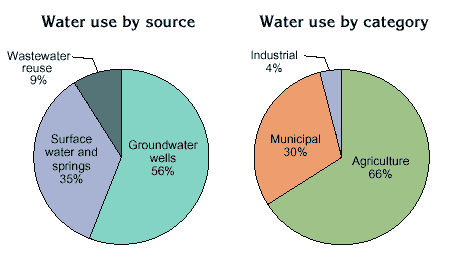 |
| Most of
the region's water supply is pumped from groundwater;
agriculture is the largest water user. Total withdrawals
in 1994 were more than is naturally replenished in an
average year. |
The supply of water is limited to that naturally renewed
by the hydrologic cycle or artificially replenished by anthropogenic
(human) activities. Period-ically, the amount of natural
replenishment can exceed water demands during unusually wet
periods or fall far below demands during drought periods.
The reality of growing needs for a limited resource is one
of the factors driving water con-servation efforts and considerations
of alternate water sources.
Renewal of water resources depends on the overall amount
of precipitation and is affected by temperature, evaporation
and transpiration to plants (evapotranspiration), as well
as rates of runoff and groundwater infiltration (recharge).
On the western side of the Jordan Rift Valley, an average
of approximately 30 percent (%) of the total precipitation
that falls on the region is usable: 70% is lost through evapotranspiration,
5% is runoff, leaving 25% to recharge groundwater. On the
eastern side of the Jordan Rift Valley, 90% of the total
precipitation is lost to evapotranspiration, 5% is runoff,
leaving only 5% for groundwater recharge. Of the 5% to 25%
that infiltrates to groundwater, a portion eventually is
discharged into streams or springs which then are classified
as surface-water resources. The remaining infiltrated water
is stored in the ground-water reservoirs (aquifers) and potentially
is available for withdrawal from wells.
Water distribution systems, such as the Israeli National
Water Carrier and the Jordanian King Abdullah Canal, distribute
water from areas of water surplus to areas of water deficiency.
The northern end of the King Abdullah Canal, shown here,
receives water diverted from the Yarmouk River via a 900-meter
(m) long tunnel.
Total water withdrawal in the region in 1994 was about 3,050
million cubic meters (MCM), of which 56% was withdrawn from
wells, 35% from springs and surface-water sources, and 9%
from wastewater reuse and artificially recharged water. The
estimated total renewable water supply that is practically
available in the region is about 2,400 million cubic meters
per year (MCM/yr). There is then a water deficit in the region
of about 375 MCM/yr that is being pumped from the aquifers
without being replenished. Available water supply can be
enhanced or expanded to a limited extent by desalination
of brackish or sea water sources, leak reduction in infrastructure
systems, water awareness and conservation where appropriate,
dam construction and/or enlargement, and the increased use
of treated wastewater.
Climate
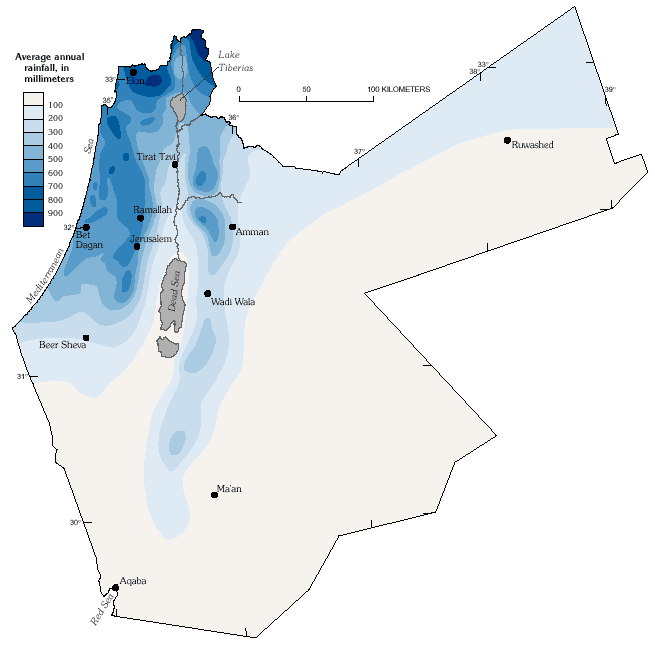 |
Average
annual rainfall, in millimeters. |
Natural replenishment of water resources in the Middle
East varies greatly, as shown below on the map of average
annual rainfall which exhibits large changes in relatively
small distances across the region. A Mediterranean-type climate,
characterized by a hot, dry summer and cool winter with short
transitional seasons predominates in the northern, central,
and western parts of the region. The eastern and southern
parts of the region have a semi-arid to arid climate. Winter
begins around mid-November and summer begins around the end
of May. Rainfall occurs mainly during the winter months.
The Middle East experiences extreme seasonal variations
in climate, as shown below in graphs of average monthly rainfall,
potential evaporation, and average daily maximum and minimum
temperatures for various locations. Large rainfall variations
also occur from year to year, as shown in the graph of annual
rainfall for Jerusalem. Consecutive years of relatively high
or low annual rainfall have an enormous effect on the region
and, in the case of dry years, present the greatest challenge
to manage the region's precious water resources. These consecutive-year
patterns also may affect water-use practices, policies, and
expectations.
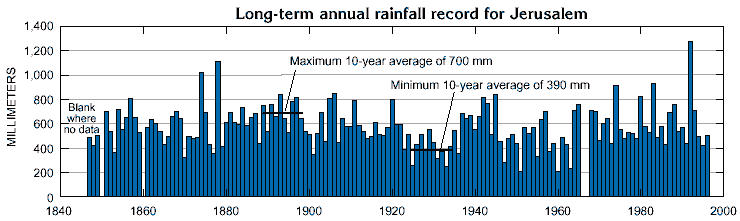 |
| At
Jerusalem, the wettest year of record, 1992, had six
times more rainfall than 1960, the driest year of record.
Consecutive wet years provide sustained increases in
flow to springs and streams, and groundwater recharge.
Conversely, consecutive dry years produce hydrological
droughts. For example, the wettest 10-year period on
record, 1889–98, had 1.8 times more average annual rainfall
than the driest 10-year period, 1925–34. |
Climate characteristics exhibit large changes from one
area to another and across seasons and years. As shown on
the rainfall map, average rainfall decreases from west to
east and from north to south, ranging from 1,200 millimeters
(mm) at the northern tip of the region to less than 50 mm
in the desert areas. Rainfall less than 200 millimeters per
year (mm/yr) constrains development of rainfed agriculture
in about half of the area on the western side, and 90% of
the area on the eastern side of the Jordan Rift Valley.
Temperature also varies across the area, generally according
to latitude and altitude and by physiographic province (see
next pages for description of provinces). The hilly areas
of the Mountain Belt and Jordan Highland and Plateau experience
cold winters and hot summers. In Amman and Jerusalem, average
daily mean temperatures for January range from about 7 to
9 degrees Celsius (°C), whereas, in summer, the average mean
temperature is about 24 °C. Average daily mean temperatures
in the Jordan Rift Valley area range from about about 15
°C in the winter to about
WHAT IS A WATER YEAR?
The hydrologic year runs from October 1 to September
30. Year dates in the graphs and text of this report
refer to water years, not calendar years. |
31 °C in the summer. In the Coastal Plain, average daily
temperatures are between 16 and 22 °C in the winter and between
20 and 31 °C in the summer. The desert region has a continental
climate with a wide range of temperatures. In August average
daily maximum temperatures are between 34 and 38 °C. In winter,
the air is very cold and dry with an average daily minimum
temperature between 2 and 9 °C. When air from a cold, polar
origin penetrates the region, temperatures decrease to below
the freezing point. The region periodically experiences very
hot days during the spring and autumn, called Sharav or Khamasini,
that may produce temperature rises from 10 to 20 °C above
average, and reach from 40 to 45 °C in many areas.
Physical
Geography
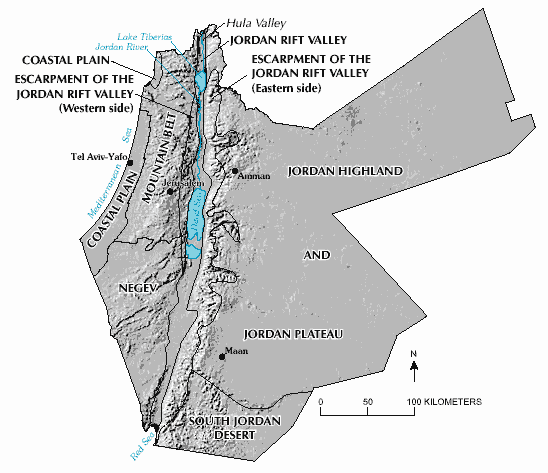
Coastal Plain — Located along
the Mediterranean Sea, the Coastal Plain is home to over
one fourth of the region's inhabitants. It is characterized
by a flat topography with a white-sand shoreline, bordered
by fertile farmlands. The Coastal Plain is formed by the
emergent surface of the continental shelf, consisting of
thick Nile-derived sediments covered by eolian sands of Quaternary
age.
Mountain Belt — Formed of sedimentary rocks
originally deposited as flat layers that were folded in southern
and central areas. In northern areas, including the mountains
west of Lake Tiberias and their transverse valleys, the sedimentary
rocks were offset by faulting. The Mountain Belt rises to
elevations from 500 to 1,200 m above sea level. Cooling of
coastal air masses as they rise over the mountains in northern
areas results in relatively high rainfall.
Negev — An arid zone that does not support a
large popu-lation. In the northern Negev, Upper Cretaceous
and Tertiary sedimentary rocks were folded into a northwest-oriented
mountain belt. The central Negev is charac-terized by low
sandstone hills and plains. These highly erodible areas are
deeply incised by wadis which flow after winter rains and
often produce flash floods. Further south, the region becomes
an area of volcanic craters, rock-strewn plateaus, and rugged
mountains. Several large east-west oriented faults occur
in the Negev.
Jordan Rift Valley — This dominant physiographic
and geologic feature is a 375-kilometer (km) long strike-slip
fault zone that affects the climate, hydrology, and anthropogenic
activities of the region. Vertical displacement of the faults
of more than 3,000 m resulted in the development of the Hula
Valley, Lake Tiberias, and the Dead Sea. The elevation of
the rift valley drops to about 400 m below sea level at the
present shores of the Dead Sea, the lowest point on the surface
of the earth. North of the Dead Sea, the valley has long
been used for agriculture because of avaliable water from
the Jordan River and numerous springs along the flanks of
the valley.
Western and Eastern Escarpments of the Jordan Rift Valley — Formed as the Jordan Rift Valley deepened, causing
abrupt valley walls and deeply incised wadis across the escarpments.
The area is characterized by deep canyons that cut through
Upper Cretaceous sedimentary rocks into underlying rocks
of Precambrian to Lower Cretaceous age.
Jordan Highland and Plateau — Jordan Highland
consists mainly of deeply-incised Cretaceous sedimentary
rocks that rise to elevations of as much as 1,200 m. These
elevations drop gradually eastward toward the Jordan Plateau,
which is characterized by flat open country with shallow
incised wadis draining inland toward the various depressions.
Basalt flows have markedly smoothed the relief in parts of
the plateau.
South Jordan Desert — Extremely arid region
characterized by mountains of exposed Paleozoic sandstone,
dune deposits, and exposed Precambrian crystalline rocks
near the Red Sea. Several extensive northwest-southeast oriented
fault occur in this area.
Groundwater
Groundwater from wells and springs is the most important
source of water supply in the region, providing more than
half of the total water consumption. Groundwater is contained
in openings in water-bearing rock units called aquifers.
The volume of the openings and the other water-bearing characteristics
of the aquifers depend on the mineral composition, texture,
and structure of the rocks. Groundwater generally moves very
slowly and follows the least resistive (most permeable) pathway
from the point of recharge (where water enters the aquifer)
to the point of discharge (where water leaves the aquifer).
Shallow groundwater generally moves at rates up to one meter
per day or greater. An exception is in aquifers that have
conduit-like openings, such as basalt and karstic (cavernous)
limestone, where water may move much faster. Deeply circulating
groundwater moves extremely slowly—sometimes as little
as a meter or less per century.
The flow of groundwater may be inhibited by non-water bearing
rock units called aquicludes. Aquicludes typically consist
of clay, silt, or shale which do not transmit water readily,
although they may hold much water in pore spaces. Aquicludes
influence patterns of flow in aquifers by restricting groundwater
movement. Confined aquifers occur where an aquifer is filled
by water and is overlain by an aquiclude. Unconfined aquifers
occur where an aquifer is not overlain by an aquiclude. Geologic
structure (lithology) also controls flow patterns in aquifers,
either by providing barriers restricting flow or by providing
a less-resistive pathway for flow. The geologic structure
and topography determines if the groundwater will be discharged
as springs or remain underground until tapped by wells.
The importance of an aquifer as a source of water may change
from one area to another because of changes in demands for
freshwater, variations in groundwater quality, and differences
in the hydrogeologic characteristics. Lithologic changes
in a formation may result in its being an aquifer in some
locations and an aquiclude in others. The most productive
aquifers of the region are in Quaternary sand and gravel
in the Coastal Plain; Cretaceous limestone in the Mountain
Belt, eastern and western escarpments of the Jordan Rift
Valley, and Jordan Highland; basalt of the Jordan High-land
and Plateau; and sandstone of the South Jordan Desert. Other
aquifers include water-bearing zones of limestone and sandstone
of lower productivity. Water occurs in pore spaces in the
sand and gravel, pore spaces and cavernous zones in the limestone
and sandstone, and in fractured zones in the basalt.
Freshwater supplies may be obtained from wells drilled to
shallow depths in the Coastal Plain and Jordan Rift Valley;
and from deeper wells (as much as 650 m) in the Mountain
Belt, Jordan Highland and Plateau, and the desert regions.
Generally, water depths are greatest in the mountain ranges
and desert regions, and shallowest in valley floors and in
the Coastal Plain.
In addition to wells, springs provide a source of water
supply from aquifers and form the headwaters of many streams
and wadis. Springs occur where the water table intersects
the surface topography and are common where geologic structures,
such as faults, provide an outlet for groundwater discharge.
Springs represent visible discharge from aquifers; invisible
or concealed discharges include seepages, evaporation, transpiration
to plants, and hidden springs. Under natural conditions,
aquifers discharge water in an amount proportional to total
annual infiltration (recharge).
Groundwater
Basins
Groundwater resources of the region are subdivided into
groundwater basins on the basis of:
- a natural boundary that does not change with time, such
as one determined by structural features, intervening layers,
or aquifer extent;
- a boundary that may change with time, such as an underground
watershed or groundwater divide which may change in response
to pumpage or recharge; or
- a boundary designated solely for administrative or operative
reasons.
Although many basins have been designated by the various
water-resources institutions in the region, in this report
groundwater resources are generalized into 20 basins solely
on the basis of hydrogeological factors. These include ground-water
divides of the most important regional aquifer system, the
limits of an aquifer, or important physiographic features.
The natural boundaries of one aquifer will not coincide
with those of another aquifer. Thus, a basin may contain
several aquifers of different ages and areal extent occurring
at different depths.
Groundwater
Recharge
Although a rock formation may have properties favorable
for storage of water, it must be in contact with a source
of water for replenishment (recharge) to provide a continual
supply of water. Groundwater is derived from two origins:
(1) fossil, which receives no or only a very small amount
of recharge; or (2) recent and renewable.
Fossil aquifers are non-renewable and are found mostly
in the southern and eastern parts of the region. Water probably
infiltrated the fossil aquifers tens of thousands of years
ago, when the prevailing climate was more humid. Because
water pumped from fossil aquifers is not replenished, groundwater
levels show a continual decline as the water is "mined"
from beneath the ground.
Recent and renewable recharge is derived naturally from
precipitation, or from streams, wadis, lakes, ponds, or other
impoundments that seep through soil into the aquifers. In
addition, recharge may be induced by anthropogenic activities
that are intentional, such as injection wells or seepage
ponds, or unintentional, such as irrigation seepage, wastewater
infiltration, or pipe leakage.
Estimates of annual ground-water recharge for the 20 groundwater
basins were derived by the various water-resources agencies
of the region and are illustrated below. Estimates were determined
by summing all points of discharge, with the assumption that
this sum equals aquifer recharge. For each groundwater basin
estimated recharge includes:
- discharge into surface runoff, including measured spring
discharge and estimated discharge into surface-water bodies;
- pumped discharge from wells (measured);
- evapotranspiration (roughly estimated from regional setting
and estimation from other areas); and
- underground outflow to adjacent basins.
Recharge is generally highest in the mountainous northern
part of the region where precipitation is greatest. The percentage
of annual precipitation recharging the aquifers is dependent
on the rates of evaporation, transpiration to plants, runoff,
and soil permeability.
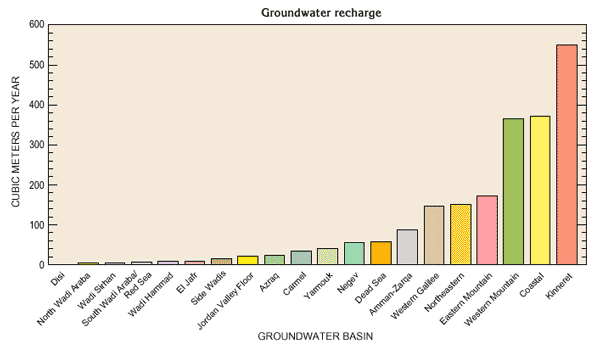 |
| Estimated
recharge rates are highest in the coastal and mountain
basins, and least in the southern and eastern basins.
These patterns generally correspond to the distribution
of precipitation in the region. |
Groundwater
Quality
Groundwater quality can be affected by both natural and
anthropogenic activities. In aquifers unaffected by human
activity, the quality of groundwater results from geochemical
reactions between the water and rock matrix as the water
moves along flow paths from areas of recharge to areas of
discharge. In general, the longer groundwater remains in
contact with soluble materials, the greater the concentrations
of dissolved materials in the water. The quality of groundwater
also can change as the result of the mixing of waters from
different aquifers. In aquifers affected by human activity,
the quality of water can be directly affected by the infiltration
of anthropogenic compounds or indirectly affected by alteration
of flow paths or geochemical conditions.
Contamination of fresh groundwater by saline water is a
common problem in the region. Salinity of groundwater generally
is measured in terms of total dissolved solids or dissolved
chloride. In humid areas and where recharge is abundant,
potential groundwater salinization is limited because of
the natural flushing by freshwater. Conversely, in semiarid
areas, the absence of natural flushing by freshwater enhances
the accumulation of salts and saline water. Natural sources
of saline water include:
- encroachment of sea water near the Mediterranean Sea
and Red Sea;
- upward migration of highly pressurized brines in the
Jordan Rift Valley and other areas; and
- subsurface dissolution of soluble salts originating
in rocks throughout the region.
East of the Jordan Rift Valley and Wadi Araba, water at
depths of a few hundred meters below land surface generally
is saline. Within these areas of generally high salinity,
it is possible that a local source of acceptable, relatively
fresh water exists. Heavy pumping in some areas has led to
water-level declines and changes in flow directions in the
aquifers. In some cases, this has induced saline water from
the sea or deep brines, to move into and contaminate an aquifer.
In addition to natural sources, groundwater quality can
be affected by agricultural, municipal, and industrial activities
in the recharge zone of the aquifer. Potential sources of
contamination include recycled irrigation water, wastewater
from human activities, and waste by-products from industrial
activities. Nitrate is an important constituent in fertilizers
and is present in relatively high concen-trations in human
and animal wastes. In general, nitrate concentrations in
excess of a few milligrams per liter indicate that water
is arriving at the well from shallow aquifers that are polluted
from human or animal waste, or from excess nitrates used
in agriculture. Water-quality changes for selected groundwater
basins are described in the following sections.
Groundwater
Levels
Changes in water levels in wells reflect changes in recharge
to, and discharge from an aquifer. Recharge rates vary in
response to precipitation, evaporation, transpiration by
plants, and surface-water infiltration into an aquifer. Discharge
occurs as natural flow from an aquifer to streams or springs,
as evaporation and transpiration from the shallow water table,
as leakage to vertically adjacent aquifers, and as withdrawal
from wells. Where water-level changes are due to withdrawals,
they also may reflect changes in groundwater flow direction.
Water-level changes for selected groundwater basins are described
in the following sections.
Springs
Springs have been used for thousands of years as an important
source of water supply in the region. Springs are places
where groundwater discharges through natural openings in
the ground and are common in areas of cavernous limestone
or basalt. Springs may vary greatly in the volume of water
they discharge; some springs are so small that they occur
only as seeps where water oozes slowly from the aquifer,
whereas others, such as the Dan Spring, are large enough
to form the headwaters of large streams. Springs flowing
from water-table aquifers tend to have small, extremely variable
flows and are influenced greatly by climatic conditions.
Such springs may cease flowing during periods of low precipitation.
Springs issuing from confined aquifers have larger and more
consistent flows, and show less influence from climate than
do water-table springs.
Springflow is controlled by the size of the recharge area,
the difference in altitude between the spring opening(s)
and the water level in the aquifer, and the size of the opening(s)
through which the spring issues. In addition, climatic conditions
and pumping of wells located near the spring may influence
flows.
Flow characteristics of selected springs are presented on
the following three pages in graphs showing annual flow volume
and statistical summaries of monthly flow volume based on
the period of record. Quality of spring water is indicated
by graphs showing chloride and nitrate concentrations.
Surface
Water
Surface water in most of the region drains to the Mediterranean,
Red, or Dead Seas. In the large desert watersheds, most streams
flow only in response to storms and drain internally, the
water evaporating or infiltrating the ground.
Surface water is very limited in the region because
of generally low rainfall and high evapotranspiration.
However, nearly all of the available, fresh
surface water is used and together with springs
supply about 35% of total water use in the region.
Streamflow characteristics change rapidly across
the region and closely follow precipitation
patterns. Annual streamflow generally declines
from west to east with distance away from
Mediterranean moisture sources, and from north
to south with increasing temperature and evaporation.
Streamflow typically is higher on the
western side of the Mountain Belt, due to temperature
and orographically induced precipitation,
and decreases on the eastern side of the Mountain
Belt descending into the Jordan Rift Valley.
Watersheds
The location and boundaries of the major watersheds of the
region are shown above. Watershed size is a poor indicator
of relative flow because of the extreme differences in climate
across the region. Few streams outside the Jordan River watershed
have adequate baseflow from ground-water and springs to flow
throughout the year. Many streams of the Mediterranean and
Dead Sea watersheds flow throughout the rainy season and are
dry during the summer. Streams of the Wadi Araba and Desert
watersheds typically flow only in response to winter storms.
Peak flows typically occur during February and March, lagging
the peak precipitation period by about one month. This lag
time is due principally to the balancing of extreme moisture
deficits in parched soils and plants after the dry season.
Flood events may also occur following intense storms in the
spring and fall months.
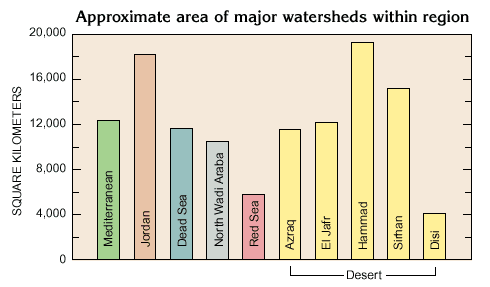 |
| Natural
flow characteristics of streams in the region are related
first to watershed location with respect to rainfall
patterns, and secondly, to watershed size. |
The Mediterranean watershed includes the
Coastal Plain and parts of the Mountain Belt and Negev. The
streams generally have small watersheds with headwaters in
the western mountains. Many of the streams are affected by
water supply diversions and wastewater discharges.
The Jordan River watershed has the largest
water yield in the region and provides most of the usable
surface-water supply. The annual flow volume of the upper
Jordan River above Lake Tiberias is about three times greater
than the combined annual volume of the streams in the much
larger Mediterranean watershed. The Jordan River watershed
is in the Mountain Belt, Jordan Rift Valley and Escarpments,
and the Jordan Highland and Plateau. The largest tributary
to the Jordan River is the Yarmouk River, which is the principal
surface-water resource for Jordan. The Jordan River is perennial
throughout its course, but its flow downstream from Lake
Tiberias is substantially reduced in quantity and quality.
The Dead Sea watershed includes streams with
headwaters in the eastern side of the Mountain
Belt, the Eastern and Western Escarpments of the
Jordan Rift Valley, and the Jordan Highland and
Plateau. The larger of these streams, such as the
Wadi Wala and Wadi Mujib, flow perennially during
their steep decent into the lowest point on the
surface of the earth.
The North and South Wadi Araba and the Red Sea
watersheds contain ephemeral streams that typically
flow only during winter storms that may cause
dangerous flash floods in the deeply incised wadis.
The watersheds are in the Negev, the Jordan
Highland and Plateau, the Jordan Rift Valley and
Eastern Escarpment, and the South Jordan Desert.
Near the mouth of the Hiyyon River lies the internal
divide of the Wadi Araba from which water flows
north to the Dead Sea or south to the Red Sea.
Large parts of the Jordan Highland and Plateaus
and the South Jordan Desert physiographic
provinces are characterized by Desert watersheds
that drain internally. Stormwater flows in these
streams generally decrease in the downstream
direction as water is lost through evaporation and
infiltration. The stream courses of the El Jafr
watershed provides a vivid example of this.
The following pages describe the flow characteristics of selected
streams in the region. Measured annual flow volumes are shown
in a column chart at the lower right corner of each page.
The median annual flow volume of a site may be compared to
other regional streams in the column chart at the lower left
corner of each page. The graph of monthly flow volume illustrates
the seasonal flow characteristics for each stream. Median
monthly flows may be regarded as characteristic for the stream
site, while the minimum indicates whether a zero flow condition
has been observed for each month. The maximum flow indicates
the range of flow and the magnitude of floods that have been
observed on the stream.
Dead
Sea
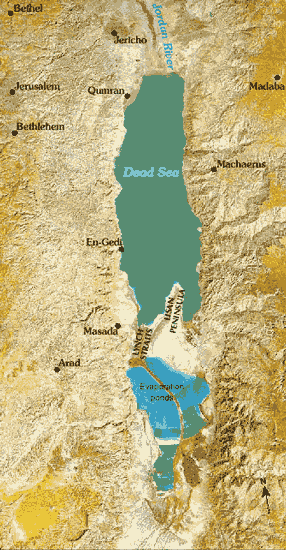
| Located
near the center of the region, the Dead Sea lies at the
terminus of the Jordan River, flowing in from the north,
and the Wadi Araba to the south. The shallow southern
basin has been separated from the main water body by
declining water levels and now contains manmade evaporation
ponds. |
 |
The Dead Sea is the terminal lake of the Jordan Rift Valley.
It is the lowest point on the surface of the earth, and the
waters have the highest density and salinity of any sea in
the world. The east and west shores of the Dead Sea are bounded
by towering fault escarpments that form part of the African-Syrian
rift system. The valley slopes gently upward to the north
along the Jordan River, and to the south along the Wadi Araba.
Historically, the Dead Sea is composed of two basins: the
principal northern one that is about 320 m deep (in 1997),
and the shallow southern one from which the Dead Sea has
retreated since 1978. The two basins are divided by the Lisan
(or Lashon) Peninsula and the Lynch Straits, which has a
sill elevation of about 400 m below sea level.
The closed watershed of the Dead Sea is 40,650 km2 . Most
of the water flowing to the Dead Sea comes from the relatively
high rainfall areas of the Jordan River watershed to the
north, and the rift valley escarpments to the east and west
of the Dead Sea. To the south, the Wadi Araba watershed covers
the arid regions of the Negev and South Jordan Desert. The
climate in the watershed varies from snow capped Mount Hermon
(Jabel El Sheik), with annual precipitation in excess of
1,200 mm, to the arid regions of the southern Negev, where
annual rainfall averages less than 50 mm. Over the Dead Sea
itself, average annual rainfall is about 90 mm and the annual
potential evapotranspiration is about 2,000 mm. Actual evaporation
ranges from about 1,300 to 1,600 mm and varies with the salinity
at the surface of the Dead Sea, which is affected by the
annual volume of freshwater inflow. The average temperature
is about 40 °C in summer and about 15 °C in winter.
The water level of the Dead Sea has a seasonal cycle. Prior
to development of water resources in the watershed, the peak
water level occurred in May and the low occurred in December,
as shown for the period 1935-55 in the bottom graph on the
next page. Within-year variation ranges from 0.3 to 1.2 m
for most of the period of record. Intensive development of
freshwater in the Dead Sea watershed has altered the seasonal
variation in water level, typically increasing the decline
and decreasing the rise.
The water level of the Dead Sea has been monitored continuously
since 1930, and has declined over 21 m from 1930 to 1997.
Such a large decline raises questions of whether there are
precedents for this water-level change and whether they can
be explained by normal vari-ances in climate. Fortunately,
evidence of histori-cal Dead Sea water-level changes may
be found from several independent sources.
|
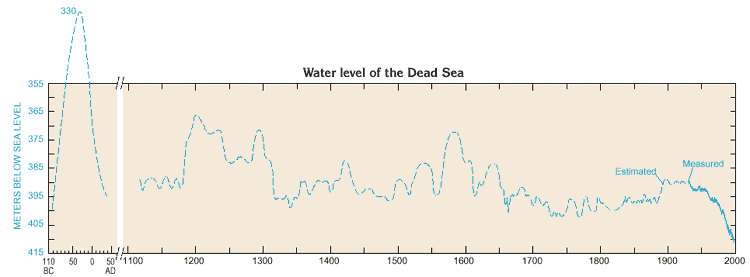
| Historical
water-level records of the Dead Sea have been reconstructed
for a period of over 1,000 years, including the very
large rise and fall in water level around the first century
B.C. (modified from C. Klein, 1985). |
As shown above, there are many precedents in the historical
record of larger, more rapid water-level changes than the 21
m decline over the last seven decades. Furthermore, the historical
range of water-level fluctuations is about 83 m, nearly four
times the 21 m decline in this century. Should further water-level
declines reveal submerged trees, or should traces of historical
submergence be found at elevations higher than 330 m below
sea level, the historical range would increase.
The largest change in water level shown on the estimated
historical hydrograph occurred between about
100 B.C. and A.D. 40. Within this period, the water
level of the Dead Sea rose some 70 m, from about
400 m to about 330 m below sea level (where
Qumran was inundated) in about 67 years; and
subsequently fell some 65 m in about 66 years. A
second large rise, not shown on the graph, occurred
between A.D. 900 and 1100 and crested at about
350 m below sea level. Could these extreme changes
in stage be explained by climate fluctuations?
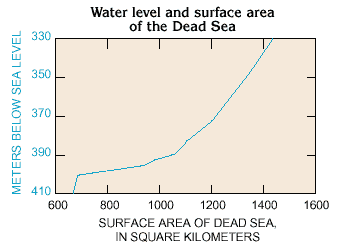 |
| The
surface area of the Dead Sea is known to have varied
between about 1,440 km2 at its historical high of about
330 m below sea level, and about 670 km2 at 410 m below
sea level, a greater than twofold difference. There is
a corresponding difference in the volume of water lost
to evaporation each year. |
To address this question, investigators have made
computer simulations of increased rainfall and runoff
in the Dead Sea watershed, accounting for evaporation
losses. These simulations indicate that rapid
water-level changes on the order of 70 m over a
67-year period could occur if inflow increased by
33 to 48% over an average inflow condition. Likewise,
persistent years of below average rainfall could
cause rapid declines in the water level. Historical
references lend weight to this conclusion. There are
historical references to abundant harvests during the
period of the rising Dead Sea water level prior to
about 67 B.C., and there was severe drought during
the period of the falling Dead Sea water level recorded
by Josephus Flavius for 25-24 B.C. when
Herod had to sell his treasures in order to buy corn
from Egypt for the population.
The Dead Sea balances increased inflows not only
by a rise in water level but also by increased evaporation
losses. As the water level of the Dead Sea
rises, its surface area increases causing a corresponding
increase in the volume of evaporated water.
The greater than twofold increase in surface area
between the elevations of 410 and 330 m below sea
level would increase the annual volume of evaporated
water from 1,005 to 2,160 MCM, assuming a
constant annual evaporation of 1,500 mm per year.
Evaporation during periods of high water level is
further accelerated by the dilution of saline waters
near the surface, because in reality evaporation is
not constant but increases as salinity decreases.
|
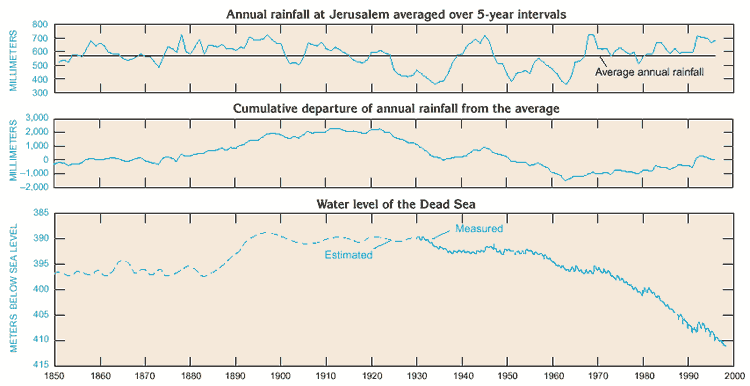
| Water-level
trends of the Dead Sea respond to measured rainfall trends
in the watershed, except for the last three decades,
when the effects of water use dominate the water-level
trend. |
Long-term fluctuations of the Dead Sea water level
are caused by periodic fluctuations in rainfall over
the watershed. The year-to-year water level is steady
when the volume of water leaving the Dead Sea by
evaporation is equal to the volume flowing in from
perennial streams, flash floods in the wadis, and
springs and seeps draining the groundwater. The
water level rises following seasons of abundant
rainfall and declines during drought years, as shown
above in the graph of water level and rainfall from
1850 to 1997. In this graph, rainfall patterns in
Jerusalem are assumed to be indicative of Mediterranean-
based rainfall patterns over the Dead Sea
watershed. When the annual rainfall is above
average for several years, there is a cumulative
effect (shown in the cumulative departure curve)
leading to a rise in water level, such as occurred
from about 1882 to 1895. The cumulative effect of
below average rainfall periods leads to declining
water levels as seen in 1930-36, and 1954-63.
Effects
of Development of Water Resources on Dead Sea Water Level
During the last four decades, water resources in the Dead Sea
watershed have been intensively developed to meet growing demands
for this precious resource. Increasing amounts of water were
diverted from surface and groundwater sources in the watershed
to meet domestic, agricultural, and industrial needs. Since
1964, only a fraction of the flow from the water-rich areas
of the upper Jordan River leave Lake Tiberias to move toward
the Dead Sea. Most of this water and water from the Yarmouk
and Zarqa Rivers is diverted for uses inside and outside the
watershed. Under current conditions on an average annual basis,
the combined inflow from all sources to the Dead Sea has been
estimated as only one-half to one-fourth that of the inflow
prior to development. Water also is pumped from the Dead Sea
itself into evaporation ponds constructed in the shallow southern
basin.
The influence of rainfall and water-resources development
on Dead Sea water levels is illustrated in
the graph above. Until around 1970, Dead Sea water
levels and rainfall showed a correlation. For example,
a falling trend in Dead Sea water levels during
1954-63 corresponds to a period of below-normal
rainfall. This downward trend was interrupted by
above-normal rainfall that produced a rise in water
levels during 1964-69. Since about 1970, however,
the historical correlation between rainfall and Dead
Sea water levels appears to deviate. Although rainfall
generally increased during this period, water
levels declined steeply, corresponding to decreased
inflows from the Jordan River. Although the effects
of rainy years in 1980, and especially 1992, are still
evident, their influence on Dead Sea water levels is
moderated. Development of water resources will
result in a more pronounced impact of droughts on
Dead Sea water levels. Thus, Dead Sea water levels
continue to offer a record of the integrated effects of
historical climate and water-resources development
in this watershed.
Sources: U.S. Geological Survey, Water
Data Banks Project, Multilateral Working Group on Water Resources,
Middle East Peace Process |