Hula Valley
The Hula Valley, an agricultural
region in northern Israel with abundant fresh water, affords an example of
the delicate balance between nature and human development. The past 150
years of human settlement in the valley has been a continuous attempt to
impose order upon nature. The drainage of Lake Hula and its surrounding
swamps in the 1950s was the epitome of the attempts to alter the
environment to suit human needs. Though initially perceived as a great
national achievement for the fledgling State of Israel, with time it became
evident that the benefits from transforming a "wasteland," Lake
Hula and its swamps, into an agricultural "blessing" were
limited. Today, after nearly 50 years of largely unsuccessful struggle to
utilize the drained valley’s resources, the State of Israel has finally
recognized that successful development can endure only if a balanced
compromise between nature and development is achieved. Consequently, a
small section of the former lake and swamp region was recently reflooded in
an attempt to prevent further soil deterioration and to revive the spirit
of an extinct ecosystem.
In this article, we provide an
overview of human activity in the Hula Valley, focusing on exploitation of
the valley’s natural resources. As aquatic scientists keenly aware of
contemporary environmental issues, we hope to highlight the conflicting
demands between social and economic development and environmental
protection and conservation. We also hope to illustrate the vital role that
scientists can have in resolving such a conflict.
The Geology and Geography of
the Hula Valley
The Hula Valley lies within the
northern part of the Dead Sea Rift Valley (Afro-Syrian Series) at an
elevation of about 70 metres above mean sea level. Thousands of metres of
land subsidence during the formation of the Rift Valley about a million
years ago are still evident in the steep slopes of the Golan Heights to the
east and the Upper Galilee mountains to the west, rising 400-900 metres
above sea level. Basaltic hills of about 200 metres above sea level along
the line Korazim–Rosh Pina–Gadot and originating from late Pleistocene
volcanic activity define the southern border of the valley. Where these
hills intercept the Jordan River, they are commonly referred to as the
basalt "plug" because they restrict water drainage downstream
into the Sea of Galilee (Lake Kinneret),* thereby forming
the historic Lake Hula and its surrounding wetlands. In the north, the
valley is delimited by a more gradual transition to the elevated Lebanon
Valley, also rising to about 200 metres above sea level. As such, the Hula
Valley is clearly defined, covering an area of 177 square kilometres (25
kilometres long by 6-8 kilometres wide).
The composition of the sediments
accumulated on the valley floor provides a glimpse into the geological
history of the region’s climatic fluctuations. Lacustrine sediments rich
in lime indicate that a fresh water lake existed at times, expanding in
size and depth during wetter periods. Drier periods led to the formations
of swamps, during which peat, rich in organic matter, was deposited. The
most recent lake, the historic Lake Hula, was formed about 20,000 years
ago. During at least 14,000 years prior to the formation of Lake Hula the
valley was swampland.
The climate of the Hula Valley
today is Mediterranean, with hot dry summers and cool rainy winters.
However, unlike the moderate Mediterranean climate of the coastal plains,
the mountain-enclosed topography of the Hula Valley leads to more extreme
seasonal, as well as daily, temperature fluctuations. Annual rainfull
varies greatly between different parts of the valley and ranges from about
400 millimetres in the south, to up to 800 millimetres in the north. More
than 1,500 millimetres of precipitation falls on the Herman mountain range
(mostly in the form of snow), feeding underground springs, including the
sources of the Jordan River, and giving rise to much of the abundant water
flowing through the valley. The wind regime is dominated by regional
patterns in the winter, with occasional strong north-easterly wind storms (Sharkiyah in Arabic). In summer, local warming and cooling patterns produce strong
westerly to northerly winds in the afternoons.
Lake Hula and the Swamps
With its long history of human
settlement, it is not surprising that Lake Hula (or Huleh) was referred to
by different names. In the 14th century BCE, the Egyptians called the lake Samchuna.
In the 1st century CE, the Jewish historian Flavius Josephus termed it Semechonitis,
while in Aramaic the lake was called Hulata or Ulata. Yam
Sumchi is used in Talmudic literature. More recently, the lake was
called Buheirat el Huleh in Arabic and Agam Hula in Hebrew.
The Waters of Merom has sometimes been used – erroneously – in
scientific literature, although that term refers specifically to springs on
the western side of the valley.
Prior to its drainage in the
1950s, Lake Hula was 5.3 kilometres long and 4.4 kilometres wide, extending
over 12-14 square kilometres. It was a shallow, pear-shaped basin about one
and a half metres deep in summer and three metres deep in winter. The area
north of the lake was covered by peat swamps with dense stands of papyrus.
Open-water ponds covered with yellow water-lilies occurred in deeper
depressions within this papyrus "jungle." Further to the north,
in areas that were water-logged in winter but dry in summer, was a zone of
swampy meadows covered with grasses. A belt of reeds, mostly restricted to
mineral soils, encompassed most of the lake and swamps. Altogether, the
lake and swamps covered up to 60 square kilometres, with large seasonal and
inter-annual variations due to changes in water level.
About two thirds of the water
flowing into Lake Hula came from the Jordan River. The three sources of the
Jordan, the Dan, Hazbani and Banias Rivers, originating on Mount Hermon,
converged in the flat centre of the Hula Valley to form the Jordan River.
Prior to the draining of the Hula, the Jordan split again into three main
deltaic branches before entering the swamps. The stronger and perennial
western branch, the Jordan itself, crossed the swamps and emptied into the
lake. The two eastern branches, Tura and Az- Zawiya, had only winter flow
and disappeared in the swamps. Other streams from the Golan Heights, the
eastern Galilee mountains and from approximately 70 springs in the Hula
Valley itself also fed the lake and swamps. From the lake’s outlet the
Jordan River* bisected the basaltic "plug,"
flowing another 18 kilometres through the Jordan Canyon before emptying
into the Kinneret.
Lake Hula was characterized by its
tranquillity. Dense strands of emergent, submerged and floating aquatic
vegetation covering the lake’s surface and bottom provided lush habitats
for a diverse variety of animal life. The lake extended into the swamps,
adjacent springs and streams, creating an even greater diversity of
inter-connected aquatic niches. This habitat diversity supported the floral
and faunal richness of the old Hula, and rendered it a key feeding station
for migratory birds on their route between Europe and Africa. According to
the researcher Ch. Dimentman and co-authors, Lake Hula probably contained
the richest diversity of aquatic biota in the Levant, south of Lake Amiq in
Turkey, which was also drained at about the same time as the Hula. Based on
an extensive literature review and an examination of archived samples, they
listed 260 species of insects, 95 crustaceans, 30 snails and clams, 21
fishes, seven amphibians and reptiles, 131 birds and three mammals.
Human Settlement and
Development
The natural setting of the Hula,
with ample water, abundant fish, waterfowl and other wildlife, as well as
rich terrestrial and plant resources on its flanks, attracted human
settlement from early prehistoric times. As such, it is not surprising that
archaeological remains near the B’not Ya’akov ("Daughters of
Jacob") bridge at the southern end of the valley date as early as the
Paleolithic, and remnants of one of the first permanent settlements, Enan (Mallaha),
dating from 9,000-10,000 years ago were discovered in the valley.
During early historical times, the
Hula Valley was a main junction on the important trade route connecting the
large commercial centre of Damascus with the eastern Mediterranean coast
and Egypt. The Bronze Age cities of Hazor and Layish were built at key
locations on this route approximately 4,000 years ago. Toward the end of
the 13th century BCE, the Israelite tribe of Dan destroyed the city of
Layish and built in its place a new city which they named Dan. This marked
the beginning of about 400 years of Israelite rule over the Hula Valley,
which ended when the valley was captured by the Assyrian armies of Tiglath
Pileser III and its inhabitants were driven away.
Agriculture in the Hula Valley was
always dependent on the effective use and control of water resources.
Farming communities which mastered the use of irrigation endured, but
unsuitable irrigation methods led to the proliferation of mosquitoes and
malaria. It is uncertain when malaria first appeared in the Hula Valley,
and its extent and impact varied with irrigation and drainage practices.
Throughout the Hellenistic, Roman,
Byzantine and early Arab periods (fourth century bce to eighth centuries
CE) rural settlement in the Hula Valley was uninterrupted. Literary sources
testify to dense and prosperous settlement at the time of the Crusades.
Traditional crops were rice (as early as the Hellenistic period), cotton
and sugar cane (starting after the Arab conquest in 636), sorghum and
maize. Water buffalo were introduced in the eighth century or earlier and
raised on the rich pasture lands as an alternative cattle species,
supplying milk and serving as beasts of burden.
During the 14th-19th centuries,
there were no permanent settlements in the valley, though Bedouin shepherds
continued to graze their flocks in the pasture lands. The cessation of
settlement has been traced to the Mameluk invasion at the end of the 13th
century and the building of the B’not Ya’akov Bridge in about 1260. The
basalt arches of the bridge narrowed the bed of the Jordan River so that
Lake Hula rose higher in winter and the swamps expanded northwards almost
to the edge of the valley.
Settlement resumed between 1830
and 1840 primarily by run-away slaves, deserters from the Egyptian army,
and other refugees. These Arab settlers are collectively referred to as Ghawarna.
They subsisted primarily from the local assets of the swamps, building
their houses from papyrus and earning income from reed-based crafts such as
mat-making. They practiced primitive agriculture based on water buffalo
husbandry and cultivation of rice, wheat and maize. The Ghawarna suffered
severely from malaria, but many of them, especially those of African
origin, had a genetic resistance to the disease. Still, mortality rates
were high and nearly all newborn children died in infancy. Nevertheless, a
population of not more than 3,000-4,000 people was maintained by a constant
influx of newcomers. During the British Mandate (1918-1948), anti-malarial
measures such as planned drainage led to improved living conditions and by
1936, the Ghawarna population had increased to nearly 12,000 persons.
The first modern Jewish settlement
in the Hula Valley, Yesod Hama’ala on the western shore of the lake, was
established in 1883 during the first aliya (wave of Jewish
immigration and settlement) to Palestine.* Malaria hit
this village hard, and no additional Jewish settlements were established in
the valley for more than 50 years. A second wave of Jewish settlement in
the valley started in 1939. Initially, these settlements also suffered
heavily from malaria, but improvements in agricultural practices and the
use of pesticides such as DDT reduced the infection rate among the Jewish
settlers to below one percent. In total, by 1948 there were 12 Jewish and
23 Arab settlements in the Hula Valley. Following the etablishment of the
State of Israel and during the 1948 War of Independence, the Arab
inhabitants left the valley, moving to neighbouring Arab countries.
The Hula Drainage Project
The concept of draining the lake
and swamps of the Hula Valley so as to increase the amount of arable and
grazeable land and eradicate malaria, extends back to the 19th century.
John MacGregor, a Scottish traveller to the Hula Valey in the 1860s,
commented in his notes that in his opinion, the entire lake and swamps
could be drained in one year by digging a 400-yard-long, 20 feet-deep canal
at the outlet.
Attempts to drain the swamps were
made by the Ghawarna in the late 1800s, by enlarging the outlet and by
digging drainage canals. The extent of their operations and their
effectiveness is uncertain. Soon afterwards, the valley became the property
of the Turkish Sultan Abed el-Hamid. His administration planned to drain
the swamps in order to gain profits from agriculture. However, after
several failed attempts they turned the task into a concession for private
companies. The concession was sold initially to Syrian merchants. After
many years of dealings and bargaining, the drainage concession was
purchased by the British Palestine Land Development Company in 1934. But
due to the outbreak of political disturbances in 1936 and economic
difficulties during World War II the Hula draining project materialized
only after the State of Israel was established in 1948.
The declared objectives of the
Hula draining project were two-fold: the addition of arable land and the
eradication of malaria. Additional perceived benefits were to be an
increase in the water potential of the newly established state by reducing
evaporation losses, and utilization of peat as fertilizer and for industry.
The draining operations, carried
out by the Jewish National Fund (JNF), the agency responsible for land
development in Israel, began in 1951 and were completed by 1958. The
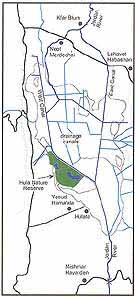
draining was achieved by two main engineering operations. The Jordan River
downstream of the lake was deepened and widened, especially at the basalt
plug, to allow the outflow of larger quantities of water. In the swamp
region north of the lake, the Jordan was diverted into two newly-dug
peripheral canals, the East Canal and the West Canal, which enclosed most
of the peat lands. These canals converged near the centre of the former
lake and then followed the original but now deepened course of the Jordan,
continuing southward to Lake Kinneret. Consequently, the section of the
Jordan going through the centre of the drained valley as well as other
waters flowing through the valley were channeled through a dense network of
secondary drainage and irrigation canals to the East and West Canals. In
the years following the completion of the drainage project, sewage from the
growing town of Kiryat Shmona was also directed into the West Canal.
Public interest associated with
the draining project was so great that the digging sites at the Hula Valley
became major tourist attractions. In fact, it was necessary to restrict
tourism in order to prevent delays in the progress of the work. At the same
time, concern was already voiced by scientists and naturalists who opposed
the project because they viewed the swamps as an ecological treasure that
must be preserved for future generations. As a result, a small (350
hectare) area of papyrus swampland in the southwest of the valley was set
aside and in 1963, became Israel’s first nature reserve.
Perhaps the greatest benefit of
the debate over the draining of the Hula was the establishment of
Israel’s most prominent environmental institutions: the Society for
Protection of Nature, and a few years later the Nature Reserves Authority.
The Dry Hula Valley
(1958-1993)
Given the conditions and knowledge
existing at the time, the drainage of the lake and swamps of the Hula
seemed fully justified. Not only did it provide solutions to urgent needs
of the young state, it was also considered a great engineering achievement
and followed common practice worldwide. Moreover, the increase in
cultivable land and the eradication of malaria were rooted in Zionist
philosophy. During the 1950s, prior to the construction of the National
Water Carrier, food was scarce in Israel and currency for its import was
lacking. The additional 5,000 hectares of arable land in the Hula Valley
proved to be highly beneficial to the economic development of the country.
However, as the years went by, it
became clear that the objectives of the draining project had been only
partially fulfilled. The peat soils proved suitable for agriculture, but
the anticipated exceptional yields were never obtained. The goal of
eradication of malaria was actually achieved in 1949, irrespective of the
draining project, as a by-product of the exodus of carriers of the malarial
parasite. Nevertheless the project succeeded in removing 5,000 hectares of anopheles mosquito habitat thereby reducing the chances for re-introduction of the
disease. The use of peat as fertilizer or for industry never materialized.
Probably the main benefit of the project was the addition of an estimated
28 million cubic metres of water per year to the country’s water
potential through reduction of loss by evaporation.
With time, severe problems
developed in the middle and southern parts of the Hula Valley, most of
which originated from peat sediment degradation and subsidence. As the
level of the groundwater table fell, air penetrated into the dried peat
enhancing microbial decomposition of organic matter. Often these processes
led to uncontrollable underground fires and the formation of dangerous
caverns within the peat. The weathered peat soils turned into infertile
black dust. Strong winds sweeping the valley produced dust storms that
caused major damage to agricultural crops. Consequently, the ground surface
subsided by up to three metres in some regions and inundation of these
areas during winter rains restricted cultivation in many areas. An indirect
problem associated with the drying of the soils was the proliferation of
field mice populations which soared and wreaked havoc on agricultural crops
in the valley. Over time, farmers abandoned more and more of the valley
where cultivation was no longer profitable, thereby further enhancing the
rate at which these soils deteriorated.
In addition to these agricultural
problems, various ecological problems became apparent. The decomposing peat
released large amounts of nitrates and sulfates which during the winter
rainy season were washed into Lake Kinneret. Although the impact of
sulfates on the Kinneret is less obvious, nitrates are major sources of the
nitrogen required for algal growth and their addition to water can lead to
reduced water quality. Estimates are that about 40 per cent of all nitrate
loading into Lake Kinneret comes from the drained Hula Valley.*
Furthermore, even though the Hula
Nature Reserve was created to preserve much of the character and nature of
the original lake and swamps, after the draining, 119 animal species were
lost to the region, of which 37 were totally lost from Israel. Similarly,
many freshwater plant species became extinct and many of the massive flocks
of migratory birds that used to land in the valley found alternative
feeding sites on their route between Europe and Africa.
In the 1980s it became apparent
that action had to be taken to stop the deterioration of conditions in the
Hula Valley. Consequently, the Hula Restoration Project was formulated.
The Hula Restoration Project
From the beginning it was clear
that a successful rehabilitation programme for the Hula would require
careful planning based on the best possible expertise in many disciplines,
including soil sciences, agriculture, hydrology, ecology and tourism. Again
the JNF stepped in as the driving force, and a scientific overseeing
committee was appointed to review the relevant issues of the project. The
committee identified two national goals for a rehabilitation programme: 1)
preservation of the peat soils for future generations, and 2) protection of
Lake Kinneret from contamination originating from the Hula peat.
A feasibility survey was completed
by 1990, examining alternative ways for achieving these national goals in
the framework of a rehabilitation plan that would also address nature
conservation and water supply issues. In addition, because the
rehabilitation plan would require the giving up of land by the farming
communities in the area, it had to include a means of alternative income to
the farmers. Therefore a compromise plan was chosen which would provide
alternative income in the form of eco-tourism. The project commenced in
1993, with joint funding by the Israeli government (67 percent) and the JNF
(33 percent). As of June 1996, more than US $23 million had been invested.
The three main principles of the
Hula Restoration Project are:
1. Maintenance of a high water
table and year-round green cover on the peat soils in order to slow down
the decomposition and subsidence processes;
2. Creation of a small shallow
lake rich in plant, fish and bird life and surrounded by green pastures
with grazing safari animals to serve as a centre for tourism and
recreation;
3. Minimization of the flow of
pollutants into Lake Kinneret from both the communities of the Hula Valley
and from the peat soils.
To reduce soil deterioration, soil
and agricultural scientists have devised a crop rotation scheme which
offers a compromise between income and soil protection. In the areas
unsuitable for cultivation, current research results indicate that local
vegetation in conjunction with imported tropical grasses could provide the
desired year-round green cover of the peat soils, as well as providing
grazing lands for safari animals.
In order to keep the peat soils
wet, hydrologists drafted plans to raise the water table to an average of
75 centimetres below the surface. The height of the water table was
determined so as to be deep enough to allow cultivation of the land
allocated for agriculture, but shallow enough to reduce the volume of peat
requiring constant irrigation. The high water table would be regulated
primarily via an extensive network of 90 kilometres of new drainage/flood
canals, a small lake and large-scale surface irrigation equipment.
In addition to providing increased
flexibility in water level management, the lake was designed to serve as a
centre for developing eco-tourism and recreation. This small lake, named
Lake Agmon,* was dug in the area of the peat lands least
suitable for agriculture and flooded in April-May, 1994. The historic, but
dried-up route of the Jordan River, through the centre of the valley, was
restored and forms the primary source of water for the lake. By creating
these two aquatic systems, the planners hoped to create suitable conditions
for the re-establishment of some of the many plant and animal species that
had been lost to the region, thus attracting tourists. Justifiably, the
concept of tourist development caused concern among those interested in
ecological priorities, principally the Nature Reserves Authority and the
Society for the Protection of Nature in Israel. While the environmental
organizations acknowledged that the area could not be totally insulated as
a formal nature reserve, they were able to convince the farmers and
developers that the commercial elements had to be integrated aesthetically
into the new landscape. The agreed plan called for building a holiday
village northwest of the lake. This centre would also offer sites for bird
watching, hiking, picknicking, and boating.
Several actions were taken to
minimize the flow of polluted water from the Hula Valley into Lake
Kinneret. First, pumping stations and regulation facilities were
constructed to prevent overflows from the peat lands into the Jordan.
Instead, these waters are diverted into Lake Agmon via a northern inlet
canal. Water flowing out of Lake Agmon is diverted into a large storage
basin, the Einan Reservoir, west of the valley, to be used for irrigation
in adjacent farmlands. Second, an underground partition was constructed,
sectioning the valley south of Lake Agmon from east to west, to prevent
underground seepage of peat water southward. Thirdly, there is a pipeline
to carry sewage effluents from the town of Kiryat Shmona and other
communities in the valley, directly to the Einan Reservoir. As with the
waters flowing through the Hula peat soils, these polluted waters will be
treated and used for irrigation and will not reach Lake Kinneret.
Before 1951
 |
|
1951-1958
 |
|
After 1994
 |
Lake Agmon
Lake Agmon is located in the
southern part of the Hula Valley in the area that once served as the
transition between Lake Hula and the surrounding swamps. It is important to
note that this new lake was not intended to be a re-creation of Lake Hula.
It is shallower and much smaller than the original lake. It has an
irregular shape, covering an area of one square kilometre with mostly less
than one metre depth of water. Deeper (one and a half metre) boat canals
were dug along its rims and surrounding two islands on the northeast side,
to allow limited boating activity. Several smaller islands were created in
the middle of the lake, to provide protected nesting sites for birds.
The quality of water in Lake Agmon
is strongly influenced by the two primary water sources – the Jordan
River entering the lake from the northwest and bringing relatively clean,
high-quality water, and a central drainage canal flowing into the lake from
the north, bringing poorer-quality peat drainage waters. Even though the
Jordan is the primary source of water during much of the year, the water
quality in the lake is more characteristic of peat drainage waters, often
highly coloured and cloudy with high levels of dissolved substances such as
sulfates, carbonates and plant nutrients. Although rendering the water
unsuitable for drinking, these substances contribute to the vitality of the
ecosystem. The combination of abundant plant nutrients, diverse aquatic
habitats and sunlight leads to enhanced growth of many forms of plant life.
These include microscopic free-floating algae (phytoplankton), mats of
filamentous algae covering the lake sediments, rooted plants emerging
through the water, such as papyrus and cattail, and rooted submerged or
floating vascular plants. The high primary production supports a healthy
food web of zooplankton (microscopic grazing and predatory animals),
insects, molluscs, fish, birds and other animals.
An important attribute for the
eco-tourism aspects of the project has been the successful re-introduction
of plant species that had beome extinct following the drying of Lake Hula.
Of ten such plant species that were selected for re-introduction, five
successfully established populations within two years and two more showed
potential to survive. In addition, more than 30 aquatic plant species have
re-established themselves spontaneously. Near the shores of the lake an
additional 15-20 species have re-invaded the valley.
Much of the success in species
re-establishment in the area may be attributed to high nutrient
availability, which also gives rise to extensive plant development on the
shorelines and in the lake. These dense stands of plants in Lake Agmon are
aesthetically pleasing and attract abundant bird populations and other
wildlife. However, in the drainage/flood canals, dense strands of plant
growth impede water movement, thereby reducing the effectiveness and
flexibility of the management of the water table elevation. Moreover, the
slow backwater conditions in these canals with heavy vegetation raise the
problem of a possible return of malaria. Neverthless, recent surveys
suggest that the particular species of anopheles mosquito responsible for
the spread of malaria remains rare and the threat of malaria in the Hula
Valley is no higher than in other parts of Israel.
During the first three years after
re-flooding, at least 120 species of birds have been recorded in or around
the lake. Massive flocks of migratory pelicans, storks, cormorants, cranes,
and other birds en route between Europe and Africa, spend days to weeks in
the vicinity of Lake Agmon. Also, new nesting colonies of various species
such as herons have been established. Birds are attracted not only by the
lush nesting sites, but also by the rich food resources in the lake.
Following the draining of the original Hula, many of these birds were quick
to discover commercial fish ponds as an alternative source of food in the
valley, causing extensive economic losses. For this reason, the managers of
the Hula Restoration Project are not taking any chances. Fearing the new
lake may not support enough fish production to draw birds away from the
fish ponds, the natural fish populations are supplemented by artificial
stocking. Unfortunately, not all aspects of the returning bird populations
are positive. An unforeseen complication is that many of the species
attracted to the lake for nesting or other reasons, such as coots and
cranes, cause extensive damage to agriculture in nearby fields.
Though still in research and
planning stages, the Hula Restoration Project also intends to populate the
areas around the lake with grazing mammals. The water buffalo is an obvious
choice due to its history in the area and because a small population is
already present in the Hula Nature Reserve. Other animals, such as donkeys,
or swamp horses from France, were also considered. The project has
recognized that not only will sufficient grazing areas be required, but
these animals will also need shade from the strong summer sun. For this
reason, intense efforts are underway to decide on appropriate shade trees
that can be introduced into the area. Unfortunately, the peat soils are
unstable, so that most tree species would be uprooted by the strong winds
common in the valley. Researchers are hoping that by planting trees in
large holes filled with lacustrine soils from the bed of the reconstructed
Jordan River, the trees will be better able to tolerate the winds.
Lake Agmon is an aesthetically
pleasing site with relatively good water quality. As yet this is still a
developing environment and major changes in community composition and
structure of its animal and plant life may still take place. Within the
first four years since its formation, the lake has shown signs of a healthy
ecosystem that attracts visitors (both human and wildlife) year round. In
1998, the diversion of the Hula peat waters and Kiryat Shmona sewage
through the Einan Reservoir was completed, and now we anticipate that,
indeed, the flow of nitrates into Lake Kinneret will be reduced by at least
40 per cent annually and pollution of the Kinneret in general will be
lowered.
Similar to the emotional reactions
of those who expected an agricultural paradise in the Hula Valley following
drainage of the swamps in the 1950s, today we have the feeling that the
restoration project has been remarkably successful. A beautiful lake with
lush vegetation, green fields and flocks of birds dazzle the eye and offer
a picturesque scene of tranquillity against the grandeur of Mount Hermon.
It is perhaps ironic that this
project has instigated a conflict with several environmental organizations
over the planned development of tourism. Granted, a return to the Hula of
yesteryear would be a conservationist’s dream. However, we must be
reminded that dreams are usually not practical. Therefore it may be
beneficial for the environmentally concerned to try to find a positive side
to touristic development, such as the opportunity to increase national
awareness of the environment. We should applaud the communities of the
valley and the Hula project for bringing back a small fragment of an
extinct ecosystem.
Acknowledgements
We have drawn material for this
article from the published Hebrew and English literature and from
professional reports. Especially useful were the writings of Y. Avnimelech,
S. Dasberg, A. Harpaz, A. Horowitz, D. Kaplan, Y. Karmon, D. Levanon, M.
Livneh, G. Orshan, G. Shacham, E. Shy and M. Zohary, and the monographs on
the Hula Valley by Ch. Dimentman, H. Bromli and F.D.Por.
Much of the present-day material
relating to the Hula Restoration Project and Lake Agmon is based on our
work as coordinators of the Hula Aquatic Research Programme which
accompanies the restoration project, as well as on other research
programmes within the project. For this, we are greatly indebted to our
many colleagues. Lastly, we thank T. Berman, D. Kaplan and D. Zohary for
providing useful comments and suggestions.
*In the
present article, we have used the common Israeli term – Kinneret – for the Sea of Galilee. The word comes from the Hebrew word kinor (lyre or harp), roughly describing the shape of the lake.
* See Eli Choter: "The River Jordan," Ariel no 89, 1992.
* See Arik Lubovsky: "The Subotniks of Yesod Hama’ala," Ariel
no. 90, 1992.
* See Tom Berman: "The Kinneret – Sea of Galilee," Ariel no 98,
1994.
* From the Hebrew word for "bullrush."
Sources: Israeli
Foreign Ministry |