Operation Gift
(December 28-29, 1968)
Operation Gift is the codename for an Israel Defense Forces raid at the Beirut Airport in reponse to multiple terror attacks against Israel's national airline, El Al. In the raid, IDF special forces destroyed numerous airplanes belonging to various Arab airlines; no casualties were reported.
- Background
- The Target
- Planning & Preparation
- The Air & Naval Roles
- The Operation
- "Uzi" Force
- Digli Force
- Negbi Force
- Naval Force
- Results
Background
On 22 July 1968, terrorists hijacked an El Al plane on its way from Israel
to Rome, and forced the pilot to land in Algiers. About four months later, in
the early afternoon of 26 November, two terrorists who had arrived in Athens
from Beirut Airport, fired at an El Al plane about to take off from the Athens
Airport. As a result, an Israeli citizen was killed, a stewardess was wounded,
and the plane damaged. Thanks to the quick intervention of Israeli security
guards, who captured the terrorists, a greater tragedy was averted. The
spokesman of the "People's Front for the Liberation of Palestine (PFLP),
whose headquarters was in Beirut, announced that the operation was carried out
by his organization. Beirut, at that time was a center for Arab terrorism.
In response, the IDF decided to attack aircraft belonging to Arab airlines,
that were at the Beirut Airport for an airborne commando operation.
The Target
Beirut International Airport is located approximately 90 kms (55 miles)
north of Rosh-Hanikra, on the Israeli-Lebanon border. It is situated south of
the city of Beirut, and approximately two kms eastward from sea. The airport
is comprised of two runways crisscrossing scissor-like, in north-south
direction. Between the two lanes lies the passenger terminal and in front of
it, an open area. At the north-eastern and the south-western edges of the
runways, were hangars, parking and maintenance areas for the planes. South of
the terminal was the standby emergency services pavilion of the airport, where
fire and first-aid stations were located.
In the airport there were only about 90 security men armed primarily with
handguns. They worked in three shifts. A Lebanese Army commando company was
deployed three kms from the airport, standing by at five-minute alert status.
Lebanese Gendarmes and Police in the Beirut area could arrive at the airport
in an half hour, and the Armored Car Mobile Gendarmes Unit and other military
forces could arrive within an hour after receiving an order. Our air and naval
forces did not expect any Lebanese air and naval forces activity, nor did they
expect that our activity would be detected by Lebanese radar.
Planning & Preparation
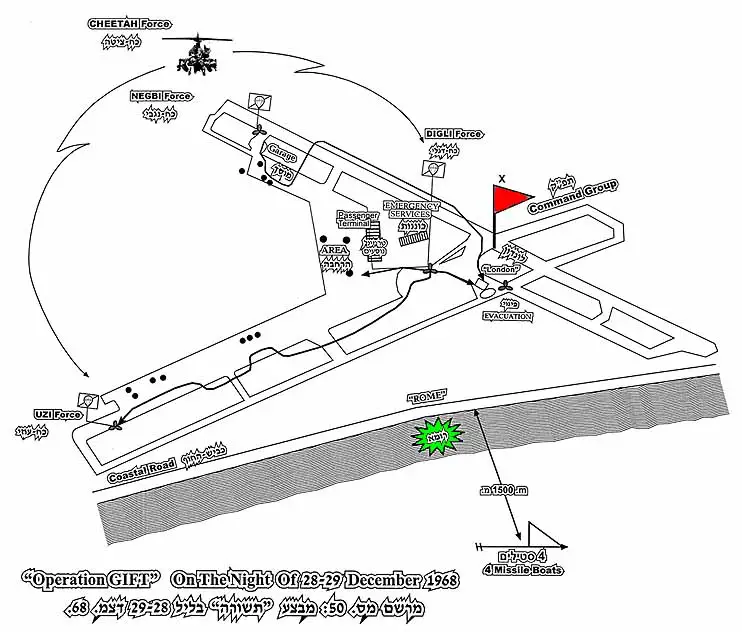
Plan for Operation Gift (click to enlarge) |
Planning for "Operation Gift" commenced following the plane
hijacking on 22 July. The initial intention was to hijack planes in Beirut.
Since a basic plan existed, an order went out to IDF General Staff Operations
immediately following the Athens plane attack, to revise the Operation Gift
contingency plan for the possibility of destroying and not hijacking the
aircraft. A similar order was issued to the Israel Air Force, whose aircraft
were immediately placed on alert and their serviceability was increased. Two
days later, on Saturday, 28 December, the operational task force assembled in
Ramat-David Airbase, fully trained and ready for action. An air-head was
established in Betzet Airport to enable helicopters to land there in case they
should run out of fuel. The mission, which every task force member knew to the
letter was: To sabotage the maximum number of airplanes belonging to Arab
airlines at Beirut International Airport, while avoiding harm to civilians and
damage to aircraft belonging to other airlines; to damage installations, and
if the number of planes be small - to sabotage military aircraft that might be
in the military area of the airport.
The operational plan was as follows:
The airport was divided into three primary operational sectors: the eastern
sector, the western sector and the terminal area sector. Each sector was
assigned a force of 20-22 fighters. They were commanded from a forward command
group headed by the then Chief Paratrooper and Infantry Officer, Brig. Gen.
Rafael Eitan, "Raful". The forward command group consisted of 12
fighters, including the Head of the General Staff Operations Branch, Nadal,
who was deputy commander of the operation.
A 22-man force from an elite unit under the command of Lt. Col. Uzi
("Uzi Force") was ordered to land in a Super-Frelon helicopter in
the north-western edge of the runway. They were to sabotage aircraft on the
western part of the airport up to the boundary of the force's sector of
operations, the north western corner of the passenger terminal. The force was
to then proceed to the "London" evacuation point which was at the
intersection of the two runways.
The second force of that unit, comprised of 20 men under the command of the
elite unit commander, Maj. Digli ("Digli Force"), was ordered to
land in a Super-Frelon south of the area of the main building, and to sabotage
the planes there. The troops were then to precede to the "London"
evacuation point after completing their mission. They would stand by, and in
the event that evacuation would take place by sea, they would secure a bridge
head on the shore.
The third force, comprised of 22 men of the 35th Brigade's Reconnaissance
Company, commanded by the company commander, Capt. Negbi ("Negbi
Force"), was ordered to land in a Super-Frelon on the northern edge of
the eastern runway and to sabotage planes situated from that point southward
to its sector boundary, the passenger terminal, and to then evacuate in the
same manner as the other two forces.
The Helicopter Squadron Commander, Lt. Col. Eliezer "Cheetah"
Cohen, who was in a light helicopter along with a Paratroop officer, a flight
surgeon and flight mechanic, was ordered to block the area of operations
eastward and northward from the air.
It was decided that the sabotage of the aircraft belonging to Arab
countries would be effected by two charges, one which would be placed in the
landing gear under the aircraft's nose and the second, which would be placed
in the landing gear of one of the wings. This would immobilize the aircraft
and set it aflame. Each aircraft would be prepared for a separate explosion,
although it would be possible to link charges by means of a switch, and to
blow up several planes simultaneously dependent upon the conditions on the
ground and providing t`hat non-Arab planes would not be damaged.
Evacuation would be carried out by one of the following alternative routes
in accordance with conditions in the field:
- From the intersection point of the two runways, code-named
"London", where the forces were to assemble after completing
their mission. Three Super-Frelon helicopters would be tasked to evacuate
the forces.
- From a point on the seacoast, code-named "Rome". The
evacuation would take place by Israel Navy missile boats and naval
commando.
- From the main runway of the airport, by two Nord aircraft which would land
there.
If a mishap were to take place, the force would be evacuated by naval
commandos or with the support of 36 soldiers from a special forces battalion,
who were standing by to be flown out from Ramat-David Airbase to Beirut
Airport.
The entire operation was to last 30 minutes from the landing of the first
helicopter until the take-off of the last helicopter for Israel.
"H" hour, which had been set for 22:00 hrs on the 28 December,
was advanced by three quarters of an hour following updated intelligence which
arrived on Saturday afternoon, 28 December, that the number of aircraft at
21:15 hrs would be greater than that three quarters of an hour later.
The Air & Naval Roles
The operational plan assigned six Super-Frelon helicopters and two
additional helicopters as reserve, for landing the force in three different
locations and evacuating them from the point of evacuation.
Seven Bell helicopters (and an additional one in reserve) were tasked: five
to serve as the rescue or evacuation force, one for the forward command group,
and another for patrol and transmission.
Four Nord aircraft (and additional one in reserve) were tasked: two to
evacuate the force, and an additional two for dropping flares, transmission,
and naval rescue. Two Boeings would serve for transmission. Two skyhawks and
four Vautours were in reserve for illumination and attack, should need arise.
According to the operational plan for the Navy, two Torpedo boats four Saar
class missile boats and thirteen rubber dinghies as well as naval commandos
were to be in stand-by in the event that naval - air rescue operations would
be required. The naval forces were to group at "H" hour six nautical
miles off "Rome Beach" and at "H" + thirty minutes, half
of the force was to deploy 1,500 meters off the beach. The Torpedo boats were
to stand-by 12 nautical miles off the coast. One opposite Tyre and the second
opposite Sidon. The naval forces were to reach their objectives by proceeding
north twenty-five miles west of the coast, then to reach a point twenty miles
off their objectives and then to approach slowly to the coast. The trip from
Haifa port to the objective was to last about three and a half hours.
The Operation
The helicopters took off from Ramat David Air Base at 20:37 hours. The
calculated times to target were 45 minutes for the Super Frelon helicopters
and 53 minutes for the Bells. They grouped about twelve kilometers west of
Rosh Hanikra and from there approached the coast flying northward. When they
approached the airport, the helicopters dropped to 200 - 300 feet, and as of
21:18 hours, three Super Frelons landed at intervals of several minutes. At
"H" + 5 minutes, the Bell forward command post landed and the second
Bell hovered above, opposite the international airport on a patrol and
blocking mission.
Lt. Col. Eliezer (Cheetah) Cohen at the controls of the Bell helicopter was
responsible for carrying out the blocking mission. On his first and second
passes he dropped 95 smoke grenades and twenty smoke flares which created a
heavy smoke screen on the eastern and northern perimeters of the airfield. The
helicopter then dropped nails on the roads leading to the airport. This
succeeded in halting six cars traveling to the airport. Vehicles in the
airport trying to escape northwards to Beirut city and police and fire brigade
vehicles traveling to the airport created a traffic jam which in itself
constituted an effective block. In addition, Cheetah's helicopter fired
warning shots at vehicles trying to enter the airport. When Cheetah spotted
what appeared to be a military truck attempting to enter the airport by
bypassing the traffic jam, he opened fire at it and the vehicle came to a
halt.
Supported by the blocking helicopter, Uzi Digli Negbi forces proceeded to
carry out their missions.
"Uzi" Force
Uzi force which landed as planned in the northern edge of the western
runway, confronted three groups of aircraft: The first comprised of five
planes, the second of two to three planes, and the third of three. Since the
planes of the latter group of aircraft were in close proximity to each other,
the force blew them up collectively. The troops then secured the area and
began to plant explosive charges working from north to south and proceeded to
blow up each plane individually. The force avoided entering the military area
of the airport where the lights went out as soon as the force landed. Thus,
the force did not sabotage a number of planes that were undergoing servicing
there.
In total, the force destroyed four planes in the first group while a fifth,
a "Dakota" was intentionally spared. The second group was left
untouched, while the third group was completely destroyed. In total, six Jets
were destroyed.
As the force was planting explosive devices, a vehicle approached the
scene. LTC Uzi fired several warning shots over it and it vanished. Warning
shots were also fired over the heads of workers who approached and immediately
fled the area as they were ordered by LTC Uzi. The force was not hampered as
it made its way to the evacuation point.
Digli Force
Digli force which landed South of the open area, moved northwards towards
it and detached a force across the airport emergency services building. The
force saw four aircraft in the well-lit area. The force positively identified
three as Lebanese aircraft. However, the fourth was difficult to identify as
it faced the force.
The force thus decided to deal with the three positively identified craft
and destroyed three planes. Two squads were ordered to approach two planes,
plant explosive charges and when they called out "ready" they
received the order to operate the devices, as the force receded so as to not
get hurt from the explosion.
Later, an additional squad was sent to the third plane. During the
operation, light fire was directed at the squad from a passenger building. The
two remaining squads fired warning shots at the building, so as not to injure
civilians. This allowed for the first squad to sabatoge the third aircraft.
The force later moved on to the evacuation point.
Negbi Force
Negbi force landed in its designated point and from there moved south along
the eastern lane. The advance squad reported all Lebanese planes it
encountered, after which a demolition team was sent to it. Four planes were
identified, one of which was discovered inside a hanger. Capt. Negbi intended
to destroy all four planes simultaneously, which is why he waited till all
devices were planted. He then gave the order to blow up the planes. However,
the order which was issued by megaphone was not heard inside the hanger. Only
when the squad members noticed the rest of the force members were receding,
did they detonate the devices and pull out. Apparently, the aircraft in the
hangar did not blow up. However, to avoid complications, the force withdrew
southward to the airport fuel installation which was behind and east of the
passenger building. The force requested to sabotage the fuel depot but was
refused permission by the forward command group. Therefore, the force
proceeded to the evacuation point.
Since Negbi force was the first to reach the evacuation point, it prepared
two trapezes as a sign for the evacuating helicopters. At 21:47 hrs, the first
helicopter landed to evacuate the force, and fifteen minutes later, the third
? helicopter took off from Beirut International Airport on its way south to
Israel.
The Naval Force
The naval force which left Haifa at "H" -three-and-a-half hours
sailed northwards towards Sidon. En routte it was forced to return one of the
torpedo boats (the one that was supposed to be positioned across Tyre) due to
a motor failure in the craft. The force (with the exception of the single
torpedo boat which positioned itself between Tyre and Sidon) stood by 1.5 Kms
off the Beirut Coast and observed the destruction of the aircraft. After it
received a report that the ground force was evacuated safely, the naval force
returned to Haifa Naval Base.
Results
A total of 14 planes belonging to Middle East Airlines
(MEA) and Air Libea were destroyed (two Boeing 707; three Commet C - 4;
Caravel; Viscount planes; and 1V.C. -10). Estimated damage was 42 - 44 million
dollars. There were no casualties reported during the operation on either side.
Sources: IDF |