Al Gore
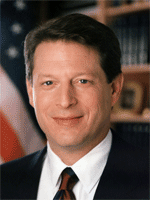
Learn More about Democratic Nominee Vice President Al Gore:
AICE does not rate or endorse any candidate for political office. This page is for informational purposes only.
Remarks by Vice President Al Gore to the American
Israel Public Affairs Committee Conference at the Washington Hilton Hotel,
Washington, D.C., May 23, 2000. Excerpts:
Our enduring support for a strong and unshakable
partnership between the United States and Israel; our commitment, our shared
commitment to one of the cornerstones of America's national security, a
strong, secure, peaceful and prosperous state of Israel. This will never
change. Never. When I think about that special relationship, I'm reminded of a
story that I read recently about some of the earliest discussions between the
United States and Israel. David
Ben-Gurion, although he proudly proclaimed that he never rested, would
frequently take time out from the difficult work of building the new state of
Israel for some of his other eclectic pursuits, one of which was the practice
of yoga. And this is not a joke, incidentally. This comes from an excellent
biography of Ben-Gurion by Dan Kurzman and is said by all involved to be a
true story.
One day, the American ambassador to Israel Ogden Reed (sp)
came in to speak to Ben-Gurion and found the great leader literally standing
on his head. Now, well-schooled in the art of diplomacy, Ambassador Reed (sp)
appraised the situation and decided to abandon State Department protocol and
promptly stood on his head also. And then he and Ben-Gurion, with their feet
in the air, began their discussions. Now, here is what I think the moral of
that story is: Even if the world is turned upside down, the United States and
Israel will see eye to eye — and you can count on it — no matter what
happens.
Now, Ben-Gurion may have had unorthodox ways of conducting
diplomacy, but he truly was a modern-day prophet, part of the generation that
believed it was their responsibility to make the centuries-old dream of a
Jewish homeland a vibrant reality in our world. He was one of the dreamers who
believed they could make the desert bloom and then did so. He was one of the
warriors who never lost hope for peace and then earned it. As Ben-Gurion wrote
to a friend, near the end of his life, and I quote: "There is hope that
peace is approaching, not quickly but slowly -- slowly. And it appears to me
that, by the end of this century, the prophesy of Isaiah will be
fulfilled."
Today, we meet for the first time in a new century, still
striving to fill that prophetic vision that all of us have quoted often about
beating the swords into plowshares and the spears into pruning hooks. And at
this time, when the pace of peace again appears to be slow -- slow -- I want
to talk about what we can do to achieve peace and security for Israel, for our
own country, and ultimately throughout the world. In a speech three weeks ago
in Boston, I laid out a vision for America's strength and role abroad. I am
not going to recapitulate that speech here. But I want to briefly say that in
its essence, I believe that we need to recognize that the classic security
agenda, the question of war and peace between sovereign nations, is still with
us during this new global age in which the destinies of billions of people
around the globe are increasingly intertwined.
We need to recognize that this global age presents us with
a new set of threats, such as rogue nations or terrorist groups acquiring, not
only nuclear weapons, but possibly chemical and biological weapons; or as we
have seen a taste of recently, merely acquiring the ability to disrupt our
computer networks; threats like the continued degradation of our environment,
which has the ability to threaten the long-term security of all humanity.
At the same time, this new age clearly presents us with new
opportunities for peace and for economic growth. We have to choose wisely. We
need to engage the new security agenda with the same vigor and commitment and
seriousness of purpose with which we continue to confront the old security
agenda. That is, we need to pursue what I call forward engagement. It comes
out of the military discussions where the strategic analysts find the value of
engaging in a forward way early on, when the chances of success are greatest.
It's an approach in which we address problems close to their source and before
they become crises, and in which we have the forces and resources to deal with
those threats quickly.
One of the great tests of this approach is in the Middle
East, where we still wrestle with the classic questions of war and peace. We
see in the Middle East the emergence of new threats that must be addressed
swiftly and definitively, but we also see the possibility of peace opening
extraordinary new horizons.
When we took office almost eight years ago, President
Clinton and I decided that the United States needed to chart a new course with
regard to the Middle East peace process. Unlike our immediate predecessors, we
chose to get intimately involved, but we also established a firm new rule, and
we have followed this rule faithfully: that we must not and would not in any
way try to pressure Israel to agree to measures that they themselves did not
see were in their own best interests.
Now that principle is one that I have long believed in. It
is a commitment to Israel that was not new for me in this administration. I
stood against the efforts of the two previous administrations to pressure
Israel to take stands against its own view of what was in Israel's best
interests. When a friend's survival is potentially at stake, you don't
pressure that friend to take steps that it believes are clearly contrary to
what is in that friend's best interests. In 1988 I took a strong stand against
a previous administration's efforts to force Israel into concessions that
would have, in my view, threatened its security. And in 1991, I vividly
remember standing up against a group of administration foreign policy advisers
who promoted the insulting concept of linkage, which tried to use loan
guarantees as a stick to bully Israel. I stood with you, and together we
defeated them and we stopped that effort.
You remember and I remember facilitating peace, not forcing
it; standing by our friends, not against them. These have been the hallmarks
of my approach for my entire career. And if I'm entrusted with the presidency,
it will be my approach in the Oval Office.
I will never, ever let people forget that the relationship
between the United States and Israel rests on granite, on the rock of our
common values, our common heritage and our common dedication to freedom. If
from time to time we disagree, I will always work to make sure that we emerge
even stronger, with a better understanding of each others' interests, so that
we're always working to reinforce one another. I will never forget that
Israel's security rests on Israel's superiority and arms. That is why, two
years ago, the United States and Israel established a new strategic
partnership ushering in an unprecedented level of military cooperation. I am
absolutely committed to making sure that Israel's qualitative edge always
remains, and always remains strong.
Our renewed partnership has brought historic progress over
the past seven years. Last year when we met, I told you that I would work to
end Israel's half-century of ostracism from the United Nations regional
groupings of countries. I have followed through on that pledge. When I was
last at the United Nations in January to speak to the Security Council, I
raised this issue with Secretary-General Annan in a private meeting. I have
continued to work on it. And I can report to you that we are closer than ever
to seeing Israel finally and proudly take its rightful, equal place in the
international order.
We're very close. The shameful wall that has blocked
Israel's full integration into the community of nations must come down. And it
will come down.
In these same last seven years, Jordan has joined Egypt as
an Arab state which has signed a peace agreement with Israel. The negotiations
between the Palestinians and the Israelis have reached a point where final
status talks and a full resolution are still possible, although the difficult
struggle to get there is clearly growing more intense.
As we have seen again this past week, there are those who
prefer violence to negotiation. I condemn this violence. I condemn this
violence. And just as I supported Prime Minister Netanyahu's efforts, I now
applaud Prime Minister Barak's resolve and his clear message that peace will
be achieved at the bargaining table, not in streets torn by riot and violence;
at the bargaining table. Incidentally, I believe we should all be proud of his
courage, because he has shown as much bravery in negotiations as he has
demonstrated in a lifetime of heroic service on the battlefield.
And the negotiations cannot be a one-way street. The
Palestinians too must recognize that they will not get all that they want. It
is the responsibility of Yasser Arafat and all of the Palestinian leadership
-- a responsibility they acknowledge -- to prevent those who would resort to
violence from disrupting the peace process at this extraordinarily difficult
and delicate time. This is a test for them.
And, of course, it is a particular disappointment that
Syria, at least for now, has turned down offers made in good faith in Geneva.
As Israel proceeds to withdraw from Lebanon in compliance with Resolution 425,
President Assad can decide to let this happen without incident, as a down
payment for peace in the future; or, by continuing to allow Hezbollah to
harass Israel as her troops withdraw and even after they withdraw, he can
signal that he is not interested in progress.
Syria may not choose to pursue peace for now. It is Syria's
choice. But make no mistake, Syria has no right to pursue a course of conflict
that denies peace to others. The people of the Galilee should be able to live
their lives without the disruptions of air raid sirens. I have been with some
of you in some of the villages right on the border. I have seen what the
people who live there feel about their proximity to this threat. If peace does
not come to this area, President Assad will bear a heavy responsibility before
the entire world.
It is a sign of how serious matters have become that Prime
Minister Barak has decided to remain at home, of course, cancelling his trip
here. Ehud Barak is far away from here tonight, but I would like him to know
that -- well, this morning -- it's this afternoon in Israel -- but the message
that we all send to him should be loud and clear. We stand by you in these
critical days. The United States of America stands by you in these critical
days. We are with you. We stand by you. You are our friend. These are tough
times; we are with you.
The classic challenges of war and peace, of course, extend
beyond Israel's immediate neighborhood, to Iraq and Iran. In 1991, I broke
with many in my own party and voted to use force to stop Saddam Hussein's
aggression in the Middle East. I believe in bipartisanship, most of all when
our national interests are at stake in foreign policy. Throughout my service
in the House and Senate, as many of you know, I was frequently among the small
group that tried to build bipartisan bridges to bring Democrats and
Republicans together in support of policies that would promote what is in our
nation's best interest.
Despite our swift victory and our efforts since, there is
no doubt in my mind that Saddam Hussein still seeks to amass weapons of mass
destruction. You know as well as I do that as long as Saddam Hussein stays in
power there can be no comprehensive peace for the people of Israel or the
people of the Middle East. We have made it clear that it is our policy to see
Saddam Hussein gone.
We have sought coalitions of opponents to challenge his
power. I have met with the Iraqi opposition and I have invited them to meet
with me again next month, when I will encourage them to further unite in their
efforts against Saddam.
We have maintained sanctions in the face of rising
criticism, while improving the oil-for-food program to help the Iraqi people
directly. We have used force when necessary, and that has been frequently. And
we will not let up in our efforts to free Iraq from Saddam's rule. Should he
think of challenging us, I would strongly advise against it. As a senator, I
voted for the use of force, as vice president I supported the use of force. If
entrusted with the presidency, my resolve will never waiver. Never waiver.
In Iran, there is increasing tension between the people who
clearly want to lead normal lives and the most extreme clerics who are bent on
preserving their radical regime by whatever means necessary. We see this
tension playing itself out in the trial of the 13 Iranian Jews in Shiraz. Like
the closure of newspapers and the assassination of dissident leaders, this
trial is part of the effort to block reform in Iran. Those conducting the
trail claim that due process is being served, but the proceedings are closed
to international observers and closed to the press, both Iranian and
international.
They say they have received confessions from some of the
accused, but it is crystal-clear that these confessions are meaningless and
that the trials are a complete mockery of justice. We utterly and absolutely
condemn these show trials as an immoral and illegal abuse of basic human
rights. And let me be clear; the United States will judge Iran by its actions,
not by its verbal assurances.
Iran is not only a conventional threat to our national
interests, the security of Israel, and the stability of the region; it also
stands at the crossroads where the classic and new security agendas meet, for
it is still a major sponsor of terrorism and seeker of weapons of mass
destruction. That is a deadly and unacceptable combination.
We have been working to cut off all possible suppliers of
missile and nuclear technology. We have gained full cooperation from our
European allies. But Russia represents a special concern, because there is a
gap between the stated policy of its government to stop proliferation and what
continues at times to occur in practice. We have made progress at some points,
but not at others. We now call on President Putin to show leadership in this
area, not just because it is in our interest, but because it is in the
interests of world peace.
But we must also prepare countermeasures. That is why we
have been working with Israel to develop and deploy the Arrow anti-missile
defense system, a vital part of its future defense. It is also one of the
reasons we are developing technology for a possible national missile defense
for the United States.
The challenges of the classic security agenda --
facilitating peace between Israel and its neighbors, and containing and
transforming Iran and Iraq -- are ones that I believe we can meet with
unwavering vigilance and commitment. But we also recognize that when the time
comes for that last peace treaty to be signed, if that time comes, there will
then be agreements between governments but not necessarily peace between
people. True peace, if it is to take hold, will come about only if we apply
the same courage and determination to making the Middle East a more stable,
secure, and prosperous region. I ask us for a moment here to lift our eyes and
look beyond the ebb and flow of daily events, as compelling as they are,
especially today.
Despite all of the grave problems of the moment, all the
real challenges to the prospect for peace, let us envision a Middle East as it
can be 10 or 20 years from now; a Middle East at peace with itself, taking
full advantage of all its potential and the talent of all its people. And let
us focus on the steps we can take to make that vision a reality. It is
possible. Even at difficult times, we must never lose hope. I believe there is
progress. I believe that over time there will be more. I believe we will
succeed. We have to integrate Israel fully and completely into the region and
into the new global economy. We must revitalize the economic summit process
started in Casablanca. We need to foster trade and investment in the region by
expanding private-sector involvement and by working with governments to remove
the political and bureaucratic barriers to growth.
In the middle of the century just past, a statesman once
said, "When goods do not cross borders, armies do." Economic
integration and trade should be seen as strategic components of the larger
effort to build peace with security. And we need to explore new ways to
marshal the limited regions -- the limited resources of the region to benefit
Israel and the entire Middle East. Specifically, we need to foster cooperation
on the issues of water and the environment. From the days chronicled in the
Bible to today, water has been a source of conflict in the Middle East. We
should work to make it a fountain of peace, encouraging all countries in the
region, including Turkey, to cooperate on this issue -- is essential to the
stability of the Middle East and critical to the security of Israel. And I am
indeed encouraged by the hopeful signs in that particular bilateral
relationship. We need to stand with our ally Jordan. King Abdullah and the
Jordanian people, now more than ever, deserve our help with defense assistance
and with economic development.
We have to work with the Palestinians to establish
transparent democratic institutions to fight corruption and to build a society
built on the rule of law. When they pursue that path, we should be prepared to
help them. We need to help lift up the region's poor, combat illiteracy, and
fight disease. We need to promote cultural exchanges and people-to- people
contact. And we need to back all of this up with a systematic effort to
encourage tolerance and mutual respect in the region's media and schools. This
is a topic that I spoke about at a meeting a few years ago, before AIPAC.
But to keep Israel secure and to keep the region at peace,
we must look even farther ahead. In this global age where it is possible for
any state or group, potentially in the future, to inflict terrific destruction
with relative ease over thousands of miles, we have to view security, not just
regionally, but in a much wider context.
One of the broader challenges we face is to actively and
forwardly engage the Islamic world, a world stretching far beyond the confines
of Israel's immediate neighbors; stretching south into sub-Saharan Africa,
north and east through the Caucasus and South Asia, through Xinjiang in China
and to Malaysia and the largest Muslim nation, Indonesia. Some say that, when
it comes to the Islamic world, there is destined to be conflict; conflict
between and even within faiths, between the religious and the secular, between
modernity and tradition. Indeed, a minority of the Islamic world has come to
view the West, particularly the United States and Israel, through that lens
and has turned to terrorism against us.
We must act decisively against that terrorism and we must
persist in making it clear that the only way forward for all nations is for
all nations, no matter what their faith, to learn to live together.
Forging the right kind of relationship with the Islamic
world is a major challenge for the United States and Israel in the coming
years. We know it will not be easy, but we will do it. And in the process, we
will advance and strengthen peace in the Middle East and the security of
Israel. Seeing the challenges of the future, and helping our country actively
prepare for them, has always been the mission of AIPAC.
You are continuing that mission today, as you go up to
Capitol Hill to make sure that Israel has all the power and support it needs
to negotiate a so-called Peace of the Brave. But then your work -- our work --
will not be done. In truth, it will just be beginning. A true peace, with
security, will be the work of generations. As the ancient rabbis taught in
Pirke Avot, it is not your responsibility to finish the work, but you are not
free to desist from it either.
This is our responsibility: to safeguard Israel and to do
the work of building peace with security. It is a moral imperative that we
share deeply. It is not just in my policy; it is in my heart, in my conscience
and in my bones and in my soul. I believe in it. And with your help, I hope to
do all that I can in this cause for many years to come. Thank you for your
friendship. Good luck in your work today. God bless you. Thank you.
|