President Barack Obama
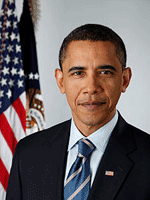
Learn More about Democratic Incumbent, President Barack Obama:
AICE does not rate or endorse any candidate for political office. This page is for informational purposes only.
US-Israel Relationship
- Israeli-Palestinian Peace Process -
Palestinain Statehood - Threat
from Iran
U.S.-Israel
Relationship
" ... It [Israel] is a true friend and our
greatest ally in the region."
- Third
Presidential Debate in Florida (October 22, 2012)
" ... if Israel is attacked, America will
stand with Israel. I’ve made that clear throughout my presidency
... I will stand with Israel if they are attacked. And this is
the reason why, working with Israel, we have created the strongest
military and intelligence cooperation between our two countries
in history. In fact, this week we’ll be carrying out the
largest military exercise with Israel in history, this very week."
- Third
Presidential Debate in Florida (October 22, 2012)
"And when I went to Israel as a candidate,
I didn’t take donors, I didn’t attend fundraisers,
I went to Yad Vashem, the — the Holocaust museum there,
to remind myself the — the nature of evil and why our bond
with Israel will be unbreakable."
- Third
Presidential Debate in Florida (October 22, 2012)
"I hope that, as I sign as this bill, once
again everybody understands how committed all of us are -- Republicans
and Democrats -- as Americans to our friends in making sure that
Israel is safe and secure."
- Signing
"U.S.-Israel Enhanced Security Cooperation Act"
(July 27, 2012)
"The tragic events that we saw in Bulgaria
emphasize the degree to which this continues to be a challenge
not just for Israel, but for the entire world -- preventing terrorist
attacks and making sure the people of Israel are not targeted."
- Signing
"U.S.-Israel Enhanced Security Cooperation Act"
(July 27, 2012)
"Yes, we are bound to Israel because of
the interests that we share -- in security for our communities,
prosperity for our people, the new frontiers of science that can
light the world. But ultimately it is our common ideals that provide
the true foundation for our relationship ... In the United States,
our support for Israel is bipartisan, and that is how it should
stay."
- AIPAC
Policy Conference (March 4, 2012)
"Our iron-clad commitment -- and I mean
iron-clad -- to Israel’s security has meant the closest
military cooperation between our two countries in history."
- State
of the Union Address (January 24, 2012)
"No U.S. administration has done more in
support of Israel's security than ours ... We’re going to
keep standing with our Israeli friends and allies, just as we’ve
been doing when they’ve needed us most. ... On my watch,
the United States of America has led the way, from Durban to the
United Nations, against attempts to use international forums to
delegitimize Israel."
- 71st
General Assembly, Union for Reform Judaism (December
16, 2011)
"The special bonds between our nations are
ones that all Americans hold dear because they’re bonds
forged by common interests and shared values. They’re bonds
that transcend partisan politics ... We stand with Israel as a
Jewish democratic state because we know that Israel is born of
firmly held values that we, as Americans, share: a culture committed
to justice, a land that welcomes the weary, a people devoted to
tikkun olam ... So America’s commitment to Israel and Israel’s
security is unshakeable.
- 71st
General Assembly, Union for Reform Judaism (December
16, 2011)
"This [Hannukkah] is also a time to be grateful
for our friendships, both with each other and between our nations.
And that includes, of course, our unshakeable support and commitment
to the security of the nation of Israel."
-
White House Hanukkah Reception (December 8, 2011)
"Israel’s legitimacy is not a matter
for debate. That is my commitment; that is my pledge to all of
you."
- AIPAC Policy
Conference (May 22, 2011)
"A strong and secure Israel is in the national
security interest of the United States not simply because we share
strategic interests ... America’s commitment to Israel’s
security flows from a deeper place -- and that’s the values
we share ... As two vibrant democracies, we recognize that the
liberties and freedoms we cherish must be constantly nurtured.
And as the nation that recognized the State of Israel moments
after its independence, we have a profound commitment to its survival
as a strong, secure homeland for the Jewish people."
-Remarks to
AIPAC Policy Conference (May 22, 2011)
Israeli-Palestinian
Peace Process
"Among Israelis and Palestinians, the future
must not belong to those who turn their backs on a prospect of
peace. Let us leave behind those who thrive on conflict, those
who reject the right of Israel to exist. The road is hard, but
the destination is clear -- a secure, Jewish state of Israel and
an independent, prosperous Palestine. Understanding that such
a peace must come through a just agreement between the parties,
America will walk alongside all who are prepared to make that
journey."
- United
Nations General Assembly (September 25, 2012)
"Our commitment to Israel's security must
not waver, and neither must our pursuit of peace."
- Democratic
National Convention (September 6, 2012)
"I make no apologies for pursuing peace.
Israel’s own leaders understand the necessity of peace.
Prime Minister Netanyahu, Defense Minister Barak, President Peres
-- each of them have called for two states, a secure Israel that
lives side by side with an independent Palestinian state. I believe
that peace is profoundly in Israel’s security interest."
- AIPAC
Policy Conference (March 4, 2012)
"As President, I have never wavered in pursuit
of a just and lasting peace - two states for two peoples; an independent
state of Palestine alongside a secure Jewish state of Israel.
I have not wavered and will not waver ... A just and lasting peace
is in the long-term interests of Israel. It is in the long-term
interests of the Palestinian people. It is in the interest of
the region. It is the interest of the United States, and it is
in the interest of the world."
- 71st
General Assembly, Union for Reform Judaism (December
16, 2011)
"We know that peace demands a partner –
which is why I said that Israel cannot be expected to negotiate
with Palestinians who do not recognize its right to exist. And
we will hold the Palestinians accountable for their actions and
for their rhetoric."
- AIPAC Policy
Conference (May 22, 2011)
"It is up to the Israelis and Palestinians
to take action. No peace can be imposed upon them -- not by the
United States; not by anybody else ... a lasting peace will involve
two states for two peoples: Israel as a Jewish state and the homeland
for the Jewish people, and the state of Palestine as the homeland
for the Palestinian people ... The United States believes that
negotiations should result in two states."
- "Arab
Spring" Speech (May 19, 2011)
"That truth is what makes peace so hard.
And the deadlock will only be broken when each side learns to
stand in each other’s shoes ... We will only succeed in
that effort if we can encourage the parties to sit down together,
to listen to each other, and to understand each other’s
hopes and fears."
- United Nations
General Assembly (September 21, 2011)
"[Israeli settlement building] is never
helpful when it comes to peace negotiations and I'm concerned
that we're not seeing each side make the extra effort to get a
breakthrough that could finally create a framework for a secure
Israel living side by side in peace with a soverign Palestine."
- Speech
in Indonesia (November 9, 2010)
"As we pursue peace between Israelis and
Palestinians, we will also pursue peace between Israel and Lebanon,
Israel and Syria, and a broader peace between Israel and its neighbors.
We will pursue regional initiatives with multilateral participation,
alongside bilateral negotiations."
- National
Security Strategy (May 2010)
"Israel is going to have to take some difficult
steps as well, and I shared with the Prime Minister the fact that
under the roadmap and under Annapolis that there’s a clear
understanding that we have to make progress on settlements. Settlements
have to be stopped in order for us to move forward."
-
Conference with Prime Minister Netanyahu (May 18, 2009)
Palestinian
Statehood
"I said it in September at the United Nations.
I said it when I stood amid the homes in Sderot that had been
struck by missiles: No nation can tolerate terror. And no nation
can accept rockets targeting innocent men, women and children.
No nation can yield to suicide bombers."
- Remarks
to the 71st General Assembly of the Union for Reform Judaism,
December 16, 2011
"The recent agreement between Fatah and
Hamas poses an enormous obstacle to peace. No country can be expected
to negotiate with a terrorist organization sworn to its destruction.
And we will continue to demand that Hamas accept the basic responsibilities
of peace, including recognizing Israel’s right to exist
and rejecting violence and adhering to all existing agreements."
- AIPAC Policy
Conference (May 22, 2011)
"No vote at the United Nations will ever
create an independent Palestinian state. And the United States
will stand up against efforts to single Israel out at the United
Nations."
- AIPAC Policy
Conference (May 22, 2011)
"We will never abandon our pursuit of a
just and lasting peace that ends this conflict with two states
living side by side in peace and security ... a genuine peace
is the only path that will ultimately provide for a peaceful Palestine
as the homeland of the Palestinian people and a Jewish state of
Israel as the homeland of the Jewish people."
- AIPAC Policy
Conference (May 22, 2011)
"We believe the borders of Israel and Palestine
should be based on the 1967 lines with mutually agreed swaps,
so that secure and recognized borders are established for both
states."
- "Arab
Spring" Speech (May 19, 2011)
Threat
from Iran
"But to the issue of Iran, as long as I’m
president of the United States, Iran will not get a nuclear weapon."
- Third
Presidential Debate in Florida (October 22, 2012)
"We’re not going to allow Iran to
perpetually engage in negotiations that lead nowhere."
- Third
Presidential Debate in Florida (October 22, 2012)
"We then organized the strongest coalition
and the strongest sanctions against Iran in history, and it is
crippling their economy. Their currency has dropped 80 percent.
Their oil production has plunged to the lowest level since they
were fighting a war with Iraq 20 years ago. So their economy is
in a shambles."
- Third
Presidential Debate in Florida (October 22, 2012)
" ... a nuclear Iran is a threat to our
national security and it’s threat to Israel’s national
security. We cannot afford ... a nuclear arms race in the most
volatile region of the world. Iran’s a state sponsor of
terrorism, and for them to be able to provide nuclear technology
to nonstate actors — that’s unacceptable. And they
have said that they want to see Israel wiped off the map."
- Third
Presidential Debate in Florida (October 22, 2012)
"...our alliances have never been stronger
... with Israel where we have unprecedented military and intelligence
cooperation, including dealing with the Iranian threat."
- Third
Presidential Debate in Florida (October 22, 2012)
" ... our goal is to get Iran to recognize
it needs to give up its nuclear program and abide by the U.N.
resolutions that have been in place, because they have the opportunity
to re-enter the community of nations ... the deal we’ll
accept is, they end their nuclear program. It’s very straightforward."
- Third
Presidential Debate in Florida (October 22, 2012)
" ... we’ve got to maintain that pressure
[on Iran]."
- Third
Presidential Debate in Florida (October 22, 2012)
" ... the strength that we have shown in
Iran is shown by the fact that we’ve been able to mobilize
the world. When I came into office, the world was divided. Iran
was resurgent. Iran is at its weakest point economically, strategically,
militarily than since — than in many years."
- Third
Presidential Debate in Florida (October 22, 2012)
"Make no mistake, a nuclear-armed Iran is
not a challenge that can be contained. It would threaten the elimination
of Israel, the security of Gulf nations, and the stability of
the global economy. It risks triggering a nuclear-arms race in
the region, and the unraveling of the non-proliferation treaty.
That’s why a coalition of countries is holding the Iranian
government accountable. And that’s why the United States
will do what we must to prevent Iran from obtaining a nuclear
weapon."
- United
Nations General Assembly (September 25, 2012)
"I understand and share Prime Minister Netanyahu's
insistence that Iran should not obtain a nuclear weapon because
it would threaten us, it would threaten Israel and it would threaten
the world and kick off a nuclear arms race ... Now I feel an obligation,
not pressure but obligation, to make sure that we're in close
consultation with the Israelis on these issues because it affects
them deeply. They're one of our closest allies in the region.
And we've got an Iranian regime that has said horrible things
that directly threaten Israel's existence."
- Interview
with '60 Minutes' (September 23, 2012)
"The Iranian government must face a world
that stays united against its nuclear ambitions."
- Democratic
National Convention (September 6, 2012)
"[Iran]- the clock is ticking."
- Latin
American Summit (April 15, 2012)
"Already there is too much loose talk of
war ... For the sake of Israel's security, America's security
and the peace and security of the world, now is not the time for
bluster. Now is the time to let our increased pressure sink in,
and to sustain the broad international pressure we have built.
A nuclear armed Iran is completely counter to Israel's security
interests, but it is also counter to the national security interests
of the United States."
- AIPAC
Policy Conference (March 4, 2012)
"Tthe entire world has an interest in preventing
Iran from acquiring a nuclear weapon. A nuclear-armed Iran would
thoroughly undermine the non-proliferation regime that we've doen
so much to build. There are risks that an Iranian nuclear weapon
could fall into the hands of a terrorist organization ... others
in the region would feel compelled to get their own nuclear weapon,
triggering an arms race in one of the world's most volatile regions.
It would embolden a regime that has brutalized its own people,
and it would embolden Iran’s proxies, who have carried out
terrorist attacks from the Levant to southwest Asia."
- AIPAC
Policy Conference (March 4, 2012)
"Iran’s leaders should understand
that I do not have a policy of containment; I have a policy to
prevent Iran from obtaining a nuclear weapon. And as I have made
clear time and again during the course of my presidency, I will
not hesitate to use force when it is necessary to defend the United
States and its interests."
- AIPAC
Policy Conference (March 4, 2012)
"As president of the United States, I don't
bluff ... I think both the Iranian and the Israeli governments
recognize that when the United States says it is unacceptable
for Iran to have a nuclear weapon, we mean what we say ... Iran
is known to sponsor terrorist organizations, so the threat of
proliferation becomes that much more severe ... it is important
for us to see if we can solve this thing permanently, as opposed
to temporarily."
- Interview
with Jeffrey Goldberg (March 2, 2012)
"Another grave concern – and a threat
to the security of Israel, the United States and the world –
is Iran’s nuclear program. And that’s why our policy
has been absolutely clear: We are determined to prevent Iran from
acquiring nuclear weapons ... We have imposed the most comprehensive,
the hardest-hitting sanctions that the Iranian regime has ever
faced ... Rest assured, we will take no options off the table."
- 71st
General Assembly, Union for Reform Judaism (December
16, 2011)
Illinois State Senate
(1997 - 2004):
- Co-sponsored SR-0346
in April 2002.
The bill called on Palestinian Authority Chairman
Yasser Arafat to end the encouragement, support, and praise
of terror attacks against Israeli civilians that emanate from
areas under his direct jurisdiction. The bill also reinforced
that the members of the Illinois State Senate seek peace for
Israel and support establishing a permanent peace accord with
its neighbors. SR-0346: CLICK
HERE
United States Senate
(2004 - 2008):
- Co-sponsored S-516
(ADVANCE Democracy Act) in March 2005.
The act stated that a fundamental component
of US foreign policy is the promotion of freedom and democracy
in the Near East. It provided funding for the Human Rights and
Democracy Fund and set forth provisions through which the Secretary
of State will work to enhance democracy and democratic processes
in foreign countries. S-516: CLICK
HERE
- Co-sponsored S-1862
(United States-Israel Energy Cooperation Act)
in October 2005.
The bill instructs the US Secretary of Energy
to implement an agreement between the US Department of Energy
and the Israeli Ministry of Energy and Infrastructure concerncing
energy cooperation. The bill also authorized grants to
support bilateral research in solar, biomass, wind, and fossil
energy as well as energy efficiency. S-1862:
CLICK
HERE
- Co-sponsored S-2370
(Palestinian Anti-Terrorism Act) in March 2006.
The bill states that it is US policy to: support
a peaceful two-state solution to the Israeli-Palestinian conflic;
oppose organizations and countries that support terrorism and
violently reject the Two-State Solution; promote democracy and
cessation of terrorism and incitement by the Palestinian Authority;
urge the international community to refrain from contact with
Hamas until the organization agrees to recognize Israel, renounce
violence, disarm, and accept prior peace agreements. The bill
also amended the Foreign Assistance Act of 1961 to ensure that
no aid will go to any Palestinian ministry or agency that is
controlled by Hamas unless Hamas publicly acknowledges Israel's
right to exist. S-2370: CLICK
HERE
- Co-sponsored SR-534
in July 2006.
The resolution reaffirmed US committment to
supporting Israel and its right to self-defense and to take
appropriate action to deter aggression by terrorist groups.
It urged President Bush to continue to fully support Israel
in exercising its right to self-defense in Lebanon and Gaza
and called for the immediate release of kidnapped Israeli soldiers
held by Hamas and Hezbollah. The resolution also condemned Hamas
and Hezbollah for exploiting civilian populations as shields
and locating their military activities in civilian areas.
SR-534: CLICK
HERE
- Co-sponsored S-970
(Iran Counter-Proliferation Act) in March 2007.
Bill subjects Iran to specified economic sanctions
unless the President certifies that Iran has verifiably dismantled
all nuclear enrichment-related and reprocessing-related programs.
Directs the President to reduce annual US contributions to the
World Bank based upon Bank amounts provided to projects in Iran.
Also subjects Russia to specific nuclear energy cooperation
prohibitions unless the President certifies that Russia has
suspended all nuclear assistance and transfers of weapons to
Iran. S-970: CLICK
HERE
- Co-sponsored SR-142
in April 2007.
The resolution marked the observance of Yom
HaShoah as a memorial day for the millions who were lost during
the Holocaust. SR-142: CLICK
HERE
- Sponsored S-1430
(Iran Sanctions Enabling Act) in May
2007.
The bill directs the Secretary of Treasury
to publish a list of people and organizations, both within or
outside the United States, that have direct investment of more
than $20 million in Iran's energy sector. It also states that
it is US policy to support the decision of governments and educational
institutions to divest from those on the list.
S-1430: CLICK
HERE
- Co-sponsored SR-522
in April 2008.
The resolution reaffirmed the bonds of friendship
and cooperation between the US and Israel on the occasion of
the 60th anniversary of the reestablishment of Israel as a homeland
for the Jewish people. It commends the Israeli people on their
achievements in building a pluralistic, democratic society and
reaffirmed support for Israel's right to defend itself against
threats to its security and existence.
SR-522: CLICK
HERE
- Sponsored SJR-23
in November 2007.
States that nothing in the Authorization for
the Use of Military Force Against Iraq, any resolution previously
adopted, or any other provision of law shall be construed to
authorize, encourage, or in any way address the use of the U.S.
Armed Forces against Iran. SJR-23: CLICK
HERE
United States Presidency
(2009 - 2012):
- Signed Executive
Order Waiver on Jerusalem Embassy
Act in June 2009.
Suspended the limitations under the Jerusalem
Embassy Act of 1995 - to move the US Embassy to Jerusalem -
pursuant to the authorities vested in the President if deteremined
that it is necessary, in order to protect the national security
interests of the United States, to not move the embassy.
Waiver: CLICK
HERE
(Jerusalem Embassy Waivers:
Signed in December
2009; June
2010; June
2011; June
2012)
- Signed HR-2194
(Iran Sanctions & Divestment Act)
in July 2010.
Bill stated that diplomatic efforts to address
Iran's illicit nuclear efforts and support for international
terrorism will be more effective when combined with strong additional
sanctions on the government of Iran. Directs the President
to impose the full range of sanctions on any individual or organization
that maintain ties with the Iranian Revolutionary Guard Corps
because the IRGC leads Iran's involvement in nuclear program,
support for international terrorism and human rights abuses.
HR-2194: CLICK
HERE
- Signed S-3847
(Security Cooperation Act) in October 2010.
Amends the Department of Defense Appropriations
Act, 2005 to extend the President's authority to transfer to
Israel surplus defense items that are stockpiled in Israel and
intended for use as Israeli reserve stocks. S-3847:
CLICK
HERE
- Singed Executive
Order 13590 (Iran Sanctions) in November
2011.
Imposed on any person or organization sanctions
for knowingly selling, leasing, or providing Iran with goods,
services, technology, or support with a market value of over
$1 million. Sanctions on such a person or organization
include the denying of any guarantee, insurance, or extension
of credit with the export of goods to Iran. EO-13590:
CLICK
HERE
(Similar Orders: Signed
in February
2012; July
2012)
- Signed S-2165
(US-Israel Enhanced Security Cooperation Act) in
July 2012.
States that it is U.S. policy to: reaffirm
the commitment to Israel's security as a Jewish state; support
Israel's right to self-defense and help Israel preserve its
qualitative military edge; expand military and civilian cooperation;
assist in a negotiated settlement of the Israeli-Palestinian
conflict that results in two states living side-by-side in peace
and security; and, veto any one-sided anti-Israel U.N. Security
Council resolutions. S-2165: CLICK
HERE
- Signed HR-1905
(Iran Threat Reduction and Syria Human Rights Act of 2012)
in October 2012.
Expresses that the goal of compelling Iran
to abandon efforts to acquire a nuclear weapons capability and
other threatening activities can be achieved through a policy
that includes economic sanctions, diplomacy, and military planning,
and urges the President to initiate diplomatic efforts to expand
the multilateral sanctions regime against Iran. Secondly, expands
sanctions related to the energy sector of Iran and proliferation
of weapons of mass destruction by Iran, by expanding the Iran
Sanctions Act of 1996. HR-1905: CLICK
HERE
In addition to his personal views, Barack Obama
must draw upon a wide array of expertise to create a coherent and
capable foreign policy, and the use of special advisory teams are
an important asset for this purpose. In order to truly evaluate
his agenda, it is therefore crucial to take these teams of foreign
policy and national security advisers into account.
Below is a list of Obama's foreign policy team
for issues affecting Israel and the Middle East:
CABINET:
-
Joe Biden (Vice President):
US Senator from Delaware between 1973 and 2009. Chairman of
the Senate Committee on Foreign Relations from January 2007
to January 2009 and from January 2001 to Januaty 2003 (with
a brief hiatus from the position January 20-June 6, 2001).
-
Hillary Clinton (Secretary
of State): First Lady of the United States (1993-2001);
US Senator from New York between January 2001 and January 2009.
Assumed the role of Secretary of State in January 2009.
-
Leon Panetta (Secretary
of Defense): US Representative from California (1977-1993);
White House Chief-of-Staff under President Bill Clinton (1994-1997);
Director of the Central Intelligence Agency (2009-2011); Assumed
office as Secretary of Defense in July 2011
-
Janet Napolitano (Secretary
of Homeland Security): Attorney General of Arizona (1999-2003);
Governor of Arizona (2003-2009); Assumed office as Secretary
of Homeland Security in 2009
NATIONAL SECURITY COUNCIL:
-
Steven Simon: Senior
Director for the Middle East and North Africa; Hasib J. Sabbagh
Senior Fellow for Middle Eastern Studies at the Council
on Foreign Relations and was a Spring 2008 Berlin Prize Fellow.
-
John Brennan:
Assistant to the President for Homeland Security and Counterterrrorism
and the Deputy National Security Advisor; Director of the National
Counterterrorism Center under President George Bush (2004-2005)
-
Gary Samore:
White House Coordinator for Arms Control and WMD, Proliferation,
and Terrorism
-
Dan Poneman:
Special Assistant to the President and Senior Director for Non-Proliferation
-
Nick Rasmussen:
Special Assistant to the President and Senior Director for Counterterrorism
AMBASSADORS:
-
Susan Rice (United Nations):
Assumed office as US Ambassador to the United Nations in 2009;
formerly Senior Fellow in Foreign Policy and Global Economy
and Development at the Brookings Institution (2002-2004); Foreign
policy advisor to Democratic Nominee John Kerry (2004); Senior
Foreign Policy Advisor to Democratic Nominee for President Barack
Obama (2008)
-
Daniel Shapiro (Israel):
Assumed office as US Ambassador to Israel in June 2011; formerly
Senior Director for the Middle East and North Africa on the
United States National Security Council
|