Arab Population in the U.S.
(2010)
In December 2003, the U.S. census bureau released
data for the first time on the Arab population of the United States.
The data is from the 2000 census. For information on the Jewish population,
see Demographics. The
census does not break down the figures by religion, but the Arab-American
Institute estimates that about 77% of Arab-Americans are Christians
(42% Catholic, 23% Orthodox, 12% Protestant) and 23% Muslim.
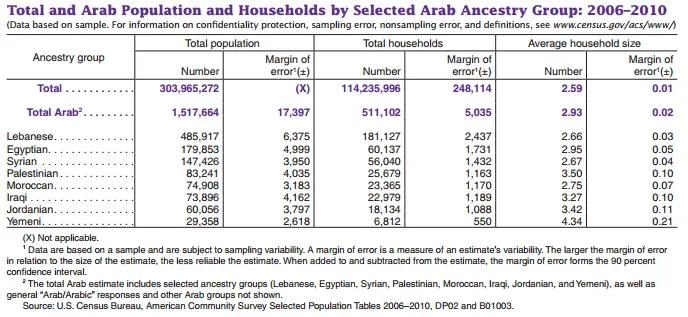
The Arab population in the United states was approximately 850,000 in 1990, 1,200,000 in 2000, and 1,500,000 in 2010 (making up 0.5% of the U.S. population).
A survey by the U.S. Census Bureau titled “Arab Households in the United States 2006-2010,” published in May 2013, offers a overview of the Arab population in the United States. Data from the survey can be found below, to read the full survey please click here.
Arab Population by Selected Ancestry Groups:
2006-2010
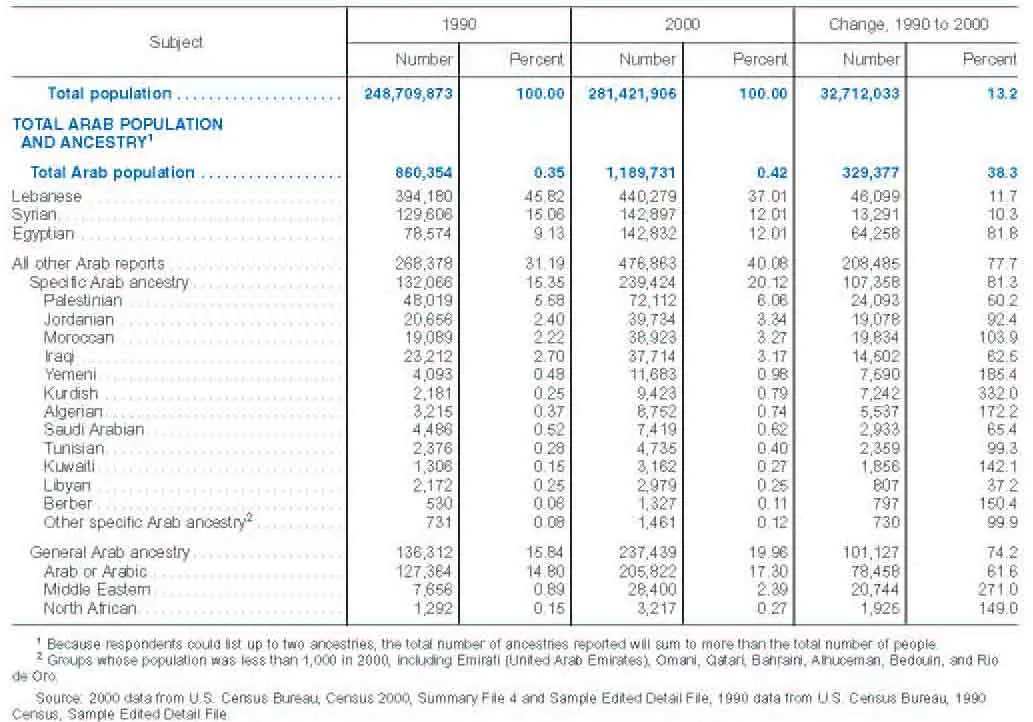
In 2000, 1.2 million people reported an Arab ancestry
in the United States, up from 610,000 in 1980 (when data on ancestry
were first collected in the decennial census) and 860,000 in 1990. The
Arab population increased over the last two decades: 41 percent in the
1980s and 38 percent in the 1990s. Arabs represented 0.42 percent of
the U.S. population in 2000, compared with 0.27 percent in 1980.
More than one-third of those reporting an Arab ancestry
were Lebanese (37 percent, see Table 1), including both people who indicated
that they were only Lebanese and those who reported being both Lebanese
and another ancestry, which might or might not also be Arab.6 The next
largest specific groups were Syrian and Egyptian (12 percent each).
Among the nearly half-million people who reported other specific Arab
ancestries, the largest proportion was Palestinian (6.1 percent of the
total Arab population). The Jordanian, Moroccan, and Iraqi populations
were also sizable (3.3 percent, 3.3 percent, and 3.2 percent, respectively).
Arab Population by Ancestry:
2000
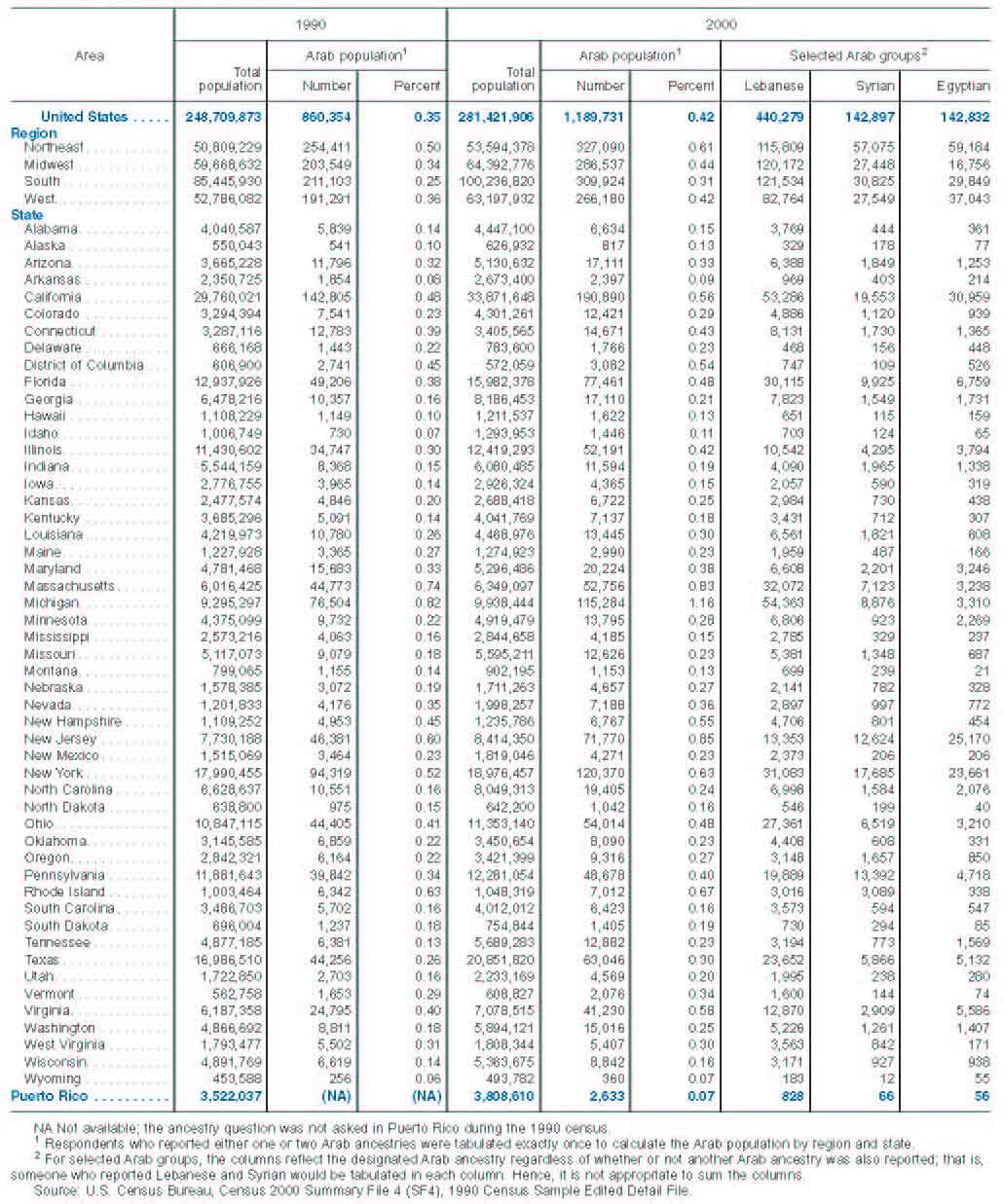
About half of the Arab population was concentrated
in only five states: California, Florida, Michigan, New Jersey, and
New York. These states contained 31 percent of the total U.S. population.
People reporting an Arab ancestry also numbered over 40,000 in five
other states (Illinois, Massachusetts, Ohio, Pennsylvania, and Texas).
Over the last decade, the Arab population increased in almost every
state. The Arab population in California increased by 48,000, more than
in any other state.
The proportion of the population that was Arab was
highest in Michigan where Arabs accounted for 1.2 percent of the total.
Arabs comprised nearly 1 percent of the state populations in New Jersey
and Massachusetts, which were 0.9 percent and 0.8 percent Arab, respectively.
Arabs represented a higher proportion of the population
in 2000 than they did in 1990 in a large majority of states. The proportion
of the population that was Arab grew from 0.8 percent in 1990 to 1.2
percent in 2000 in Michigan, and from 0.6 percent to 0.9 percent in
New Jersey.
Arab Population by Ancestry
for the United States, Regions, States, and for Puerto Rico: 1990 and
2000
The largest number of Arabs lived in New York City.
In 2000, 70,000 people of Arab ancestry lived in New York, making it
the city with the largest number of Arabs. Six of the ten largest cities
in the United States were also among the ten places with the largest
Arab populations (New York, Los Angeles, Chicago, Houston, Detroit,
and San Diego.
Arab Population in Selected
Places: 2000

Source: U.S. Census Bureau
|