 |
U.S.-Israel Military Cooperation:
|


 |
|
The U.S. Congress and successive Presidential administrations have shown strong support for joint U.S.-Israeli missile defense projects. U.S.-Israeli missile defense cooperation has been authorized annually and appropriated in the defense authorization and appropriations bills. Missile defense cooperation is generally not considered a form of direct aid, but many U.S. and Israeli observers consider it a vital component of the Israel’s strategic relationship with the United States. Both countries contribute financially to several projects and share technology from co-developed weapons systems.
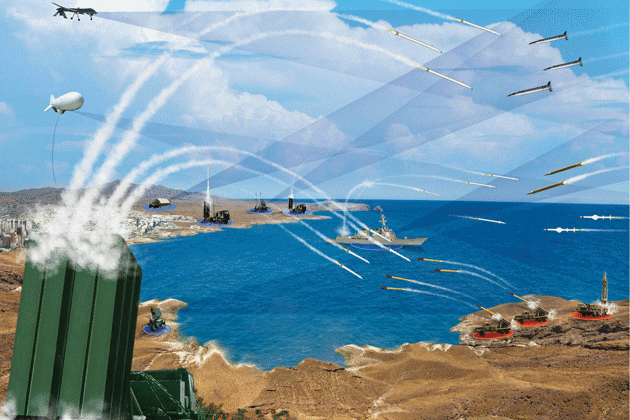
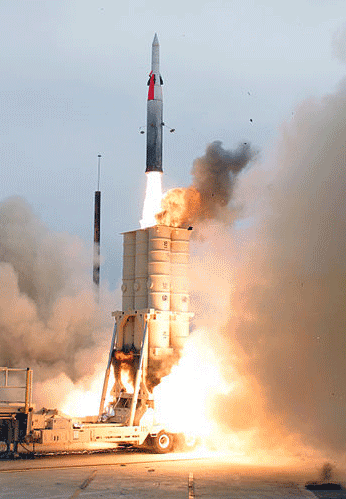
The U.S. and Israeli militaries also participate together in joint antiaircraft exercises (code named Juniper-Cobra), which generally include U.S. naval ships and ground personnel operating the Aegis, THAAD and Patriot missile shields in coordination with Israel’s Arrow interceptor.
Over the past several years, U.S.-Israeli missile defense cooperation has evolved to include the co-development of several systems designed to thwart a diverse range of threats, from short-range missiles and rockets fired by non-state actors, such as Hamas and Hezbollah, to mid- and long-range ballistic missiles in Syria’s and Iran’s arsenals:
Name: David's Sling (קלע דוד)
Developers: Rafael Advanced Defense Systems; Raytheon
Target: Medium- to long-range rockets (25-185 mile range)
Missile: Stunner two-stage Interceptor with electro-optical sensor & radar targeting system
Operational Timetable: Initial Operational Capability expected in 2012
Budget Allocation: $330 million from US government since 2006
Overview: David's Sling was developed as a flexible, multipurpose weapon system capable of engaging aircraft, cruise missiles, ballistic and guided missiles. Its Stunner interceptor missile is designed for land-based, maritime and airborne applications and is fitted with a dual-band imaging infrared and radio-frequency seeker, as well as a multi-pulse rocket motor enabling all-weather operation. David's Sling was designed to target incoming missiles during their terminal phase, unlike the Iron Dome which intercepts missiles at their highest trajectory. Its primary role will be to intercept medium- and long-range ballistic and guided rockets, such as the Iranian Fajr-5 and BM-25 as well as the Syrian M-600 and Yakhont supersonic cruise missile.
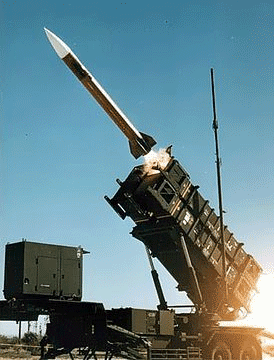
Name: Patriot
Developers: Raytheon; Hughes; RCA
Target: High-Perfomance Aircraft; mid- and long-range tactical ballistic missiles
Missile: Surface-to-Air Interceptor (SAM)
Battery Components: Stationary launcher (with 4 missiles); scanning radar; command & control center
Operational Timetable: First deployment (US) - 1984; First Activity (Israel) - 1991
Overview: The Patriot missile system was first used in Israel during the Gulf War when Saddam Hussein fired Scud missiles at Israel and it had a 40% claimed success rate in shooting down incoming missiles. The Israeli government, however, with dissatisfied with the performance and has worked to update the system and will now be phasing it out for the David's Sling. The upgraded versions, PAC-2 and -3, provide a more reliable and lethal capability to defeat advanced threats - including aircraft, tactical ballistic missiles, cruise missiles, and UAVs - in almost all operational combat environments. The newest Israeli version is set to replace the four-missile stationary launcher with a 16-missile launcher, which will make it better equiped to contend with a prolonged barrage of missiles. In 2006, Israel stationed a Patriot battery in Haifa to protect from Hezbollah rockets. Another was placed in the north during 2012.

Defense Budget Appropriations Report for FY2006 - FY2012
($ millions)
|
2006 |
2007 |
2008 |
2009 |
2010 |
2011 |
2012 |
David's Sling |
$10.0 |
$20.4 |
$37.0 |
$72.895 |
$80.092 |
$47 |
$69 |
Arrow-2 |
$122.866 |
$117.494 |
$98.572 |
$74.342 |
$72.306 |
$24 |
$105 |
High Altitude Arrow-3 |
$20.0 |
$30.0 |
$50.036 |
$51 |
$61 |
||
Total |
$132.866
|
$137.894
|
$155.572
|
$177.237
|
$202.434
|
$122 |
$235 |
Sources:
- Jeremy Sharp, "US Foreign Aid to Israel," CRS
Report (September 16, 2010).
- "MDA Fiscal Year 2012 Budget Outline," Department
of Defense.
- Yitzhak Benhorin, "US Earmarks $235 Million for Israel's Defense
Systems," Ynet,
(December 22, 2011).
- Malkah Fleisher, "US OKs Unprecedented Amount for Israeli Missile
Defense," Jewish
Press, (December 23, 2011).


