Jamal al-Din al-Afghani
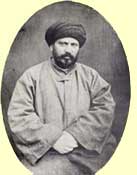
(1838-1897)
Journalist, reformer. A founder of modern Muslim anti-colonialism, he advocated a religious and cultural revival to counteract
European influence. Jamal al-Din Afghani is considered to be the founding
father of Islamic modernism.
His place of birth, which has become a source of long-standing controversy,
is not known, but he received his early education in various religious
schools near Kabul, Afghanistan and Tehran, Iran. He went
to India in 1855-6 to continue
his studies. In 1870, he traveled to Istanbul where he received a warm welcome from Ottoman officials and intellectuals who were instrumental in the creation of
reforms. Afghani went to Egypt in 1871 and remained there for the next eight years, during which
time he began to spread his philosophical and political ideas through
classes and public lectures.
In 1886, he was invited by Shah Nasir al-Din to Iran
and offered the position of special adviser to the Shah, which he accepted.
Afghani, however, was critical of the Shah’s policies, and this
differing of opinion forced Afghani to leave Iran for Russia in 1886,
where he remianed until 1889. In 1889 on his way to Paris, Afghani met
Shah Nasir al-Din in Munich and was offered the position of grand vizier.
Although he accepted, Afghani’s unabated criticisms of the rule
and conduct of the Shah led to his eventual deportation from Iran in
the winter of 1891. Afghani was later implicated in the murder of Shah
Nasir al-Din in 1896.
Afghani spent the last part of his life in Istanbul
under the patronage and, later surveillance of Sultan ‘Abd al-Hamid
II. The demands for Afghani’s extradition by the Iranian officials
for his alleged involvement in the assassination of Shah Nasir al-Din
were rejected by ‘Abd al-Hamid who collaborated with Afghani in
the implementation of his political program of pan-Islamism or Islamic
unity, "ittihad-i islam." Afghani sent a number of letters
to various Islamic countries and leaders to mobilize and unite them
against British rule, while
at the same time trying to establish the foundations of a mutual rapprochement
between the Sunnis and the Shi`ites. Despite his efforts to unite Muslims,
‘Abd al-Hamid eventually grew suspicious of Afghani’s meetings
with Arab leaders and the British officials in Istanbul, and his policy
of supporting Afghani changed, not permitting him to leave the country.
Not long after on March 9, 1897, Afghani died of cancer and was buried
in Istanbul.
Afghani’s career as a thinker and activist had
a deep impact on the Islamic world and continues to be a source of inspiration
and controversy for many today. Afghani’s project of Islamic modernism
that he developed in his lectures, polemics, short essays, and newspaper
columns was based on the idea of finding a modus vivendi between traditional
Islamic culture and the philosophical and scientific challenges of the
modern West. Afghani’s political program of pan-Islamism, "ittihad-i
islam," sought to mobilize Muslim nations to fight against Western
imperialism and gain military power through modern technology. Afghani’s
call for the independence of individual Muslim nations was a key factor
in the development of “Islamic nationalism,” and influenced
such Muslim figures as Muhammad Iqbal, Muhammad Ali Jinnah and Abu’l
Kalam Azad in the Indian subcontinent.
Sources: “Jamal al-Din al-Afghani,” Center
for Islam and Science, Saudi Aramco World,
Jan-Feb. 2002, Photo courtesy
Center for Islam and Science |