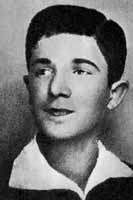
Commander of the Warsaw
ghetto uprising was born in a poor family in a poor neighborhood.
After he completed his high school studies, he joined the "Hashomer
Hatzair" youth movement. As a youngsters guide he excelled as a
leader and organizer.
In September 7, 1939, a week after the war broke
out, Anielewicz escaped with his youth movement friends from Warsaw
to the east regions, assuming that the Polish army would restrain the
German advance. In September 17, the Soviet army occupied the eastern
regions of Poland. Anielewicz tried to pass the border to Romania to
open a route for youngsters to Israel. Anielewicz was caught and put
in a Soviet jail. After he was released he returned to Warsaw
Ghetto passing through a lot of communities on his way.
Anielewicz stayed in Warsaw a short time and left
for Vilna, Lithuania, where a lot of refugees, youth movement's
members and political groups came from the west. The city was annexed
to the USSR a short time before.
Anielewicz demanded from his colleagues to send
back a group of members to the occupied territories in Poland to
continue the educational and political activities underground. He and
his girlfriend, Mira Fukrer, were among the first volunteers that
went back to Warsaw.
From January 1940, Anielewicz became a
professional underground activist. As a leader of his youth movement,
he organized cells and youngsters groups, instructed, participated in
underground publications, organized meetings and seminars and visited
other groups in different cities.
Anielewicz dedicated part of his time learning
Hebrew, reading and studying History, sociology and economics. At the
same time his point of view was formatted and expressed in
publications and lectures.
His activities changed when the news about the
mass killings of Jews in Eastern Europe were known. Immediately
Anielewicz start organizing self-defense groups inside the Warsaw
Ghetto. His first attempts to connect with Polish forces outside
the Ghetto, acting under orders of the Polish government in London,
failed. In March - April 1942, Anielewicz was one of the founders of
the "Anti-fascist group". The "group" did not
fulfill the expectations of Zionist groups, and, after a wave of arrests of communist members the
organization, was dismantled.
When the major deportation to extermination camps
started in Warsaw Ghetto,
in the summer of 1942, Anielewicz was visiting in the south-west
region of Poland, that was annexed to Germany, trying to organize
armed defense. At his return he found only 60,000 Jews from 350,000,
and a small "Jews Fighter Organization", without any
weapons and with a lot of difficulties, a lost of fighters and
failures. Anielewicz started to reorganize the group with great
success because there was much support for the idea of fighting after
the major deportation of all the underground groups. Next step was to
compose a public committee and a coordination committee. In November
1942 Anielewicz was elected as chief commander. Until January 1943, a
few fighter groups of youth movement members were based in the
ghetto. A connection with the Polish army commanded from London was
made and weapons were supplied from the Polish side of the city.
In January 18, 1943, the Nazis planned the second
big deportation of the Jews to the extermination
camps from the Warsaw
Ghetto. The headquarters organization did not have enough time to
discuss the possible response but the armed groups decided to react.
The resistance was lead in two points. Anielewicz commanded the
battle in the main street. The fighters joined the deported and when
they got a signal between the streets Zamenhoff and Niska they
attacked the escort. The Jews escaped and dispersed. Most of Hashomer
Hatzair's members were killed in this battle. This was a very
significant move because four days after the revolt, the Nazis
stopped the operation.
The next three months - January to April 1943 -
was an intensive preparation and very decisive period for the
underground organization, under Anielewicz's command. In April 19, on
the eve of Pesah, the last deportation began, and the uprising broke
out. At the first the superiority of the resistance was clear, and
the Nazis suffered many losses. Three long days of battles between
streets took place. The Nazis greatly outnumbered the resistance in
soldiers and weapons, so that the hundreds of fighters, with only
hand revolvers, had no chances. However, the Jewish fighters didn't
surrender, and even survivors in shelters did not exit them despite
the calls and promises. The Nazis forces were compelled to burn house
by house and to go through every shelter in the Ghetto. The fight
lasted for four weeks, and in May 16, 1943, after a lot of
casualties, General Jurgen Stroop could report that the Ghetto was
defeated and "there is no more Jewish suburb in Warsaw".
The first days of battles Anielewicz commanded the
resistance forces. When the street fight ended he moved to the
headquarters shelter to Mila 18 street. On May 8, Anielewicz was
killed in the headquarters bunker together with a few colleagues.
In Israel Kibbutz, "Yad Mordechai" was
named in memory of Mordecai Anielewicz, and a monument is erected in
his memory.