Arthur Balfour
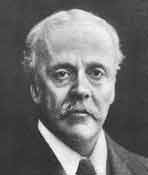
(1848 - 1930)
Arthur Balfour was born on the family's Scottish estate
in East Lothian in 1848. Educated at Eton and Trinity College, Cambridge,
he entered the House of Commons in 1874 as the Conservative MP for Hertford.
In 1878 Balfour became private secretary to his uncle,
the Marquess of Salisbury, who was Foreign Secretary in the Conservative
government headed by Benjamin
Disraeli.
In the 1885 General Election Balfour was elected to
represent the East Manchester constituency. The Marquess of Salisbury,
who was now Prime Minister, appointed him as his Secretary for Scotland.
Other posts during the next few years included Chief Secretary of Ireland
(1887), First Lord of the Treasury (1892) and leader of the House of
Commons (1892).
Balfour replaced his uncle as Prime Minister in 1902.
The most important events during his premiership included the 1902 Education
Act and the ending of the Boer War. The topic of Tariff Reform split
Balfour's government and when he resigned in 1905, Edward VII invited
Henry Campbell-Bannerman to form a government. Campbell-Bannerman accepted
and in the 1906 General Election that followed the Liberal Party had
a landslide victory.
Balfour remained leader of the Conservative Party until
he was replaced by Andrew Bonar Law in 1911. He returned to government
when in 1915 Herbert Asquith offered him the post of First Lord of the
Admiralty in Britain's First World War coalition government. The following
year, David Lloyd George, the new Prime Minister, appointed him as Foreign
Secretary, and consequently was responsible for the Balfour
Declaration in 1917 which promised Zionists a national home in Palestine.
Balfour left Lloyd George's government in 1919 but
returned to office when he served as Lord President of the Council (1925-29)
in theConservative government headed by Stanley Baldwin. Arthur Balfour
died in 1930.
Sources: Spartacus
Educational |