Judah Benjamin
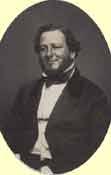
(1811 - 1884)
One of the most misunderstood figures in American Jewish
history is Judah P. Benjamin, whom some historians have called “the
brains of the Confederacy,” even as others tried to blame him for the
South’s defeat. Born in the West Indies in 1811 to observant Jewish
parents, Benjamin was raised in Charleston, South Carolina. A brilliant
child, at age 14 he attended Yale Law School and, on graduation, practiced
law in New Orleans. A founder of the Illinois Central Railroad, a state
legislator, a planter who owned 140 slaves until he sold his plantation in
1850, Judah Benjamin was elected to the United States Senate from Louisiana
in 1852. When the slave states seceded in 1861, Confederate President
Jefferson Davis appointed Benjamin as Attorney-General, making him the
first Jew to hold a Cabinet-level office in an American government and the
only Confederate Cabinet member who did not own slaves. Benjamin later
served as the Confederacy’s Secretary of War, and then Secretary of
State.
 Two Dollar Bill
of the Confederate States of America picturing Judah Benjamin
Two Dollar Bill
of the Confederate States of America picturing Judah Benjamin |
For an individual of such prominence, Benjamin’s kept
his personal life and views somewhat hidden. In her autobiography,
Jefferson Davis’s wife, Varina, informs us that Benjamin spent twelve
hours each day at her husband’s side, tirelessly shaping every important
Confederate strategy and tactic. Yet, Benjamin never spoke publicly or
wrote about his role and burned his personal papers before his death,
allowing both his contemporaries and later historians to interpret Benjamin
as they wished, usually unsympathetically.
During the Civil War itself, many Southerners blamed
Benjamin for their nation’s misfortunes. The Confederacy lacked the men
and materials to match the Union armies and, when President Davis decided
in 1862 to let Roanoke Island fall into Union hands without mounting a
defense rather than letting the Union know the true weakness of Southern
forces, Benjamin, as Davis’s loyal Secretary of War, took the blame and
resigned. Anti-Semitism was a fact of life
– North and South – during the Civil War years and Benjamin was falsely
defamed as having weakened the Confederacy by transferring its funds to
personal bank accounts in Europe.
After Benjamin resigned as Confederate Secretary of War,
Davis appointed him Secretary of State. Eli Evans, Benjamin’s most
perceptive biographer, observed that “Benjamin served Davis as his
Sephardic ancestors had served the kings of Europe for hundreds of years,
as a kind of court Jew to the Confederacy. An insecure President [Davis]
was able to trust him completely because, among other things, no Jew could
ever challenge him for leadership of the Confederacy.” Near the end of
the war, Benjamin privately persuaded Robert E. Lee and other Confederate
military leaders that the South’s best chance was to emancipate any slave
who volunteered to fight for the Confederacy. When Benjamin repeated this
proposal to an audience of 10,000 persons in Richmond in 1864, his remarks
lit a firestorm. Georgian Howell Cobb observed, “If slaves will make
good soldiers, our whole theory of slavery is wrong.” Benjamin’s
idea, however valuable, was rejected as politically impossible. As Evans
observes, “The South chose [instead] to go down in defeat with the
institution of slavery intact.”
 Five Hundred Dollar
Bond, Confederate States of America. Authorized by an Act of Congress, C.S.A., August 18,
1861, featuring the picture of Judah Benjamin
Five Hundred Dollar
Bond, Confederate States of America. Authorized by an Act of Congress, C.S.A., August 18,
1861, featuring the picture of Judah Benjamin |
When John Wilkes Booth assassinated Lincoln in 1865,
Davis and Benjamin were suspected of having plotted the event and, as the
martyred Lincoln was compared to Christ in the Northern press, Benjamin was
pilloried as Judas. When the South was defeated, Benjamin -fearing that he
could never receive a fair trial if charged with Lincoln’s murder, fled
to England, where he lived out his life as a barrister, publishing a
classic legal text on the sale of personal property. Evans speculates that,
had Benjamin been captured by Union troops, the United States might have
had its own Dreyfus Trial.
A solitary man, estranged from his wife, Benjamin died
alone in England, and his daughter arranged to have him buried in Pere
Lachaise Cemetery in Paris. Until 1938, when the Paris chapter of the
Daughters of the Confederacy provided an inscription with his American
name, his simple tombstone was engraved with the name “Philippe
Benjamin.”
While Judah Benjamin preferred such obscurity, his
prominence as a Jew assured that he would come under harsh scrutiny, both
during and after his life. For example, on the floor of the Senate Ben Wade
of Ohio charged Benjamin with being an “Israelite in Egyptian
clothing.” With characteristic eloquence, Benjamin replied, “It
is true that I am a Jew, and when my ancestors were receiving their Ten
Commandments from the immediate Deity, amidst the thundering and lightnings
of Mt. Sinai, the ancestors of my opponent were herding swine in the
forests of Great Britain.”
Perhaps the best-known posthumous caricature of Benjamin
appears in the epic poem John Brown’s Body, by Stephen Vincent
Benet. Describing him as a “dark prince,” Benet depicts Judah
Benjamin as “other” in Confederate inner circles:
Judah P. Benjamin, the dapper Jew,
Seal-sleek, black-eyed, lawyer and epicure,
Able, well-hated, face alive with life,
Looked round the council-chamber with the slight
Perpetual smile he held before himself
continually like a silk-ribbed fan.
. . . [His] quick, shrewd fluid mind
Weighed Gentiles in an old balance . . .
The eyes stared, searching.
“I am a Jew. What am I doing here?”
Sources: American
Jewish Historical Society (AJHS); Photos courtesy of the Library
of Congress |