Jack Benny
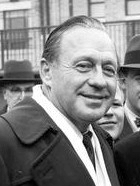
(1894-1974)
Jack Benny was among the most beloved American entertainers of the 20th century. He brought a relationship-oriented,
humorously vain persona honed in vaudeville, radio, and film
to television in 1950, starring in his own television series
from that year until 1965.
Born Benjamin Kublesky on February 14, 1894, the comedian grew up in Waukegan, Illinois. Although there is now a school named after him in Waukegan (Jack Benny Junior High School), Benny's education consisted of one term at Central High School. He worked in his father's haberdashery shop, then at age 16 he got a job playing violin in the orchestra pit of the town's Barrison Theater. After spending several years on the road with various partners in piano-violin duos he served in the Navy during World War I, where his talent for stand-up comedy was revealed. After his naval stint he created a solo vaudeville act, touring as comic and dancer under
name Ben K. Benny, which ultimately got him noticed by the film industry. In 1928 he appeared in the short film Bright Moments and in 1929 headlined in the films Hollywood Revue of 1929 and Chasing Rainbows, and in Medicine Man (1930). With this national exposure in film, Benny became a star.
In 1932 Benny hit the radio waves, featured on his friend Ed Sullivan's talk show. Two months later, Benny was the host of his own radio program. He starred in a regular radio program
from 1932 to 1955, establishing the format and personality
he would transfer almost intact to television. According to Benny, comedy was based on seven principles: the joke, exaggeration, ridicule, ignorance, surprise, the pun, and the comic situation. Most of his
films capitalized on his radio fame (e.g., The Big Broadcast
of 1937), although a couple of pictures, Charley's
Aunt (1941) and To Be or Not to Be (1942) showed
that he could play more than one character.
Benny's radio program spent most of its run on NBC. In 1948,
the entertainer, who had just signed a deal with the Music
Corporation of American (MCA) that allowed him to form a
company to produce the program and thereby make more money
on it, was lured to CBS, where he stayed through the remainder
of his radio career and most of his television years.
In 1950 Benny advanced to television. Benny made only four
television shows in his first season. By 1954-55, he was
up to 20, and by 1960-61, 39. The format of The Jack Benny
Show was flexible. Although each week's episode usually
had a theme or starting premise, the actual playing out of
that premise often devolved into a loose collection of skits.
Benny played a fictional version of himself, Jack Benny
the television star, and the program often revolved around
preparation for the next week's show--involving interactions
between Benny and a regular stable of characters that included
the program's announcer, Don Wilson, and its resident crooner,
Dennis Day. Until her retirement in 1958, Benny's wife, Mary Livingstone (née Sadye Marks, 1909–1983), portrayed what her husband termed in his memoirs
"a kind of heckler-secretary," a wise-cracking friend of
the family and the television program.
The main point of these interactions was to show off Benny's
onscreen character. The Jack Benny with whom viewers were
familiar was a cheap, vain, insecure, untalented braggart
who would never willingly enter his fifth decade. Despite
his conceit and braggadocio, however, Jack Benny's video
persona was uniquely endearing and even in many ways admirable.
He possessed a vulnerability and a flexibility few male fictional
characters have achieved. His myriad shortcomings were mercilessly exposed every week
by his supporting cast, yet those characters always forgave
him. They knew that "Jack" was never violent and never intentionally
cruel--and that he wanted nothing (not even money) so much
as love. The interaction between this protagonist and his
fellow cast members turned the Jack Benny Show into a forum
for human absurdity and human affection.
"Human" is a key word, for the Benny persona defied sub-categorization.
Benny had shed his Jewish identity along with his Jewish
name on his way from vaudeville to radio. The character he
and his writers sustained on the airwaves for four decades
had no ethnicity or religion.
He had no strongly defined sexuality either, despite his
boasts about mythical romantic success with glamorous female
movie stars and his occasional brief dates with working-class
women. In minimizing his ethnicity and sexuality, the Benny
character managed to transcend those categories rather than
deny them. Beneath his quickly lifted arrogant facade lurked
an American Everyperson.
The Jack Benny Show further crossed boundaries by
being the only program for decades that consistently portrayed
Americans of mixed races living and working side by side.
Jack Benny's ever-present butler/valet/nanny, Rochester (portrayed
by Eddie Anderson), had first appeared on the Benny radio
program as a Pullman porter but had pleased audiences so
universally that he moved into Benny's fictional household.
Unlike the popular African-American radio characters Amos
and Andy, Rochester was portrayed by a Black actor, Eddie
Anderson, rather than a white actor in blackface.
Rochester's characterization was not devoid of racism. As
Benny's employee he was, after all, always in a nominally
subservient position. Nevertheless, neither Rochester nor
his relationship with his employer was defined or limited
by race. Like the other characters on the program, Rochester
viewed Benny with slightly condescending affection--and frequently
got the better of his employer in arguments that were obviously
battles between peers. He was, in fact, the closest thing
the Benny character had to either a spouse or a best friend.
The complex relationship between the two was typical of
the Benny persona and its fictional formula, which relied
on character rather than jokes. Benny sustained the persona
and the formula, in his regular half-hour program and in
a series of one-hour specials, until both wore out in the
mid-1960s. He returned to television from time to time thereafter
to star in additional specials but never dominated American
ratings as he had in the 1950s, when he spent several years
in the Neilsen top-20s and garnered Emmy awards year after
year.
Offscreen, Benny was apparently ambivalent
about television. In his memoirs, Sunday Nights at Seven,
posthumously published with his daughter as co-author in
1990, he wrote, "By my second year in television, I saw that
the camera was a man-eating monster. It gave a performer
close-up exposure that, week after week, threatened his existence
as an interesting entertainer." Despite this concern, Jack
Benny and American television clearly did well by each other.
Benny died of stomach cancer
in Beverly Hills, California, on December 26, 1974.
TELEVISION SERIES
1950-64 The Jack Benny Show (CBS)
1964-65 The Jack Benny Show (NBC)
FILMS
Bright Moments (short), 1928; The Hollywood Revue
of 1929, 1929; Chasing Rainbows, 1930; Medicine
Man, 1930; Mr. Broadway, 1933; Transatlantic Merry-Go-Round,
1934; Broadway Melody of 1936, 1935; It's in the
Air, 1935; The Big Broadcast of 1937, 1936; College
Holiday, 1936; Artists and Models, 1937; Manhattan
Merry-Go-Round, 1937; Artists and Models Abroad,
1938; Man About Town, 1939; Buck Benny Rides Again,
1940; Love Thy Neighbor, 1940; Charley's Aunt,
1941; To Be or Not to Be, 1942; George Washington
Slept Here, 1942; The Meanest Man in the World;
1943; Hollywood Canteen, 1944; It's in the Bag,
1945; The Horn Blows at Midnight, 1945; Without
Reservations, 1946; The Lucky Stiff, 1949; Somebody
Loves Me, 1952; Who Was That Lady?, 1962; It's
a Mad, Mad, Mad, Mad World, 1967; A Guide for the
Married Man, 1967; The Man, 1972.
RADIO
The Jack Benny Show, 1933-41.
STAGE
The Earl Carroll Vanities, 1930.
PUBLICATIONS
Sunday Nights at Seven: The Jack Benny Story, with
Joan Benny. New York: Warner, 1990
FURTHER READING
Burns, George. "My Friend Jack Benny." Reader's
Digest (Pleasantville, New York), February 1991.
Fein, Irving. Jack Benny: An Intimate Biography.
New York: Putnam, 1976.
Jack Benny: The Radio and Television Work.
Published in Conjunction with an Exhibition of the Same Title: Museum of Television and Radio, New York. New York:
Harper-Perennial, 1991.
Josefsberg, Milt. The Jack Benny Show.
New Rochelle, New York: Arlington House, 1977.
Marc, David. "Lending Character to American
Comedy." Television Quarterly (New York), Winter 1992.
McFadden, Margaret T. "America's Boy Friend
Who Can't Get a Date: Gender, Race, and the Cultural
Work of the Jack Benny Program, 1932-1946." Journal of
American History (Bloomington, Indiana), June 1993.
O'Connor, John J. "Jack Benny: Comedy in
Bloom." New York Times, 5 October 1992.
Sources: The Museum of Broadcast Communications; Encyclopaedia
Judaica; I. Fein, Jack Benny: An Intimate Biography (1976); M. Josefsberg, The Jack Benny Show (1977). |