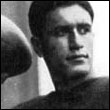
After a storied high school career in Cleveland, Benny
attended Michigan after Penn State decided he was too small to play
college ball. During his sophomore year, however, he considered transferring
to Dartmouth because he did not start in the first three games of the
1924 season under Coach George Little. After Michigan lost 39-14 to
Illinois (Red Grange scored five touchdowns for the Illini), Fielding
Yost, Michigan’s legendary coach who had retired before the season,
convinced Little to start Friedman. Benny started the next game against
Wisconsin at right halfback and became an instant star by throwing a
62-yard touchdown pass and running 26 yards for a score in Michigan’s
21-0 win. Benny led the Wolverines to four consecutive victories as
they defeated their opponents by a combined score of 77-6! Although
they lost the final game of the season to No. 6 Iowa, Friedman showed
much of the brilliance to come and was named Walter Eckersoll All-Midwest
honorable mention.
In 1925, Yost came out of retirement to resume coaching,
and Friedman became the full-time starting quarterback. Joined by sophomore
end Bennie Oosterbaan, Benny was spectacular game after game as he ran
for a 65-yard touchdown and threw two touchdown passes against Michigan
State, had an 80-yard kickoff return against Wisconsin, and accounted
for 44 of Michigan’s points in a 63-0 victory over Indiana; he
threw five touchdowns, kicked eight extra points, and scored twice.
That year, Benny threw for 11 touchdowns and did all the placekicking
as both he and Oosterbaan were named first team All-America. The Wolverines
outscored their opponents by an incredible 227-3 and won the Big Ten
title with a record of 7-1-0; they finished the season ranked No. 2
in the nation. The only blemish on their record was a 3-2 loss to Northwestern
in rain and sleet and 55 mph winds; the teams combined for one passing
attempt and one first down the entire game. Michigan coach Yost called
the 1925 team the best he ever coached.
As good as Benny was in 1925, he was even better his
senior season. Against Ohio State, he threw two touchdown passes and
kicked the game-winning 43-yard field goal. Trailing Minnesota, 6-0,
Oosterbaan scored a touchdown to tie the game and Friedman provided
the winning margin by adding the extra point. One account reported:
“it evolved upon Captain Benny Friedman, the Boy Scout of Ann Arbor,
to do his good deed for the day, and he didn’t miss the trick.”
Benny led the Wolverines to a record of 7-1-0 and repeated as Big Ten
champs (they tied for first with Northwestern). The Michigan captain
was the Big Ten MVP and consensus first team All-America, and his coach,
Fielding Yost, said, “In Benny Friedman, I have one of the greatest
passers and smartest quarterbacks in history. He never makes a mistake,
and as for football brains, it's like having a coach on the field when
Benny is out there calling signals."
After graduating in 1927, Benny took his talents to
the NFL. Called the best quarterback he ever played against by the legendary
star Red Grange, Benny dominated the pro ranks and to this day is the
only player ever to lead the NFL in both rushing and passing for an
entire season (1928). Chicago Bears' coach and owner George Halas said
that Benny was the first pro quarterback "to exploit the strategic
possibilities of the pass... Benny demonstrated that the pass could
be mixed with the running plays as an integral part of the offense."
In the early years of the NFL, pro football in New York struggled, but
Friedman is credited with keeping the sport alive in the nation's largest
city.
There can be little question that Friedman is one of the most important
figures in football history. Paul Gallico, the top football expert of
the day, called him the greatest football player in the world: “The
things that a perfect football player must do are kick, pass, run the
ends, plunge the line, block, tackle, weave his way through broken fields,
drop and place kick, interfere, diagnose plays, spot enemy weaknesses,
direct an offense, and not get hurt. I have just been describing Benny
Friedman’s repertoire to you.”
In 1927, Benny turned pro and joined his hometown Cleveland
Bulldogs of the NFL. At that time, the professional game was of little
national interest. Two years before, pro football had its first sellout
when Red Grange turned pro and played for the Chicago Bears. Along with
Grange, Friedman became one of the NFL’s stars and helped spark
interest in the league. Much like the NBA in the 1980s, which relied
on its stars to promote the game, the NFL did the same in the late 1920s.
Like Red Grange and Ernie Nevers, Benny was a star and headlines would
read: "Friedman’s team wins." His passing and inventiveness
(he would throw on first down!) captured the public’s imagination
and scared his opponents. In November 1927, the Chicago Herald-Examiner
wrote of the Bears that “They had a million ideas about winning
the game, but not a darn man to stop Friedman’s passes.”
In his first four years in the NFL, Friedman led the league in passing,
passing touchdowns, and was named All-Pro all four years. Over that
span, no one else even came close to eclipsing his marks. In 1928, he
also led the league in scoring, extra points, and rushing -- the only
player in NFL history to lead the league in passing and rushing in a
single season. The following year, he threw for a record 20 touchdowns
in what must be recognized as one of the greatest feats in NFL history.
What one must remember is that the rules of the day made it extremely
difficult to throw for many touchdowns. To begin with, the ball was
rounder, thicker, bigger, and much harder to throw than today’s
ball (the league did not change the size until 1933); it was practically
a watermelon. Also, quarterbacks were hindered by rules which did not
promote passing; they could not throw a ball unless they were five yards
behind the line of scrimmage and if they threw an incomplete pass into
the end zone, it was considered a turnover. Given the rules, it is understandable
why most teams chose to run; this makes Benny’s 20 touchdowns an
even more remarkable accomplishment.
After Benny played for the Bulldogs in 1927, the Cleveland franchise
folded, and he moved to the Detroit Wolverines. Despite being a Michigan
star, he could not bring fans to the stadium (he was an attraction on
the road) and the Detroit franchise was on the verge of folding as well.
In 1928, the New York Giants bought the entire Detroit franchise just
to get Friedman (the $10,000 he was paid made him the highest paid professional
player). Football historian Bob Carroll wrote, "it was a bargain,"
and it was. The Giants finished the 1929 season with a record of 13-1-1
and made a profit of $8,500 after having lost $40,000 the previous year.
Benny remained with the Giants for three seasons, and helped keep the
New York club afloat in the early years when it looked like professional
football might fail in New York City.
In 1932, Benny moved to the Brooklyn Dodgers as head coach and quarterback.
By then, his numbers were not what they were in his early years, but
that is partly due to injury and partly due to the fact that he was
also the backfield coach at Yale from 1932-1934. Still, in 1933, he
was named to the second team of the official All-Pro squad. When he
retired following the 1934 season, Benny was among the top five career
rushers in total yards, and was easily first in career passing, although
statistics are somewhat incomplete.
After retiring in 1934, Friedman became the head coach
at CCNY (City College of New York), a position he held until 1941; he
had a record of 27-31-4. In 1949, he became the Athletic Director at
Brandeis and also served as the head football coach from 1951-1959 (he
was AD until 1963). Recognized for his brilliance as a passer and coach,
Friedman also took time out to help Michigan passers, including the
great Jewish quarterback Harry Newman (class of 1933), as well as players
at Yale and other football powers. In 1964, he opened a summer camp
for boys, including the Kamp Kohut Football School in Maine for young,
aspiring passers.
Although he kept in great shape through the years,
Benny developed a blood clot in his left leg and the leg had to be amputated
in 1979. Three years later, despondent over his health, Benny shot himself
in his New York apartment.
Benny was named one of the 300 Greatest Players of
All-Time by Total Sports: The Official Encyclopedia of the National
Football League. He was elected to the College Football Hall of Fame,
the University of Michigan Hall of Honor, the state of Michigan Sports
Hall of Fame, and the International Jewish Sports Hall of Fame.