Martin Buber
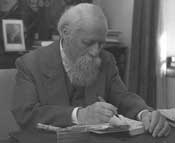
(1878 - 1965)
Martin Buber was born in Vienna in
1878. He lived for a period of time with his grandfather, Solomon Buber, a
famous midrash scholar. Powerfully influenced by Ahad
HaAm, he was a member of the Third
Zionist Congress in 1899.
When he was 26, Buber began
studying Chassidic texts and was greatly moved by their spiritual message.
During World War I, he founded the
Jewish National Committee, which worked at helping Eastern European
Jews suffering under Axis domination.
Buber was a utopian Zionist.
He believed strongly that the most important possibility for Zionism
was in changing the relationships between people. He wrote powerfully
in favor of Arab rights in Palestine. Even in later years, he worked
for the establishment of a joint Arab-Jewish state. Obviously, he
failed
In 1938, Buber settled in Palestine
and was a professor of philosophy at Hebrew University. He died in
1965.
Martin Buber is best-known for his
book I
and Thou, which he wrote in 1923. It focused on the way
humans relate to their world. According to Buber, frequently we view
both objects and people by their functions. Doing this is sometimes
good: when doctors examine us for specific maladies, it's best if
they view us as organisms, not as individuals. Scientists can learn a
great deal about our world by observing, measuring, and examining.
For Buber, all such processes are I-It relationships.
Unfortunately, we frequently view
people in the same way. Rather than truly making ourselves completely
available to them, understanding them, sharing totally with them,
really talking with them, we observe them or keep part of ourselves
outside the moment of relationship. We do so either to protect our
vulnerabilities or to get them to respond in some preconceived way,
to get something from them. Buber calls such an interaction I-It.
It is possible, notes Buber, to
place ourselves completely into a relationship, to truly understand
and "be there" with another person, without masks,
pretenses, even without words. Such a moment of relating is called
"I-Thou." Each person comes to such a relationship without
preconditions. The bond thus created enlarges each person, and each
person responds by trying to enhance the other person. The result is
true dialogue, true sharing.
Such I-Thou relationships are not
constant or static. People move in and out of I-It moments to I-Thou
moments. Ironically, attempts to achieve an I-Thou moment will fail
because the process of trying to create an I-Thou relationship
objectifies it and makes it I-It. Even describing the moment
objectifies it and makes it an I-It. The most Buber can do in
describing this process is to encourage us to be available to the
possibility of I-Thou moments, to achieve real dialogue. It can't be
described. When you have it, you know it. Buber maintains that it is
possible to have an I-Thou relationship with the world and the
objects in it as well. Art, music, poetry are all possible media for
such responses in which true dialogue can take place.
Buber then moves from this
existential description of personal relating to the religious
experience. For Buber, God is the Eternal Thou. By trying to prove
God's existence or define God, the rationalist philosophers
automatically established an I-It relationship. This is Buber's major
problem with Hermann
Cohen.
Like a person we love, we can't
define God; we can't set up preconditions for the relationship. We
simply have to be available, open to the relationship with the
Eternal Thou. And when we experience such an I-Thou relationship, the
moment doesn't need words. In fact, the most intense moments we
experience with another person take place without words. Nor is the
intensity of the experience significant. Buber wasn't encouraging
mystical moments. The I-Thou relationship changed the sharers, but it
did so naturally, sometimes almost imperceptibly. For Buber, it is
possible to have an I-Thou relationship with God through I-Thou
moments with people, nature, art, the world.
Finally, Buber offers us a Jewish
insight into the I-Thou relationship. After our redemption from
Egypt, we as a people encountered God. We were available and open,
and the Sinai moment was an I-Thou relationship for an entire people
and for each individual. The Torah, the prophets, and our rabbinic
texts were all written by humans expressing the I-Thou relationship
with the Eternal Thou. By reading those texts and being available to
the relationship inherent in them, it is also possible for us to make
ourselves available for the I-Thou experience with the Eternal Thou.
We must come without precondition, without expectation because that
would already attempt to limit our relationship partner, God, and
thus create an I-It moment. If we try to analyze the text, we again
create an I-It relationship because analysis places ourselves outside
of the dialogue, as an observer and not a total participant.
For Buber, to do an action because
it has been previously legislated is meaningless. Only our response
at the moment of I-Thou can have meaning. Because of that premise,
Buber disagreed with Rosenzweig over the importance of traditional
practice in daily life. It was enough to respond to the I-Thou
encounter in whatever individualized way the moment created.
Sources: Gates
to Jewish Heritage |