Francisco Franco Bahamonde
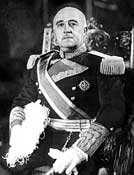
(1892 - 1975)
Francisco Paulino Hermenegildo Teódulo Franco
y Bahamonde Salgado Pardo, abbreviated Francisco Franco Bahamonde and
sometimes known as Generalísimo Francisco Franco, was head of
state of Spain from 1939 until his death in 1975. Known as "El
Caudillo de España" ("the leader"), he presided
over the fascist authoritarian dictatorial government of the Spanish
State following victory in the Spanish Civil War.
Early life
Born in Ferrol (officially known as El Ferrol del
Caudillo from 1938 to 1982), Spain,
on December 4, 1892, Franco's early life was marked by his father's
drunkenness and womanizing which contrasted with his devout mother's
overprotective devotion. His first ambition was to follow the family
tradition and join the navy, but cutbacks resulting from Spain's humiliating
defeat in the Spanish-American War of 1898 reduced the available positions
and Franco enlisted in the army instead. His brother Ramón Franco
was a pioneer aviator.
After graduating from the Infantry Academy in Toledo,
he spent two years in a quiet garrison in mainland Spain,
but obtained a posting to Morocco at the earliest opportunity. Spanish efforts to physically occupy their
new African protectorate provided the only chance of being engaged in
combat and thus earning promotion through merit. In practice this meant
surviving actions in which heavy losses were suffered, officers would
get either la caja o la faja (a coffin or a general's sash).
Franco soon gained a reputation as a meticulous and
fearless officer and joined the newly formed regulares colonial troops
to improve his chances of swift advancement.
At the age of 23, he was badly wounded in a skirmish
at El Biutz and although Spain's highest award for gallantry, the coveted
Cruz Laureada de San Fernando, eluded him, he became the youngest major
in the Spanish army and returned to the mainland where he met José
Millán Astray, a histrionic but charismatic officer who was soon
to found the Legión Extranjera, along similar lines to the French
Foreign Legion. Franco became the Legión's second-in-command.
In the summer of 1921, the overextended Spanish army
suffered a crushing defeat at Annual at the hands of the Riff tribes
led by the Abd el-Krim brothers. The Legión symbolically, if
not materially, saved the Spanish enclave of Melilla after a gruelling
three-day forced march led by Franco.
Rise to Power
Promoted to colonel, Franco led the first wave of
troops ashore at Alhucemas. This landing, in the heartland of Abd el-Krim's
tribe, combined with the French invasion from the south, spelt the beginning
of the end for the shortlived Republic of the Riff.
Becoming the youngest general in any European army
in 1926, Franco was appointed director of the newly created Joint Military
Academy in Zaragoza, where cadets were taught the brutal lessons of
the irregular war in Morocco.
With the fall of the monarchy in 1931, Franco initially
maintained an ambivalent attitude to the new Republic, not wishing to
compromise his career by overt opposition. He even swallowed the bitter
pill of the closure of his beloved Military Academy and subsequent postings
to La Coruña and the Balearic Islands, the main purpose of which
was to keep him at a distance from other potentially disloyal elements.
The Republic's failure to satisfy much of the popular
expectation it had created and the fragmentation of the left-wing parties
permitted a strong right-wing government to gain power in 1933. When
miners in Asturias started a full scale rebellion a year later, it was
Franco who ensured that colonial troops were sent to crush the uprising.
They employed the same ruthless tactics that had been used against the
tribesmen in Morocco. Having thus 'saved' Spain again, Franco was given
the top job in the army — chief of the general staff.
Having learnt their lesson, the left-wing and republican
parties presented a common front in the tense elections of spring 1936
and won a narrow victory. This time, Franco was posted to the Canary
Islands.
He, in fact, had not been actively plotting to overthrow
the Republic, but when the coup came, he flew to Morocco to take command
of the colonial army (including the Legión and the Regulares)
which had rebelled and rapidly taken control of the Spanish Protectorate.
The coup failed in many of the large cities and the
situation quickly degenerated into the Spanish Civil War. During the
war, in late September 1936, he became Generalísimo of the Nationalist
army, with rank of lieutenant general and then on October 1, 1936, he
was elected Jefe del Estado (Head of State). He also managed to fuse
the ideologically incompatible Falange ("phalanx," a far-right
Spanish political party with close connections to Hitler and Mussolini) and the
Carlist parties under his rule. His army was supported by troops from
Nazi Germany (Legion Condor) and Fascist Italy (Corpo Truppe Volontari).
Salazar's Portugal also openly assisted the Nationalists from the start.
The war officially ended on April 1, 1939, shortly after the conquest
of Madrid, although guerrilla resistance to Franco continued into the
late 1940s. Franco continued to rule as dictator of Spain until his death in 1975.
Dictatorship
Spain was bitterly
divided and economically ruined as a result of the civil war and Franco's
government actively promoted this division between "victors"
and "vanquished" while its incompetence did little to improve
the economic situation. In September 1939, World
War II broke out in Europe, and although Adolf
Hitler met Franco in Hendaye, France (23 October 1940), to discuss
Spanish entry on the side of the Axis, Franco's demands (Gibraltar,
French North Africa, etc.) proved too much and no agreement was reached
(Hitler remarked that he'd rather "have two or three teeth pulled
out" before trying to negotiate Franco's entry into the war again).
Also contributing to the disagreement was an ongoing disagreement over
German mining rights in Spain.
Some historians argue that Franco made demands that he knew Hitler would not accede to in order to stay out of the war. However, others
argue that he simply had nothing to offer the victorious Germans. Spain adopted a pro-Axis non-belligerency until returning to complete neutrality
in 1943 when the tide of the war had turned decisively against Germany.
Franco sent troops (División Azul, or "Blue Division")
to fight on the Eastern Front against the Soviet Union. They were "volunteers";
some were crusaders against Communism and some went just for the pay
or to clear former liaisons with the Republic. Franco also offered facilities
to German ships.
With the end of World War II, Franco and Spain were forced to suffer the economic consequences of the isolation imposed
on it by nations such as the United Kingdom and the United States. This
situation ended in part when, due to Spain's strategic location in light
of Cold War tensions, the United States entered into a trade and military
alliance with Spain. This historic
alliance commenced with U.S. President Eisenhower's visit in 1953. This
launched the so-called "Spanish Miracle," which developed
Spain from autarky into capitalism. Spain was admitted in the United
Nations in 1955. In spite of this opening, Franco almost never left Spain once in power.
In 1947, Franco proclaimed Spain a monarchy, but ironically did not designate a monarch. In 1969, he
designated Prince Juan Carlos de Borbón with the new title of
Prince of Spain as his successor.
This came as a surprise for the Carlist pretender to the throne, as
well as for Juan Carlos's father, Don Juan, the Count of Barcelona,
who technically had a superior right to the throne. By 1973 Franco had
given up the function of Prime Minister (Presidente del Gobierno), remaining
only as head of the country and as commander in chief of the military
forces.
Lacking any strong ideology, Franco initially sought
support from National Syndicalism (nacionalsindicalismo) and the Catholic
Church (nacionalcatolicismo). His coalition ruling single party, the
Movimiento Nacional, was so heterogeneous as to barely qualify as a
party at all, and certainly not an ideological monolith like the Fascio
di Combattimento (Fascist Party) and the Nationalsozialistische Deutsche
Arbeiterpartei (Nazi Party). His Spanish State was chiefly a conservative
- even traditionalist - rightist regime, with emphasis on order and
stability, rather than a definite political vision.
Although a monarchist, Franco had no particular desire
for a king. As such, he left the throne vacant, with himself as de facto
un-crowned king. He wore the uniform of a captain general (a rank traditionally
reserved for the King), resided in the Pardo Palace, appropriated the
kingly privilege of walking beneath a canopy, and his portrait appeared
on most Spanish coins. Indeed, although his formal titles were Jefe
del Estado (Chief of State) and Generalísimo de los Ejércitos
Españoles (Highest General of the Spanish Armed Forces), his
personal title was por la gracia de Dios, Caudillo de España
y de la Cruzada, or "by the grace of God, Caudillo of Spain and
of the Crusade" ("by the grace of God" is a technical,
legal phrase which indicates sovereign dignity, and is only used by
monarchs).
During his rule non-Government trade unions and all
political opponents (right across the spectrum, from communist and anarchist
organizations to liberal democrats and nationalists, especially Basque
and Catalan nationalists), were suppressed. In every town there was
a constant presence of Guardia Civil, a military police force, who patrolled
in pairs with submachine guns, and functioned as his chief means of
control. A Freemasonry conspiracy was a constant obsession for him.
In popular imagination, he is often remembered as in the black and white
images of No-Do newsreels, inaugurating a reservoir, hence his nickname
Paco Ranas (Paco - a familiar form of Francisco - "the Frog"),
or catching enormous fishes from the Azor yacht during his holidays.
Franco's tomb is located at Santa Cruz del Valle de
los Caídos. Famous quote: "Our regime is based on bayonets
and blood, not on hypocritical elections."
He died on November 20, 1975, on the same date as José
Antonio Primo de Rivera, founder of the Falange. It is suspected that
the doctors were ordered to keep him barely alive by artificial means
until that symbolic date. Franco is buried at Santa Cruz del Valle de
los Caídos, a site he had built as the tomb of el Ausente. When
he died, it was allegedly impossible to buy a single bottle of champagne
in Spain, since it had sold out. His successor was the current Spanish
Monarch, Juan Carlos.
Since his death, almost all the places named after
him (most Spanish towns had a calle del Generalísimo) have been
changed.
Sources: Wikpedia |