George Burns
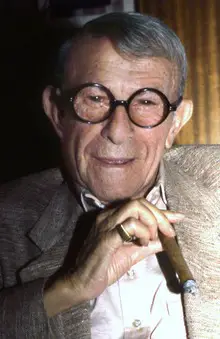
(1896-1996)
George Burns was a legendary Jewish American comedian, award-winning actor and best-selling writer.
He was born Nathan Birnbaum on January 20,
1896, in New
York City. Burns began performing at the age of six, with
a group of three other children, singing harmonies and calling themselves
the Peewee Quartet. In the fourth grade, Burns quit school to go into
show business full-time.
In 1923, Burns met Grace “Gracie” Allen,
whom he married on January 7, 1926, in Clevelend, Ohio. The two
immediately launched a partnership in acting and performing. In the
beginning, the twosome worked their act tirelessly on the road, slowly
building a following.
During the 1930s, Burns and Allen began their careers
in motion pictures with a series of short comic films, including The
Big Broadcast of 1932, International House (1933), Damsel
in Distress (1937), and College Swing (1938). In 1938, the
couple made motion-picture history, with the film Road to Singapore,
also starring Bob Hope and Bing Crosby.
Burns and Allen made their first radio appearance as
the comedy relief for bandleader Guy Lombardo. The duo’s own show, The George Burns and Gracie Allen Show, premiered on the air
on NBC on February 15, 1932. They formatted their show as a situational
comedy. In 1948, the couple took the show to CBS, and thus to television
in 1950. Burns and Allen aslo formed a company of their own, McCadden
Corporation, which produced such television series as The Bob Cummings
Show, The People’s Choice, and Mister Ed. The
show ran through 1958, until Burns and Allen consented to retirement.
However, Burns changed his mind and continued the show without her;
the full cast returned for The George Burns Show, but Allen’s
presence was obviously missing and the show expired after only a year.
Burns continued in television for one more series,
a situational comedy, Wendy & Me, which he created and co-starred
with Connie Stevens. Nevertheless, due to Gracie’s weakening health,
George decided to retire. Allen’s death of a heart attack in 1964
devastated Burns; to cope with the saddness Burns decided to immerse
himself in work to simply survive. Burns began performing in nightclubs
and a series of solo concerts all over the country. In 1974, Burns returned
to the screen in the film, The Sunshine Boys, which earned him
the Academy Award for Best Supporting Actor. In 1977, Burns made another
hit film, Oh, God!, co-starring with singer John Denver.
Burns continued to work well into his nineties, writing
books and appearing in films and television. Burns died on March 9,
1996, at the age of 100.
Sources: “George Burns (1896 - 1996).” American
Jewish Historical Society, American
Jewish Desk Reference, (NY: Random
House, 1999). pg. 439-440, Wikipedia, IMDB |