Herbert Charles Brown
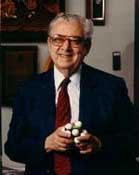
(1912 - 2004)
Herbert Charles Brown was born as Herbert Brovarnik,
on May 22, 1912, in London to Ukrainian immigrants. At a young age,
Brown and his parents immigrated to the United States where he attended
the University of Chicago. In 1938, Brown received his Ph.D. in chemistry
and went on to become the Professor of Inorganic Chemistry at Purdue
University in 1947. In 1959, Brown became the Wetherill Distinguished
Professor and, in 1960, he became a Wetherill Research Professor. Finally,
in 1978, Herbert Brown became professor emeritus but continued to work.
It was at Purdue University that Brown began his extensive
research on boranes (an inorganic compound of boron and hydrogen). He
revealed a method for producing sodium borohydride, which can generate
boranes. It was through these studies that the first process of producing
pure enantiomers was discovered. Brown’s work on boranes also
paved the way of a significant new class of inorganic reagents. Brown
was awarded the Nobel Prize for Chemistry in 1979 along with Georg Wittig for his pioneering work
with organic and inorganic organoboranes.
Brown was the author of Hydroboration (1962) and Organic
Syntheses via Boranes (1975). He was also a member of numerous distinguished
scientific societies, including the National Academy of Sciences (1957)
and the American Academy of Arts and Sciences (1966). Brown was awarded
the National Medal of Science in 1969.
Herbert Brown died on December 19, 2004, in West Lafayette,
Indiana at the age of 94.
The following press release
from the Royal Swedish Academy of Sciences
describes Brown’s work:
In contrast to most other natural sciences chemistry
is not exclusively restricted to the study of Nature per se. Chemists
can combine atoms into substances which do not exist in Nature. This
is particularly true for organic chemistry, the chemistry of carbon
compounds, where the possibilities for preparing new compounds are virtually
unlimited. These possibilities have stimulated the development of chemistry
and the practical consequences have been enormous.
The chemist soon learned
to make dye stuffs which were both cheaper
and better than naturally occurring dyes.
Chemical explosives such as nitroglycerine
were developed and their connection with
the Nobel Prize is well known. Synthetic
drugs have saved innumerable lives and
spared mankind a great deal of suffering.
The synthesis of vitamins and essential
amino acids, used as food additives, have
improved our diet, especially in developing
countries. Plastics, which are a part
of our daily lives, are products of organic
synthesis on a large scale. Chemicals
for controlling microorganisms, insects
and weeds have saved millions of lives
and reduced starvation. Many such substances,
however, have long-lasting effects which
cannot be accepted and chemists and biologists
are trying to develop better preparations.
Access to efficient synthetic reactions has been a
prerequisite for these developments and new synthetic methods have been
developed during tile past 150 years. Some of these nethods have had
such an impact that their originators have been awarded the Nobel Prize.
Boron compounds
Herbert C Brown, who is professor at Purdue University,
has developed new reagents containing boron. He jokes about his initials
H, C, and B, which are also the chemical symbols for hydrogen carbon,
and boron, the elements contained in the compounds which he studies.
One of his reagents is sodium boro-hydride, which has become the reagent
of choice for reduction of carbonyl compounds (Fig 1). He has also modified
the boro-hydrides into reagents for highly selective chemical transformations.
In addition Brown has introduced an entirely new class
of compounds, the organoboranes, obtained by reacting diborane with
olefins (Fig 2).
Thanks to the work of Brown and his coworkers, the
organoboranes have become the most versatile reagents ever created in
organic chemistry. They can be used for reductions, rearrangements and
additions and have opened up a range of new possibilities for linking
carbon atoms to each other.
The Wittig reaction
Georg Wittig has been
professor in Freiburg, Tübingen
and Heidelberg, and is now professor
emeritus. He has developed new synthetic
methods of considerable importance and
has studied reaction mechanisms. His most
important achievement is the discovery
of the rearrangement reaction which bears
his name. In the Wittig reaction (Fig 3)
an organic phosphorus compound with a formal
double bond between phosphorus and carbon
is reacted with a carbonyl compound. The
oxygen of the carbonyl compound is exchanged
for carbon, the product being an olefin.
This method of making olefins has opened
up new possibilities, not the least of
which are for the synthesis of biologically
active substances containing carbon-to-carbon
double bonds. For example, vitamin A is
synthesized industrially using the Wittig
reaction.
Brown's and Wittig's results have opened up new vistas
in organic synthesis and highly stimulated the further development of
their science. Their methods were rapidly introduced not only into chemical
laboratories, but also into elementary text books and laboratory courses.
Sources: Wikipedia;
"William
Howard Stein Autobiography"; Britannica;
Press release: "The
1979 Nobel Prize in Chemistry".
Photo courtesy of Herbert
C. Brown Center for Borane Research |