Joe Rosenthal
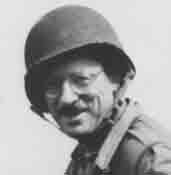
(1911-2006)
“That,” he declares with a proud chortle,
“is the greatest photograph of World War II.”
In 1945, Joe Rosenthal was 33, and as an AP photographer
assigned to the Pacific theater of the war, Rosenthal had already distinguished
himself photographing battles at New Guinea, Hollandia, Guam, Peleliu
and Angaur.
Joe Rosenthal took one of the most famous photographs
of World War II, but only
after both the U.S. Army and the Navy had rejected him as a military
photographer because his eyesight was impaired. Rosenthal saw action
when The Associated Press sent him to the Pacific.
On February 23, 1945, four days after D-Day at Iwo
Jima, Rosenthal was making his daily trek to the island on a Marine
landing craft when he heard that a flag was being raised atop Mount
Suribachi, a volcano at the southern tip of the island. Marines had
been battling for the high ground of Suribachi since their initial landing
on Iwo Jima, and now, after suffering terrible losses on the beaches
below it, they appeared to be taking it, Upon landing, Rosenthal hurried
toward Suribachi, lugging along his bulky Speed Graphic camera, the
standard for press photographers at the time. Along the way, he came
across two Marine photographers, Pfc. Bob Campbell, shooting still pictures,
and Staff Sgt. Bill Genaust, shooting movies. The three men proceeded
up the mountain together.
About halfway up, they met four Marines coming down.
Among them was Sgt. Lou Lowery, a photographer for Leatherneck magazine, who said the flag had already been raised on the summit. He
added that it was worth the climb anyway for the view. Rosenthal and
the others decided to continua The first flag, he would later learn,
was raised at 10:37 a.m. Shortly thereafter, Marine commanders decided,
for reasons still clouded in controversy, to replace it with a larger
flag.
At the top, Rosenthal tried to find the Marines who
had raised the first flag, figuring he could get a group picture of
them beside it. When no one seemed willing or able to tell him where
they were, he turned his attention to a group of Marines preparing the
second flag to be raised.
“I thought of trying to get a shot of the two
flags, one coming down and the other going up, but although this turned
out to be a picture Bob Campbell got, I couldn't line it up. Then I
decided to get just the one flag going up, and I backed off about 35
feet.
“Here the ground sloped down toward the center
of the volcanic crater, and I found that the ground line was in my way.
I put my Speed Graphic down and quickly piled up some stones and a Jap
sandbag to raise me about two feet (I am only 5 feet 5 inches tall)
and I picked up the camera and climbed up on the pile. I decided on
a lens setting between f-8 and f-11, and set the speed at 1-400th of
a second.
“At this point, 1st Lt. Harold G. Shrier ...
stepped between me and the men getting ready to raise the flag. When
he moved away, Genaust came across in front of me with his movie camera
and then took a position about three feet to my right. 'I'm not in your
way, Joe?' he called.
"No,” I shouted, “and there it goes.”
“Out of the corner of my eye, as I had turned
toward Genaust, I had seen the men start the flag up. I swung my camera,
and shot the scene.”
On Iwo Jima, Rosenthal shot the flag-raising photograph
that won the Pulitzer Prize in 1945. The image generated controversy
because the now-famous flag was put up to replace a smaller flag. Some
argued the event was staged for the benefit of the camera. Repeatedly,
Rosenthal explained that it was not.
Rosenthal was born in Washington, DC on October 9, 1911. His parents were Russian Jewish immigrants, but Rosenthal converted to Catholicism. Rosenthal's career in photojournalism began in San
Francisco with the Newspaper Enterprise Association. He was chief photographer
and manager for Times Wide World Photos before it was taken over by
the AP. After the war and after Iwo Jima, Rosenthal became a San Francisco
Chronicle staff photographer, where he remained for thirty-five years.
Now, close to 90 years old, Rosenthal recalls that day on a tiny atoll
in the Pacific where his life became intertwined with a photograph of
the raising of a flag. That 1 /400th of a second has lasted his entire
life.
Rosenthal died on August 20, 2006 at age 94.
Sources: American Jewish Historical Society |