Robert H. Jackson
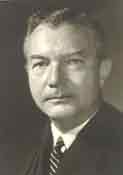
(1892 - 1954)
Robert Jackson was born in Spring Creek, Pennsylvania
on February 13, 1892. Five years later his family moved to Frewsburg,
New York, a nearby town to Jamestown, New York. Jackson graduated from
a public high school, never attended college, apprenticed in a law office,
and spent one year taking classes at Albany Law School.
It was in Jamestown where he was to spend the first
forty-two years of his life raising a family, practicing law, actively
participating in the political arena and serving the community. During
these years, his beliefs came to embrace the highest principals of conduct
and fairness for mankind. These values framed in his entire personal
and professional life.
In 1934, he answered a call from President Franklin
D. Roosevelt to serve as general counsel at the Internal Revenue Service.
His decision to move to Washington as a public servant was a fateful
one, as it steered his life into becoming one of the most remarkable
personal stories in American history. He went on to become Solicitor
General, Attorney General and a Justice of the United States Supreme
Court.
The Supreme Court
As the Supreme Court recessed for the summer on June
2, 1941, Chief Justice Charles Evans Hughes announced his intention
to retire. On June 12th, President Roosevelt nominated Associate Justice
Harlan Fiske Stone to succeed Hughes as Chief Justice of the United
States and Attorney General Jackson to succeed Stone as Associate Justice.
Jackson's nomination was confirmed by the Senate on July 7, 1941. On
July 11, Jackson took the judicial oath at the White House and received
his commission as an Associate Justice of the Supreme Court.
Justice Jackson served on the Supreme Court for more
than thirteen Terms, from his appointment in 1941 until his sudden death
just after the start of the Court's new Term in October 1954. Justice
Jackson was absent for the Court's entire October Term 1945, which was
the year he spent as the American Chief of Counsel prosecuting the principal
Nazi leaders before the International Military Tribunal at Nuremberg.
As a Supreme Court Justice, Jackson quickly became
known for his independent judging and his eloquent written opinions.
His opinions are hard to pigeonhole because, unlike some of his colleagues
on the Court, he did not vote reflexively for either individual litigants
claiming that their protected liberties had been violated or for government
officials claiming legal power to act in various ways. Justice Jackson's
votes and opinions explain and defend, in varying contexts, both the
constitutional rights of individuals and the constitutional powers of
national and state governments. He was keenly attentive to the facts
of each case and brought a practical wisdom, clearly expressed, to each
decision in which he wrote for the Court or himself. Justice Jackson,
unlike some other Justices, did virtually all of his own opinion-drafting.
His acclaimed opinions and rhetorical gems thus truly reflect his own
efforts and skills.
Nuremberg
Yet, he viewed his crowning achievement in public service
to be the new standards in international law that were created when
he served as the Chief American Prosecutor before the International
Military Tribunal Nuremberg following World
War II.
In 1945, Supreme Court Justice Robert H. Jackson was
asked by President Harry S. Truman to represent the United States as
Chief Prosecutor of the major Nazi war criminals who had been captured
at the end of World War II. On April 13th of that year, Jackson had
given a major address at the American Society of International Law in
Washington in which he had advocated that such a trial be conducted.
In his view, the victory about to be secured by the Allies in the most
destructive war in human history should be ended with a civilized proceeding
where a court of law would judge the guilt or innocence of the major
Nazi figures. This position was not held by all of the Allied nations.
Some thought that summary executions should be held or that a brief
courts martial proceedings would be sufficient to insure punishment.
However, Justice Jackson's view was similar to that
held by President Truman and several high-ranking members of his administration;
and, therefore, the decision was made to attempt to have such a trial.
The President also believed that, in order to succeed, this effort would
need to be led by an American jurist with impeccable credentials whose
involvement would give the effort its best chance of success. In late
April 1945, several days after he had become President upon the death
of Franklin Roosevelt, Harry Truman asked Judge Samuel Rosenman to call
Justice Jackson and ask him if he would consider taking a leave of absence
from the bench of the Supreme Court and undertake this mission. On April
29th, Justice Jackson responded that he would do so and plans were put
into effect that would take him to London to achieve an Agreement among
the Allied countries.
For two months during the summer of 1945, Jackson worked
at achieving a consensus among the Allies and was finally successful
when an Agreement between the American, British, French, and Soviet
governments was signed on August 8th. This Agreement, called the London
Charter, became the basis for the trials before the International Military
Tribunal held in Nuremberg from October 18, 1945 to October 1, 1946.
It was through the energy, intelligence and leadership
of Justice Jackson that these trials were organized, standards of evidence
developed, rights of defendants defined, and prosecutorial action commenced.
He was more than America's Chief Prosecutor. He was the driving force
behind the conduct of the trials themselves. Some in the United States,
including fellow members of the Supreme Court, criticized Jackson's
decision to undertake this effort. Yet, he believed that it was a mission
important to the Nation and the world. Never before had standards been
established defining aggressive war, crimes against peace and crimes
against humanity. In addition, at Nuremberg, the precedent was established
that individuals could be found personally responsible for committing
such crimes. It was not a defense that "I was ordered by Hitler
to do it". If such crimes were knowingly committed, a defendant
could be found guilty of their commission.
That individuals who commit war crimes or crimes against
humanity could be tried by an International Tribunal and be found personally
responsible was new law in 1946. Jackson's brilliance and courage in
bringing Nazi war criminals to justice set a new standard in the field
of international law. It remains the standard to which the world looks
today.
After Nuremberg, Justice Jackson returned to the bench
of the United States Supreme Court where he continued to build his reputation
as being one of the brightest and most articulate judges ever to serve
on that Court. Shortly after participating in the unanimous decision
in the famous desegregation case of 1954, Brown vs. Board of Education,
Robert Jackson suffered a fatal heart attack. Every member of the U.S.
Supreme Court came to Jamestown for his funeral. He is buried in the
Maple Grove Cemetery in nearby Frewsburg, New York, under a simple headstone
that reads: "He kept the ancient landmarks and built the new."
Sources: Robert
H. Jackson Center |