Judy Rosenberg
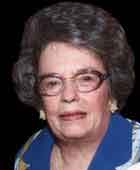
(1920 - 2008)
At 84 years old, Judy Rosenberg
has a quick, penetrating gaze and a daunting
capacity to instantly recall key dates from
long ago. When she recounts the history
of the Women's Division of Albert Einstein
College of Medicine of Yeshiva University,
she flies through names and deeds with passion,
wit and a realistic appraisal of the foibles
of human nature that never veers from good
humor into cynicism. Indeed, the whole story
comes alive with such vividness that she
could be talking about events that happened
yesterday, rather than a 50-year history
with all the twists and turns you might expect
to characterize the growth of an organization
that's raised over $100 million in five
decades.
Rosenberg is game to talk and articulate about everything-and yet,
when she's pressed to explain how she built one of the great fundraising
arms of any academic institution in our time, it's almost as though
the answer is too obvious to linger over: "We always gave everything
the personal touch." How did this unassuming, congenial woman accomplish
so much?
The story of how Rosenberg became what Dr. Deborah Kligler, associate
dean of the College, calls the "grande dame" of the Women's
Division, really begins before anyone had the idea of creating a Jewish-sponsored
medical school that would admit qualified students regardless of their
religious beliefs, gender, racial and ethnic background, or economic
status. It's really the story of a lifelong dedication to Jewish and
other philanthropic causes.
Rosenberg grew up in Brooklyn, in a household with a strong work ethic
and commitment to social activism. After she graduated from the Brooklyn
Ethical Culture School, her parents wanted her to attend the Fieldston
School. But true to the call of the personal relationships before all
else, even at the tender age of 13, she insisted that she wanted to
go to high school with her pals. Thus, Rosenberg stayed in Brooklyn
and enrolled at James Madison High School. From there, in 1937, she
went on to the College for Women at the University of Pennsylvania,
where she majored in psychology and sociology.
Apart from her rigorous academic schedule, Rosenberg was very active
in the social side of campus life at U. Penn, from the Sigma Delta Tau
sorority, where she served as president, to being business manager for
the campus newspaper. She enjoyed wonderful years in Philadelphia, but
New York was always calling her home.
Rosenberg glides over the years following graduation
before she began to be involved with the Albert
Einstein College of Medicine, saying self-effacingly, "I just
did some volunteer political work and philanthropy." In fact, after
a brief spell as a social worker, Rosenberg worked her way up through
Senator Jacob K. Javits' campaign organization, eventually becoming
his special assistant in his New York office. This work led to her enduring
friendship with Marian Javits, who later became actively involved with
the Women's Division. Rosenberg also worked on campaigns for John Lindsay
and Daniel Patrick Moynihan. She was definitely making a name for herself
as one of the most energetic and gifted young fundraisers in town.
As a result, she rarely had a free moment. She was also a newlywed,
marrying Alfred Rosenberg, a bankruptcy attorney, and setting up their
home in Brooklyn Heights. Alfred was very supportive of Judy's work
and active in the causes she championed.
Fast forward to 1951. For several years, Yeshiva University
president Dr. Samuel Belkin had been carefully putting together the complex jigsaw puzzle of support
necessary to build a medical college. The need for a top-quality institution
that wouldn't bypass talented Jewish students was unmistakable. But
mustering the necessary bureaucratic approvals and high-level support
was a painfully slow process. First, he had the internal hurdles to
face. Yeshiva University's charter had to be amended to include the
granting of degrees in medicine. Then there was the matter of getting
city and state licensing and access to a core group of patients. In
a crucial milestone, Dr. Belkin, with the assistance of Nathaniel Goldstein-New
York's Attorney General-got New York City Mayor Vincent Impellitteri
to agree to entrust care of all patients in the Bronx Municipal Hospital
Center (then under construction) to the College of Medicine faculty.
As the process of establishing the College was forging ahead on many
levels, there was one area that was glaringly behind schedule: fundraising.
Legend has it that Dr. Belkin may have made a less than complimentary
remark about the capacity of men to organize for fundraising. Regardless,
it seems certain that in 1953 he issued an unequivocal order: "Get
the women involved." It was a wise decision.
Etta Goldstein and Blanche Etra were already involved with Yeshiva
University. Now, with the blessing of Dr. Belkin, they went out in search
of women who would agree to join the greater New York Committee charged
with getting the Einstein College of Medicine actually built. Rae Harris,
a friend of Rosenberg's mother and the President of Women's American
ORT, went to see Rosenberg in her Brooklyn Heights home. "There's
going to be an interesting philanthropic meeting with chairmen and presidents
of major philanthropic organizations," she told Rosenberg. "You
should come see what they're doing. You might find it interesting."
"I'm not a chairman or a president." Rosenberg countered.
"I don't belong there." Harris persisted and eventually Rosenberg
agreed to accompany her.
"There were 50 or more women at that meeting," recalls Rosenberg,
"and every one of them was a general!" There were many talented
and powerful women eager to make Albert Einstein College of Medicine
their cause, but Rosenberg was crucial to the process whereby, in 1953-the
same year that Albert Einstein agreed to lend his name to the institution-this
loose-knit body turned into a real functioning organization.
"Judy's leadership, with Blanche and Etta, was vital during the
early days. She was-and continues to be-a source of guidance and inspiration,"
says Linda Altman, president of the National Women's Division. "She
made sure that the Women's Division was one of Einstein's earliest and
most devoted supporters. Judy knows how to motivate people."
Most of the members at the beginning were young women, often recently
married. Even when they weren't friends, they shared the same overall
social milieu. And it was the desire for stature within this larger
Jewish society that the Women's Division's first leaders managed to
leverage quite brilliantly. Fundraising began in the winter of 1953
with luncheons at the homes of different Division members. "Each
woman would compete for the chance to host a meeting and would try and
outdo the others with the quality of food," Rosenberg remembers.
In the course of these luncheons, Rosenberg and other Women's Division
leaders would try to make the guests feel like part of the family-and
then at some point in the event they'd solicit contributions. "Friend-raising
to fundraising," they called it. And it was all about the personal
touch. It was also, in its own way, quite radical. Women in those days
were often forbidden by their husbands or families to write checks.
So to appeal directly to women as the source for funds was to empower
them. Similarly, the organization's larger networking strategy demanded
skills that women were not often given a chance to develop in their
capacity as homemakers and mothers. "Suddenly," Rosenberg
says, "here we were doing everything ourselves."
In that same heady first year, Rosenberg and the Women's Division's
leaders came up with the idea of hosting an annual "mother-daughter
luncheon" as a vehicle to honor mothers and give a special high
point to the yearlong fundraising effort. "Everybody thought it
was a great idea. And we raised lots of money for those days."
Rosenberg notes.
In 1954, the "mother-daughter luncheon"
was held, honoring, among others, Marlene
Dietrich and her daughter, Maria Riva. Rosenberg was the event's
chairperson. In later years, the name would be changed to the Spirit
of Achievement Luncheon, honoring individual women in fields such as
philanthropy, the arts, business, government, and journalism. To this
day, these luncheons are the high point of the Women's Division annual
fundraising effort.
"This group is the most successful women's division of its kind
in medical academia," says Dr. Dominick P. Purpura, the Marilyn
and Stanley M. Katz Dean at the Albert Einstein College of Medicine.
"The Women's Division's activities, with the Spirit of Achievement
Luncheon as the flagship event, are vital to our cause."
Surely, one of the most
important additions to the Women's Division
during Rosenberg's tenure was Lizette Sarnoff,
whose husband, David, was Chairman of the Board of RCA and founder of
NBC. Sarnoff had been a devoted hospital volunteer in Manhattan for
25 years when Rosenberg and Marian Javits paid a call on her. Once again
the Division's personal touch went into action. And, indeed, Sarnoff
responded eagerly to their overtures on behalf of Einstein. It wasn't
long before she became one of the organization's most tireless supporters.
Her husband also became something akin to the organization's miracle
man. "Any time there was a seemingly impossible task that we wanted
to accomplish, Lizette said it wouldn't be a problem," remembers
Rosenberg. "She knew David would do everything he could to help
us."
The list of names associated with the Spirit of Achievement
Awards Luncheons is truly dazzling. Margaret Mead and Eleanor Roosevelt
were honored in 1960, and Mrs. Roosevelt also served as honorary chairperson
of the Women's Division. Thanks to the good work of the Sarnoff family,
Johnny Carson and Bob Hope served as masters of ceremonies, and the
Women's Division was able to expand its fundraising effort nationwide.
Danny Kaye once arrived as a surprise guest. Later honorees included
Helen Hayes, Betty Friedan,
Patricia Neal, Meryl Streep and Katie Couric. Perhaps it was the degree
of commitment the organization displayed that won over the hearts of
so many high-profile individuals. Certainly, once again, the personal
touch deserves part of the credit for the success of these events.
Rosenberg credits Marian Javits and Lizette Sarnoff as the two greatest
influences on her, as a community leader and philanthropist. "I
learned a lot about people and public life from them," she says.
In 1974, after her death, the Women's Division established the Lizette
H. Sarnoff Award for Volunteer Service in her honor. The Sarnoff's daughter-in-law,
famed soprano Anna Moffo, became active in the organization, and today,
with the Sarnoff's granddaughter, Rosita, she presents the award at
the Spirit of Achievement Luncheon.
Once construction on the College of Medicine was completed, providing
an opportunity to visit the campus became important so that Women's
Division members could learn firsthand about Einstein's mission. The
group organized an annual Woman's Day tour of the growing campus, including
meeting researchers in their labs and learning about their work.
"We used to bring people up to tour Albert Einstein College of
Medicine on buses," she says. "It used to be a much quicker
trip, so more people would go to the Bronx than you can convince to
travel there now. From my home in Brooklyn Heights, it used to take
less than half an hour to make it up to the College."
Rosenberg maintains that one of the reasons so many celebrities were
to be found making the trek up to the Bronx to watch the Albert Einstein
College of Medicine develop was that the trip was such a breeze.
The Women's Division grew steadily with the years. Dinners were added
to the roster of luncheons. And men were attending Women's Division
events as well. The organization opened Connoisseur's Corner, a boutique
specializing in donated antiques, china, silver, and fine art, at Fifth
Avenue and 13th Street. Quality was high enough that the store enjoyed
a steady stream of shoppers. Proceeds from sales were given to Einstein.
The Woman's Division also published a popular cookbook that compiled
favorite recipes from members.
"It has been very rewarding to watch the organization grow and
develop over time," says Rita Rosen, a longtime member and former
national president. "We have helped fund some of Einstein's most
critical research efforts by supporting programs in pre-natal studies
and birth defects, child development, women's cancers, diabetes, and
AIDS."
Although the organization became more and more successful in terms
of its fundraising capacities, Rosenberg always saw a bigger picture.
She sought to bring other people into the Women's Division family who
would be there for the organization in the future. For this reason,
she nurtured relationships with some of the most important philanthropic
families of the time.
Rosenberg's contributions to Einstein's growth took every conceivable
form. One of her most important material legacies to the College was
made in 1996 when, after her husband Alfred's death, she established
a professorial chair in diabetes research in his memory. The gift expanded
on their previous commitment to diabetes research. The Rosenbergs chose
to focus on diabetes because research in this area was underfunded.
"On top of being one of the leading causes of death and disability
in this country," Rosenberg explains, "it's an insidious disease
that can cause horrible complications, including blindness and nerve
degeneration. We were happy to be able to help Einstein fight this awful
malady."
Today, Einstein houses one of the leading diabetes research centers
in the nation.
Rosenberg's steadfast, passionate engagement with the Einstein cause
spanning the time from before the College was built until today when,
as she says, "it's become so large I can't walk all the way around
it," is a rare instance of lifelong philanthropic loyalty. Asked
to comment on her lengthy commitment, Rosenberg says, "It's been
an absolutely wonderful experience to be involved with my whole life.
I am proudest of the fact that I have worked with so many devoted and
talented women, who have shared their creativity, their time, and their
resources with the Women's Division and Einstein."
As for the future, Rosenberg modestly defers from trying to direct
where the organization must go in the years to come. She's happy to
see the ways that the Women's Division has changed to include now so
many professional women from different generations, both single and
married. But she does believe that in broad strokes it's important for
the Women's Division to continue operating by principles that were there
from the very beginning. "We have to keep our personal touch,"
she explains. "We're known for that. Today you get floods of anonymous
solicitations. People aren't going to respond. We're about caring one
on one and that's got to be kept up. After all, we have a reputation."
Whatever the personal touch is, Rosenberg has it in all she does.
It's a gift that has made for a fascinating, rich personal life, and
has helped to build the Albert Einstein College of Medicine into one
of the world's foremost medical schools. After all, both she and the
school have a reputation.
Sources: Lifestyles |