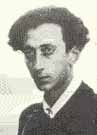
Commander of the partisan underground organization,
founder of the “Breha” (escape), poet and writer,
and activist in Israel's cultural and public life.
Born in Sebastopol, Russia, he was educated in the
Hebrew high school in Vilna and in the school of
arts. At a very young he became trainee in the Hashomer
Hatzair Youth Movement.
In 1940-1941, when Vilna was the capital of the Soviet Republic
of Lithuania, Kovner was a member of the underground
organization. After the German occupation in June 1941, Kovner
hid with a few friends temporarily in a Dominican convent in the
city suburb. After he returned to the ghetto and became aware of
the killing of thousands of Jews, Kovner expressed the idea of
revolt and began to build a Jewish force to fight against the
Nazis. On the night of December 31, 1941, Kovner read before a
meeting of delegates of all Jewish Youth Movements a public
announcement:
“Hitler is plotting to destroy all European Jews.
Lithuanians Jews will be the first in line. Let us not be led
like sheep to the slaughterhouse. It is right, we are weak and
without defense, but the only answer to the enemy is
resistance!”
It was the first time that the mass killing of Jews
was realized as part of a general plan to exterminate
all the Jews in Europe. It was also the first time
that Jews were called to defend themselves with arms.In
January 21, 1942,
the “United Organization of Partisans” was founded
in Vilnus. The new organization was comprised of
all the parties and youth movements from the entire
political spectrum in the Vilna
Ghetto. Kovner
was a member of the headquarters, and after its chief
commander, Itzhak Wittenberg, was caught in July 1943,
he became the head of the organization (his nickname
was “Uri”).
In the days of the last deportation from the Ghetto to the extermination
camps, Kovner supervised the escape of the
organization fighters to the woods. In Rodniky woods he commanded
the Jewish Unit composed of Ghetto fighters and the
“Nakam” squadron from the Jewish camp.
After the liberation Kovner was active in the “Breha”
movement and he was the spirit of the “East Europe
Survivors Brigade” — a non-political organization of Zionists spheres, that called to unit forces looking at the Holocaust lesson and the still dangerous situation that was
foreseen for the Jewish people.
In July 1945 he arrived to the “Eretz Israel Brigade”
base in Italy and made a speech about the destruction of European
Jewry and the uprising against the Nazis during the war, in front
of all the solders. Shortly after it Kovner arrived in Israel for
a short time to get support and means to perform the activities
of the “Nakam” (revenge) on the responsible murderers
of the Jewish people in the Holocaust. On his way back to Europe,
he was arrested and deported back to Israel. After a short time
he was released.
In 1946 he joined with his wife and partner in the underground
activities — Vitka Kampner — and with a few more partisans to kibbutz Ein Hahoresh. During the Independence War Kovner was an
officer in charge of cultural activities in the famous “Givati” brigade. At the end of the war Kovner returned
to his kibbutz and dedicated most of his time writing. He
published two prose volumes and collections of poems. In 1970
Kovner received the “Israel Prize” for literature. He
also was director of the “Israel Society of Writers”.
Designer of the “Diaspora House” at Tel Aviv University
and one of “MORESHET” founders.