Benjamin Leiner
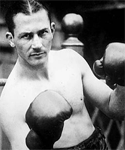
(1896 - 1947)
When Benjamin Leiner, the son of Russian Jewish
immigrants, was growing up in New York’s Greenwich Village prior to World
War I, he and his friends fought against Irish, Italian and other immigrant
youth gangs for a "place" in the neighborhood. As he later
recalled, "In the winter we fought with snowballs packed tightly
around pieces of coal and soaked with water until they were hard as cannon
balls. Then we used baseball bats, stones and loaded canes. . . . There was
many a boy who suffered permanent injury from an encounter with the
warriors from the next block."
After losing one of these street fights, Leiner’s
uncle took him for boxing lessons. According to historian Peter Levine, the
slender young Leiner became the undisputed champion of his block. Soon, he
was fighting for prize money at local gyms.
Leiner’s mother deeply opposed his fighting, which she
considered dangerous and unseemly for an Orthodox Jewish boy. To
"protect" her feelings, Leiner began fighting under the name
Benny Leonard, but could not keep his secret for long. He returned home
from a fight with a black eye and, when confronted, Benny admitted that he
was hurt in the ring. Then, he put his $20 winnings on the kitchen table.
"My mother," he later said, "looked at my black eye and
wept. My father, who had to work all week for $20, said, ‘All right
Benny, keep on fighting. It’s worth getting a black eye for $20; I am
getting verschwartzt [blackened] for $20 a week.’"
This anecdote tells much about the role boxing played in
he assimilation of Eastern European Jewish immigrants and their children
into the American mainstream. For successful fighters like Leonard, it
offered a chance to escape from the low wages of sweatshops and factories.
By 1916, Benny was so adept at boxing that he could afford to move his
parents to a larger home in Harlem, where he continued to live.
Leonard kept fighting and in 1917, won the lightweight
championship of the world. That night, his immigrant Jewish followers
proudly marched through the streets of Harlem waving American flags.
Leonard held the title for 8 long years, despite the fact that the
lightweight division was probably the most competitive in boxing. Known as
"the Great Bennah," Leonard was so skillful that he could boast
of going through fights without his opponent mussing his hair. Sportswriter
Al Lurie wrote of Leonard that, when he was the champ, he was "the
most famous Jew in America . . . beloved by thin-faced little Jewish boys
who, in their poverty, dreamed of themselves as champions of the
world."
One of those little boys was Budd Schulberg, who later
became famous as a novelist and screenwriter. Schulberg noted of Leonard,
"To see him climb in the ring sporting the six-pointed star on his
fighting trunks was to anticipate sweet revenge for all the bloody noses,
split lips and mocking laughter at pale little Jewish boys who had run the
neighborhood gauntlet."
Leonard’s reign as champion was about more than
revenge, however; it also conveyed respect and recognition. In a burst of
hyperbole, the New Warheit compared Leonard to Albert Einstein and concluded that the boxer
"is perhaps even greater than Einstein, for when Einstein was in
America only thousands knew him but Benny is known by millions. It is said
that only twelve people or at the most twelve times twelve the world over
understand Einstein, but Benny is understood by tens of millions in
America." The paper drew a Zionist conclusion: "Just as we need a country so as to be the equal of other
people, so we must have fists to become their peers."
Ever mindful of his mother’s concern for his safety,
Leonard retired in 1925. "My love for her," he told the press,
"is greater than my love for the game that has made me independently
wealthy, and to which I owe all I now possess." Unfortunately, the
stock market crash of 1929 wiped out Leonard’s wealth. By 1930, Benny
returned to the ring to recoup his fortunes.
Sadly, age and inactivity had taken its toll on Leonard.
After a series of tune up fights against weaker opponents, Leonard was
matched against a tough Irish boxer, Jimmy McClarnin. "There is
scarcely a Jew whose blood runs red," the sportswriter for the Los
Angeles B’nai B’rith Messenger wrote, "who is not vitally
interested in the outcome. . . Win, lose or draw, this compatriot of mine
will have shown the world that he was a true fighting man."
McClarnin knocked out Leonard in 6 rounds, the first
time Leonard lost by a KO. He retired again and assumed a career in
vaudeville and as a boxing referee. In 1947, while refereeing a fight, he
died in the ring of a heart attack. Al Lurie mourned Leonard with the
following words:
When a people is beaten, persecuted and frustrated, it
finds more than mere solace in its champions . . . When Leonard was
accepted and admired by the entire fair-minded American community, the Jews
of America felt they, themselves, were being accepted and admired. Leonard,
therefore, symbolized all Jewry.
Since Leonard’s time, Jews have earned America’s
admiration in fields such as science, business and politics. Like other
immigrants groups, however, Jews had to fight their way into respectable
society. Benny Leonard did his fighting in the ring, on behalf of an entire
generation.
Sources: American Jewish
Historical Society (AJHS) |