Leon Recanati
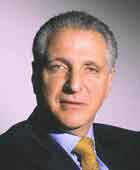
(1948 - )
Businessman Leon Recanati, who, along with his family, last year sold
IDB Holdings, a company with annual revenues of $10 billion, continues
to dedicate a substantial share of his time to philanthropic activities.
In the next few years, Recanati will spearhead an educational program
at the Israeli National Museum of Science and Space, named after the seven
fallen astronauts of the space shuttle Columbia.
Recanati has always believed that the
giver receives more than the receiver.
"For me, giving is part of the structure of my being and a family
tradition," he explains. "There is no doubt that I am a man
who is sensitive to the world's distress. I also derive great satisfaction
from the fact that I am able to help a man who is in a difficult situation.
It moves me deeply. This especially happens to me every time I see children
coping with difficulties.
"Last week, for example, we visited a kindergarten in Ariel,
where the class is made up of immigrant children from Russia and children who were born in Israel.
Together they form an ingathering of the exiles and cope very successfully.
That morning, by the way, I happened to meet an Ethiopian soldier
with a red beret in the epaulet of his shirt. That type of meeting is
very touching for me. It is the realization of a miracle and the further
realization of the ingathering of the exiles of the Jewish people in
their land."
The Recanati family is one of the biggest donors in Israel, and Leon
Recanati prefers not to reveal the extent of his family's donations
over the years. He does not usually grant interviews, and agreed to
this interview only in order to promote the STARS-Space Technology Astrophysics
Research for Students-project.
The project, under the auspices of the Israel National Museum of Science,
Haifa, and with the encouragement of the Technion - Israel Institute
of Technology, perpetuates the memory of the lost astronauts of the
Columbia space shuttle disaster, including Ilan
Ramon, the first Israeli astronaut. Recanati, true to his quiet
nature, speaks little and avoids announcements to the press. That is
also what happened a year ago, when he embarked on a new chapter in
his life after his family decided to sell IDB Holdings, whose equity
was estimated at $1 billion.
At 55, the sale of IDB closed a circle of 32 years of Recanati's life
that he had devoted to a varied business career intertwined with family
dealings. The son of a family of bankers, he has met all expectations
over the years. After completing his military service, he earned a B.A.
in economics and an M.B.A. at Hebrew
University in Jerusalem, and at age 23 began to work for Israel
Discount Bank. After a round of training in banking, he gradually advanced
until his appointment in 1979 as deputy CEO of the bank, in charge of
the bank's branches and marketing. In 1986, he transferred to IDB Holdings
and to activities in IDB's investment companies. His positions there
included chairman of Supersol, Delek and Clal, and later as co-CEO and
cochairman of IDB.
In May 2003, after the decision to sell IDB, Recanati decided to set
up a private investment company called GlenRock, which has three operating
arms. GlenRock America is headed by Larry Graev, who handles buyouts
and advises Israeli businesses in penetrating the American market. The
company is also active in serving as a bridge for American investors
interested in investing in Israel. The second arm is GlenRock Israel,
which invests in technology companies, with an emphasis on the life
sciences, medical equipment and biotechnology. The third arm, GlenRock
Italy, is headed by Rony Benatof, and here, too, the goal is the mutual
referral of businesses, similar to the connections made in the United
States.
Lifestyles: You switched from heading a company doing $10 billion a
year in business to a smaller investment company. How has this changed
your life?
Recanati: "The essential change compared with my activities in
the past is that in the case of IDB, it was a conglomerate, a huge group
with many public companies and a tremendous amount of activity. GlenRock
is smaller and its activities are measured in modest amounts. It is
a private company that maintains hands-on direct contact with the investments."
Lifestyles: What about philanthropy? Would you say that the same rules
that apply to a successful business apply to a body involved in philanthropy?
Recanati: "The measure of success in a business is the achievement
of the maximum yield. In a social investment, on the other hand, the
investment is in the quality of the fabric of the social life of the
direct beneficiaries and their surroundings. In both cases there are
immediate results, but when dealing with a donation, one sees additional
results later on. The results are like ripples from a stone thrown into
water: There is one ripple, and then another and another. You invest
in a child. He grows up. Then he contributes to society. Raises a family.
There is continuity in all directions. Thus the donation produces a
yield that is far greater than in a business. The yield is not personal,
but rather, benefits society in general.
"I also believe that a business has an obligation, not just a
privilege, to contribute and give back to society. Today there is a
broader awareness that the positive image a company gains when contributing
to the public has monetary value. Companies view it as image building.
Even among their stakeholders-customers, shareholders, suppliers, employees
and everything surrounding them."
Lifestyles: Is it possible that the whole subject of contributing is
a matter of a passing fad?
Recanati: "I don't think so. There is great awareness of the social
distress and the gaps. This is directly linked to the people with means.
When there are means, they contribute. In Israel there is also the governmental
factor, the cutting of the social budgets, and this is certainly a reason
that prompts people to volunteer."
Recanati remembers himself from a young age as being an active partner
in his family when it came to deciding on donations. "My father
often let me share in the need to give to others," he relates.
"I remember that when I was a child I was often present at the
laying of a cornerstone or participating in festive ceremonies."
The family's most significant contribution in Israel was made by Leon's
grandfather, after whom he is named, who was head of the Jewish community
in Salonika, Greece. In the
early 1930s the elder Leon saw the clear signs of the Nazi threat and decided to move to Palestine.
He arrived at the head of a large group of Jews, many of whom were port
workers in Salonika, and who went on to form the solid core of the port
workers in Haifa and Yafo.
The elder Leon, who was a teacher by profession, soon discovered that
there were 70 banks in the country, but not one of them was run by Sephardim (Jews of Spanish or Middle Eastern descent). For this reason, he founded
the Palestine Discount Bank in 1935, with a Sephardic orientation and
an emphasis on foreign trade. Having been active in community service
in Salonika and having set up a scholarship fund for needy students,
the elder Leon continued this activity in Palestine, setting up a fund
for channeling contributions to students of Sephardic origins. In addition,
he helped establish moshav farming communities such as Tzur Moshe and
Kfar Hittim, which were populated mostly by farmers from the Balkan
countries.
As a banker, he helped Jews who wanted to present themselves to the British Mandate authorities
as men of means, in order to avoid being expelled from the country.
As a result of his efforts, the bank prospered and became a very significant
force in the Israeli economy. But 10 years after his arrival in the
country, Leon died very suddenly at the age of 55. His four sons assumed
responsibility for his business enterprises.
Daniel, the father of today's Leon, who was born three years after
his grandfather's death, was 21 when he entered the banking business.
He worked his way up in the bank until he was appointed CEO and succeeded
in turning the bank into the second-largest bank in Israel. He later
founded Discount Investments and Clal Israel, all of which became in
1970 parts of IDB Holdings.
Daniel and his brothers continued the tradition of philanthropy and
established many foundations in their father's memory. One of the most
well-known is the Leon Recanati Home for the Aged in Petah Tikva, which
has over 200 residents, most of them originally from Greece, Turkey and the Balkans. There is also the Recanati Auditorium at the Tel
Aviv Museum, named after Leon and his wife, Mathilda. The family
also contributed to the construction of Heichal Yehuda, a synagogue built in a unique shell shape, in memory of the Salonika community.
Two schools of business administration, in Tel Aviv and Jerusalem,
are also named after the elder Leon, as is the nursing school at the Ben-Gurion University
of the Negev, in Be'er Sheva, and academic chairs at the Weizmann
Institute of Science in Rehovot and at other universities. Mathilda,
Daniel's wife and Leon's mother, served for many years as the vice president
of the Israel Cancer Association.
Leon's spouse, Shula, heads the College for All Association, which
runs an educational enrichment program that matches up student mentors
with elementary and high school pupils from needy populations in disadvantaged
neighborhoods. The association currently operates in eight cities and
focuses on children with potential. The program also involves the parents
and the local population as a whole, with the goal of enabling the children
to attend a university.
Leon's sister, Judith Yovel Recanati, is the founder and chairperson
of NATAL, the Israel Trauma Center for Victims of Terror and War, which
provides psychological counseling to terror victims. A cousin, Oudi
Recanati, who until recently served as chairman of Maccabi World Union,
is active in various organizations and is currently chairman of the
Multidisciplinary Center in Herzliya.
Leon's uncle, Raphael Recanati, moved to New York, where he founded
and managed OSG-Overseas Shipping Group. Raphael, who died in 1999,
also contributed very generously to the public good in the U.S. and
in Israel.
In the late 1970s, when his father became ill, Leon assumed Daniel's
public roles. Through the Recanati Family Foundation, Leon has continuously
invested a significant share of his time in philanthropic activities
and works toward promoting important major issues, particularly investments
in health and education. In the past 16 years he has been active in
the Israel Cancer Association, currently serving as its vice chairman.
(The ICA is the largest volunteer association in Israel and is involved
in all areas of battling this disease.)
For many years Recanati has been actively involved with a few universities
as a member of the board of trustees and with the Recanati schools of
business administration. He has been the chairman of Tel Aviv University's
Development Committee for the past 15 years. His activities also include
significant involvement in the Israel Museum and the Tel Aviv Museum.
Lifestyles: Is one ever able to separate oneself from such activities,
or is it a lifelong commitment?
Recanati: "Lately, after 28 years of involvement, I left the Israeli
Society for Autistic Children. I was among its founders, together with
Leah Rabin, may she rest in peace, who was the wife of Prime
Minister Yitzhak Rabin. My decision to leave was related to the
fact that I have too many involvements. I also believe that others should
become involved and I wanted to work with other organizations as well.
"I hope to gather more forces for good wherever I go. When I
look back, one of the things that gives me satisfaction is the fact
that I succeeded in drawing most of my friends into contributing willingly
and participating in helping the community by donating and in getting
workers personally involved.
"I recruit that same enthusiasm from my friends for the benefit
of an association called Tapuah, which I founded four years ago. The
goal of that association is to work toward narrowing the digital gap
between the haves and the have-nots. Tapuah was founded after I saw
the danger facing the have-nots. If they are not given digital knowledge,
they will remain behind, and we must not let this happen. We set up
centers in 48 outlying communities, disadvantaged neighborhoods and
Bedouin, Druze and Arab villages. The centers provide basic computer
and Internet training and give the whole population free access from
8:00 a.m. to 10:00 p.m.
"So far, some 300,000 people have visited Tapuah centers. That
is about 10,000 per month. We have succeeded in recruiting most of the
companies in the communications and computer industries to this project,
including most of the companies in the IDB Group. We have also managed
to have an influence on the government-to act more fervently-to bring
about the equal opportunity made possible by the new era."
Some people in the education system in Israel are already comparing
Recanati's Tapuah project to the Carnegie project in the U.S. Famed
industrialist Andrew Carnegie contributed to the establishment of libraries
all over the U.S., thus offering needy populations an education and
opportunities.
The desire to provide opportunities for broad populations characterizes
another of Recanati's philanthropic projects that is connected with
the Technion, a world-renowned institute in technology. Recanati began
this project in the mid- 1980s, after his father died, when he was looking
for a worthy cause for perpetuating his father's memory. The idea, which
began as an original initiative by professors at the Technion who wanted
to set up a science education center, captivated Recanati and the historic
Technion building was chosen to house the center.
"The subject of education, which was dear to my father and myself,
seems to be the most significant force in ensuring our economic future
and our security," says Recanati. "I convinced my family to
adopt this project and persuaded the government to call it 'national.'
Following the tragedy of the space shuttle Columbia, and after consulting
with the Ramon family, we decided to name the Technion project after
the crew of the Columbia."
The National Museum of Science and Space currently serves as the main
force in informal science education enrichment programs in Israel. Every
day, dozens of classes from all over Israel visit the museum and receive
hands-on enrichment in labs and from interactive exhibits.
"We are currently in the middle of planning the next stage. So
far we have managed to restore the historic building, which is a national
architectural gem designed by Alexander Baerwald at the beginning of
the last century. We have preserved its architectural beauty plan to
double the exhibition space and renovate the education wing, which is
over 80 years old.
"There are also important plans for bringing science and technology
innovations to this historic site. To this end, we are in the process
of raising $40 million in donations-half for the construction and half
for the development fund. The curriculum, designed to enrich the study
content, includes astrophysics, space, robotics and physics. I believe
that the investment in education, particularly in these areas, is more
essential today than ever before. This is, in light of the deterioration
in scholastic achievements in Israel, essential to ensure the future
of the students who will later study at the Technion."
The STARS project was launched in March of this year, after former
Israel Air Force Commander Maj. Gen. (Res.) Eitan Ben Eliahu joined
Recanati as co-chairman. Recanati, who believes in national strength,
also decided this year to join another project, Impact, which is run
by the Soldier's Welfare Association. The project involves American
Jews who assist with annual scholarships of $4,000 for discharged soldiers
who served in combat units.
"It is very exciting to see such donations, when they are channeled
properly and done through cooperation between Israelis and American
donors. Such donations are effective and contribute to our strength,"
says Recanati. "We distributed 550 such donations this year. Our
goal is to reach 1,000. I feel that today there are a greater number
of associates and more and more Israelis who are donating. Much of this
is linked to the budgetary constraints at the government level and the
awareness of the need to pull together and help others.
"Such models of cooperation between Israelis who can help and
Jews from abroad can be very effective. What's more, the current generation
is mostly businessmen who want to give, not only with their hearts,
but also with their heads. I am proud to say that some of the new donors
are people who joined this project thanks to the achievements of hi-tech.
"Another contributing factor is the custom inherent in Judaism.
Giving in secret, benevolent societies, and helping the public are all
Jewish values. This is certainly not just a fad, but rather, a growing
trend. And it will grow the more the people can afford to give."
Sources: Lifestyles |