The Marx Brothers were a team of sibling comedians,
who performed in vaudeville, stage plays, film and television. The Marx
Brothers, born in New York City, were the sons of Jewish German immigrants.
The brothers' real names were:
• Manfred, born in 1885 and died in infancy
• Chico- Leonard, 1887-1961
• Harpo- Adolph (later Arthur), 1888-1964
• Groucho- Julius Henry, 1890-1977
• Gummo- Milton, 1892-1977
• Zeppo- Herbert, 1901-1979
All of the boys were encouraged from an early age
to play musical instruments. Harpo’s main musical focus was the
harp (from which he derived his nickname), Chico was an excellent pianist,
and Groucho played the guitar. In 1905, Groucho made his debut as a
singer in vaudeville. By 1907 he and Gummo were singing together as
part of The Three Nighingales with Mabel O’Donnell. The next year,
Harpo became the fourth Nightingale. By 1910, the group expanded to
include their mother, Minnie, and their Aunt Hannah; the troupe was
renamed The Six Mascots.
Slowly, the group’s act evolved from singing
to a comedy with some music. By 1912, Chico had joined the group. Nevertheless,
around this time, Gummo left the group to fight in World War I; Zeppo
would replace him for their final vaudeville years.
During World War I, the brothers changed their stage
name to “The Four Marx Brothers” (including Chico, Harpo,
Groucho, and Zeppo). By 1919, they were playing the most famous venue
in vaudeville, the Palace Theatre in New York City. They also began
to develop their famous on-stage personas. Groucho began to wear his
trademark greasepaint moustache and to use a stooped walk, Harpo began
to wear a red fright wig, carried a taxi-cab horn and never spoke, Chico
started to talk in a fake Italian accent, and Zeppo adopted the schleppy,
juvenile role of the straight man.
The Marx Brothers made their next claim to fame, by
becoming successful stars on Broadway. Their first musical revue, I’ll
Say She Is, debuted in 1924. A year later they followed up with
the musical comedy, The Cocoanuts and then in 1928 with Animal
Crackers.
The brothers next struck a contract with Paramount
Pictures and embarked on their career in films. Their first two films
were adaptation of their former Broadway shows: The Cocoanuts (1929) and Animal Crackers (1930). In 1931, they made a short
film, The House That Shadows Built, which was included in Paramount’s
twentieth anniversary documentary. In 1932, the brothers filmed Horse
Feathers, their most popular film to date, and the film which won
them the cover of Time magazine. Their last Paramount film, Duck
Soup (1933), is the only Marx Brothers film on the American Film
Institute’s “100 years… 100 Movies” list. The
team left Paramount due to creative disagreements and financial issues.
After
Zeppo left the act to become an agent, the three remaining brothers
moved to Metro-Goldwyn-Mayer (MGM). Under the leadership of Irving Thalberg,
the team changed their formula; stronger plots, more musical numbers,
and using the brothers' characters as comic foils to serious romance.
The first film that the Marx Brothers shot with MGM was A Night at
the Opera (1935); the film was a great success, and for many years
considered their best work. It was followed two years later by the even
bigger hit A Day at the Races (1937). The Marx Brothers made
three more films before leaving MGM, At the Circus (1939), Go
West (1940), and The Big Store (1941).
Although the brothers seemed ready to retire, Chico
was in dire financial straits and to help settle his gambling debts,
the group made another two films, A Night in Casablanca (1946)
and Love Happy (1949), both of them released by United Artists.
In 1959, they did a television special, The Incredible Jewel Robbery.
Chico and Harpo went on to make nightclub and casino
appearances, sometimes together. Groucho began a career as a radio and
television entertainer. From 1947 to the early 1960s, he was the host
of the humorous quiz show You Bet Your Life. In 1970, the Four
Marx Brothers had a brief reunion in the ABC animated television special The Mad Mad Mad Comedians; the Marx Brothers’ segment was
a reworking of a scene from their Broadway play I’ll Say She
Is.
On January 16, 1977, The Marx Brothers were inducted
into the Motion Picture Hall of Fame.
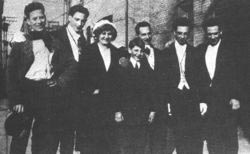
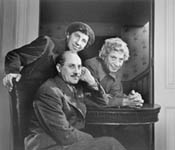 The Marx Brothers in action