Moses Mendelssohn
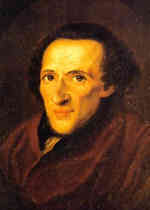
(1729 - 1786)
Moses Mendelssohn was the first Jew
to bring secular culture to those living an Orthodox Jewish life. He valued reason and felt that anyone could arrive
logically at religious truths. He argued that what makes Judaism unique is its divine revelation of a code of law. He wrote many
philosophical treatises and is considered the father of the Jewish
Enlightenment.
Moses Mendelssohn was born in Dessau, a city in the
state of Anhalt-Dessau in Germany, on September 6, 1729. As a child,
he suffered from a disease that left him with a curvature of the spine.
He was the son of a Torah scribe and his family was poor but learned. He began a traditional Jewish
education under David Fraenkel, the rabbi of Dessau. When Fraenkel became
rabbi of Berlin, the 14-year-old Mendelssohn followed him and studied
in Fraenkel’s yeshiva in Berlin. He soon became a promising scholar
of Talmud and Rabbinics.
He is a relative of Samson
Raphael Hirsch. He received free meals from neighborhood families
and took on odd tutoring jobs.In addition to learning German and Hebrew in
Berlin, Mendelssohn also studied some French, Italian, English, Latin
and Greek. He took up other secular subjects, in which he excelled,
including mathematics, logic and philosophy. In the mid-1750s, he
developed friendships with the philosopher Immanuel Kant and also
with Gotthold Lessing, a dramatist, literary critic and advocate of
enlightened toleration in Germany. With Lessing’s encouragement,
Mendelssohn began to publish philosophical essays in German.In 1750, Mendelssohn began to serve as a teacher
in the house of Isaac Bernhard, the owner of a silk factory. That
same year, Frederick the Great gave him the status of "Jew under
extraordinary protection." In 1763, the Prussian Academy of
Sciences awarded him a prize for his treatise on "evidence in
the metaphysical sciences." Four years later, he became the
bookkeeper of Bernhard’s firm and eventually a partner. Throughout
his life, he worked as a merchant while continuing to write. In 1779,
Lessing wrote the play Nathan the Wise in which a Jewish hero,
modeled after Mendelssohn, appears as a spokesman for brotherhood and
love of humanity.Mendelssohn modeled his philosophy after that of
Christian Wolff (a prominent philosopher of the Enlightenment) and
Gottfried Leibnitz (a European rationalist). He wrote some general
philosophical works, including many dealing with the theory of art,
but his most well known writings deal with Judaism.
Mendelssohn conceived of God as a
perfect Being and had faith in God’s wisdom, righteousness, mercy
and goodness. He argued that, "the world results from a creative
act through which the divine will seeks to realize the highest
good." He accepted the existence of miracles and revelation as
long as belief in God did not depend on them. He also believed that
revelation could not contradict reason. Like the deists, he claimed
that reason could discover the reality of God, divine providence and
immortality of the soul. He was the first to speak out against the
use of excommunication as a religious threat.At the height of his career, in 1769, Mendelssohn
was publicly challenged by a Christian apologist, a Zurich pastor
named John Lavater, to defend the superiority of Judaism over
Christianity. From then on, he was involved in defending Judaism in
print. In 1783, he published Jerusalem, or On Religious Power and
Judaism. This study posited that no religious institution should
use coercion and emphasized that Judaism does not coerce the mind
through dogma. He argued that through reason all people could
discover religious philosophical truths, but what made Judaism unique
was its divinely revealed code of legal, ritual and moral law. He
said that Jews must live in civil society but only in a way that
their right to observe religious laws is granted. He recognized the
necessity of multiple religions and respected each one.
Mendelssohn wanted to take the Jews out of a
ghetto lifestyle and into secular society. He translated the Bible into German, although it was written in Hebrew letters, with a Hebrew
commentary called the Biur. He campaigned for emancipation and
instructed Jews to form bonds with the gentile governments. He tried
to improve the relationship between Jews and Christians as he argued
for tolerance and humanity. He became the symbol of the Jewish
Enlightenment, the Haskalah.
Mendelssohn's own descendents, the most famous being the composer Felix
Mendelssohn, left Judaism for Christianity.
Sources: Cohn-Sherbok, Dan. Fifty
Key Jewish Thinkers. New York: Routledge, 1997.
Dimont, Max. Jews,
God and History. New York: Simon and Schuster, 1962.
Kleinman, Shanon. "Who was Moses Mendelssohn?" Hamevaser.
Kung, Hans. Judaism.
New York: Crossroad, 1992.
Seltzer, Robert. Jewish
People, Jewish Thought. New York: Macmillan Publishing Co., 1980. |