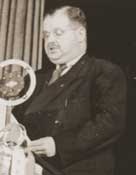
Philipp Auerbach, was born in Germany and had moved to Belgium where he became head of a chemical import-export company. After the
German invasion of Belgium he was arrested and sent to Gurs and was
later deported to Auschwitz.
His wife, Martha, and daughter, Helen, managed to flee to Cuba and then come to the United States.
In Asuchwitz, Auerbach served as the chief chemist
preparing medicines and pesticides. He attested to having been coerced
into making soap from human remains.
After liberation he served
the first chairman of the State Federation of North Rhine and Westphalia
and later as the chairman of the Association of Jewish Communities in
Bavaria. In 1946 he was appointed state commissioner of the Bavarian
provincial government for religious, political and racial victims of
the Nazis, thereby
becoming one of the first Jews to play a role in postwar German political
life. He was among the first to work for the financial compensation
of victims of Nazism.
In January 1951, he became a member of the Central
Council of Jews in Germany. One month later he was accused of financial
misconduct and forgery in regard to reparations payments. His supporters
insisted that he never personally benefited from the fraud, and that
he gave all the money to the victims. On August 14, 1952, Auerbach was
found guilty and sentenced to two and a half years in prison by a court
of five judges, three of whom had had contacts with the Nazi party.
Two days later, Auerbach committed suicide. Four years later he was
posthumously cleared of all charges.
Sources: Bauer, Yehuda. "The Organization of Holocaust
Survivors," Yad Vashem Studies, vol. 8 (1970); Hyman, Abraham
S. The Undefeated, Jerusalem, 1993; Mankowitz, Zev. "The
Formation of She'erit Hapleita," Yad Vashem Studies, vol.
20 (1990); Schwarz, Leo.The Redeemers, New York, 1953