Paul Ehrlich
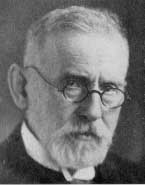
(1854 - 1915)
Paul Ehrlich was born on March 14, 1854, in Strehlen, Germany. Already as a pupil
and student of medicine he was interested in coloring microscopic tissue
substances. In his dissertation at the Leipzig university he picked
up the topic again ("Beiträge zur Theorie und Praxis der histologischen
Färbung"). After his clinical education and habilitation ("Das
Sauerstoffbedürfnis des Organismus") at the Charité
in Berlin in 1887, he received
a call from Robert Koch to join the Institute for Infection Diseases
in Berlin (1891).
Paul Ehrlich overcame the tuberculosis disease, with
which he was infected in Egypt.
Thereafter he worked with his friend Emil Adolf von Behring to contribute
to the development of the diphtheria serum that would help against such
respiratory illnesses.
These works were inspirations to his famous side-chain
theory (Seitenkettentheorie) from 1897. This theory explained the effects
of serum and allowed to measure the amount of antigen. In 1896, Ehrlich
became the director of the newly founded Royal Institute of Serum Research
and Examination (Königlichen Instituts für Serumforschung
und Serumprüfung) in Steglitz (Berlin). There he continued his
work on immunology and haemolysins; these studies ultimately led to
his side-chain theory of immunity. In 1899, the institute was moved
to Frankfurt (Main) and extended into the Institute of Experimental
Therapy (Institut für experimentelle Therapie). Here Ehrlich researched
chemotherapy and infectionious diseases. In 1904, Ehrlich became honorary
professor of the University of Göttingen.
Paul Ehrlich received the Nobel
Prize for Medicine together with Elie
Metschnikoff in 1908 for their
research on immunity. In 1906, he discovered the structural formula
of atoxyl, a chemical compund that had been shown to be able to treat
sleeping sickness. Following this discovery, he tried to create a less
toxic version of the medicine. In 1909, he and his student Sahachiro
Hata developed Salvarsan, a medicine for sleeping sickness, syphilis
and other epidemic diseases.
He was honored by the Prussian government in 1911,
when he was elected to the highest rank of Excellency in the Privy Medical
Council. A few years later, Ehrilch died on August 20, 1915, at the
age 61.
His life is depicted in the movie The Magic Bullet,
which focused on Salvarsan® (arsphenamine, "compound 606"),
his cure for syphilis. His work raised awareness of the existence of
the blood-brain barrier, a physical barrier between the blood vessels
in the central nervous system.
The "magic bullet" concept comes from the
experience of 19th century German chemists with selectively staining
tissues for histological examination, and in particular, selectively
staining bacteria (Ehrlich was an exceptionally gifted histological
chemist, and invented the precursor technique to Gram staining bacteria).
Ehrlich figured that if a compound could be made that selectively targeted
a disease causing organism, then a toxin for that organism could be
delivered along with the agent of selectivity. Hence, a magic bullet
would be created that killed only the organism targeted.
Sources: Wikipedia;
Wikipedia
Image; Nobel
Prize Biography |