Paul Goldstein
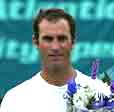
(1976 - )
An up-and-coming American professional tennis player,
Goldstein won the gold medal in the singles during the Pan American
Games in 1999. The Stanford alumnus is one of the very few college graduates
among the top 200 ranked men, and has said, "it's always been a
priority for me to try to strike a balance between my academics and
my tennis."
After achieving the highest singles ranking of his
career in August, 2000 (No. 69), Goldstein is currently ranked No. 143
(as of July 8, 2004); he is also ranked No. 223 in doubles play (his
highest doubles ranking was No. 75 in November 2000). Goldstein, whose
father Clark was a former table tennis champion, began playing tennis
when he was nine years old. Described as "an all-court player with
strong groundstrokes and excellent concentration," his first major
victory came when he was ranked No. 1 in the USTA Boys' 16 age group
in 1992. Later, while at Stanford University, Paul teamed with Scott
Humphries to win numerous doubles championships. He also became the
first athlete in college tennis history to play for four NCAA team tournament
champions.
During Paul's senior year, he played No. 1 singles
and led Stanford to a 28-0 regular season record. His coach at Stanford,
Dick Gould, praised Goldstein, saying, "I have been blessed with
outstanding young people in my 36 years of coaching at the collegiate
level. However, I can think of only one or maybe two players for whom
I could give as high a recommendation as Paul. And certainly no one
would receive a higher endorsement from me than Paul."
Following a terrific college career, Goldstein turned
pro in 1998 at the ATP tour event in Washington, D.C., which is near
his home town of Rockville, Maryland. When he made it to the round of
16 at the same tournament a year later, Paul said it was his "biggest
thrill as a professional tennis player to date." Goldstein then
faced a near impossible challenge in the U.S. Open that year when he
had to play Pete Sampras. He was able to stretch the match to 4 sets,
but lost to the world's No. 1 ranked player.
Goldstein finished 1999 as the No. 90 ranked player
in the world, the first time he was able to crack the top 100. That
year, he won the gold medal at the Pan American Games. Paul consistently
improved his ATP ranking, reaching No. 69 in 2000. That year, he reached
the third round of Wimbledon for the second consecutive year (he participated
in all 4 Grand Slam events in the same year for the first time in his
career) and had a great second-round match with Jeff Tarango (3-6, 6-2,
5-7, 6-2, 12-10).
Goldstein was a practice partner for the first-round
match against Zimbabwe in the 2000 Davis Cup. In 2001, he competed in
the Australian Open, where
he lost in the second round, and in the French Open, where he lost in the first round. Paul was defeated in the
qualifying rounds at the 2001 U.S. Open. He competed in the 2002 Australian
Open but lost in the qualifying rounds again. At the 2002 U.S. Open,
Goldstein lost in the second round of qualifying to Danai Udomchoke
(THA), 6-4, 6-1.
In the qualifying tournament for the 2003 Australian
Open, Goldstein lost in the first round to Robert Kendrick of the United
States. Paul also played in the qualifying tournament for Wimbledon
and lost in the first round to Israeli, Harel Levy.
Goldstein's singles form reached it's pinnacle towards
the end of 2003. He won the Austin tournament in mid November by beating
Robert Kendrick (USA), 6-3 6-3 in the final. Later that month, he won
the title in Champaign, Illinois.
Sources: Jews in
Sports |