Philip Roth
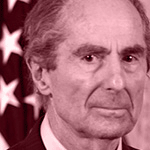
(1933 - )
Philip Milton Roth is a Jewish American novelist.
Roth (born March 19, 1933) was born in Newark, New Jersey. After graduating from high school at the age of 16, Roth
went on to attend Bucknell University, and earned a B.A. in English
in 1954. He then pursued graduate studies at the University of Chicago,
receiving a M.A. in English literature. He first began a writing career
as a film critic for The Nation. Roth went on to teach creative
writing at the University of Iowa and Princeton University. He continued
his teaching career at the University of Pennsylvania where he taught
comparative literature until his retirement in 1992.
Roth published his first book Goodbye, Columbus.,
in 1959. It won the prestigious National Book Award in 1960, and afterward
he published two long, bleak novels, Letting Go (1962) and When
She Was Good (1967); it was not until the publication of his third
novel, Portnoy's Complaint, in 1969 that Roth enjoyed widespread
success. In many of Roth’s books he utilizes his own past of the
suburban and urban American Jewish communities; nevertheless, some of
his depictions infuriate his fellow Jews with the portrait he displays.
During the 1970s, Roth experimented
in various modes, from the political satire
with Our Gang, to the fantasy
realm with The Breast.. By the
end of the decade, though, Roth had created
his Nathan Zuckerman alter-ego. In a series
of highly self-referential novels that
came between 1979 and 1986, Zuckerman appeared
as either the main character or as an interlocutor.
Critics generally regard Roth’s golden period
as commencing with Operation Shylock: A Confession and continuing to the present
day. In 1995, Roth published the Sabbath's Theater, considered
a comic masterpiece. He is perhaps best known for his late-1990s trilogy
comprising the Pulitzer Prize-winning American Pastoral (1997), I Married a Communist (1998), and The Human Stain (2000).
Philip Roth is arguably
the most decorated American writer of his
era. Two of his works of fiction have won
the National Book Award; two others were
finalists. Two have won the National Book
Critics Circle awards; again, another two
were finalists. He has also won two PEN/Faulkner
Awards and a Pulitzer Prize for Fiction.
In 2001, The Human Stain was awarded
the United Kingdom’s WH Smith
Literary Award for the best book of the year.
In 2002, he was awarded the National Book
Foundation’s Award for Distinguished
Contribution to American Letters. His 2004
novel, The Plot Against America,
won the Sidewise Award for Alternate History
in 2005, as well as the Society of American
Historians’ prize and again the W.H.
Smith Literary Award. In May 2006, he was
given the PEN/Nabokov Award.
Roth was awarded the 2010 National Humanities Medal by U.S. President Barack Obama. In May 2011, Roth was awarded the Man Booker International Prize for lifetime achievement in fiction on the world stage, the fourth winner of the biennial prize. In 2012, he received the "Prince of Asturias prize" for literature and in January 2014 he was named to the Top 5 Most Influential Jews in the United States by Forward magazine.
Sources: American
Jewish Desk Reference; Wikipedia |